
Pacaya Volcano National Park
Guatemala
Pacaya is the active volcano an hour and a half from Antigua and an hour from Guatemala City, and the half-day hike up…
7 tickets & tours
The Reserva Natural Atitlán is a small private nature reserve on the edge of Panajachel, the main tourist town on the north shore of Lake Atitlán in the Guatemalan highlands, three hours by road from Guatemala City or two and a half from Antigua, and it should not be confused with the lake as a whole, whose village-hopping boat trips, volcano climbs and lakeside hikes are sold under similar names. The reserve is five minutes by tuk-tuk, or a walk of twenty-five, from the centre of Panajachel, in the valley of San Buenaventura beside the big hotel of the same bay, and it charges a modest entrance fee at the gate, which covers the trails, the hanging bridges, the butterfly house and the private beach.
It is the easiest nature outing on the lake, well suited to families, and an agreeable half-day between boat trips: no guide is needed, the paths are clear and the loops short. Those who want more pay separately for the zip lines, of which there are two circuits, a shorter one through the forest canopy and a longer, faster one of several cables high across the ravine, with views of the lake and its three volcanoes, and for a bicycle-on-a-cable ride that is mostly for the photograph. The reserve also has simple lodges and a campsite for those who wish to stay in the forest, and a restaurant at the visitor centre. Some lake tours include it as their last stop, with a swim at its beach, after visiting the weaving and painting cooperatives of San Juan La Laguna and the market of Santiago Atitlán.
Live dates and prices from GetYourGuide. Free cancellation on most tickets.
The reserve occupies about a hundred hectares of a former coffee plantation, the Finca San Buenaventura, which its owners let return to forest from the 1990s and opened to visitors, a steep-sided ravine running up from the lake shore at 1,560 metres, with a stream, a waterfall and a regenerating subtropical humid forest of oaks, cypress, avocado relatives and fig trees, with the old coffee bushes still growing wild in their shade. A circuit of trails, about two to three kilometres in all, climbs the ravine by a series of narrow hanging bridges of cable and planks, strung over the gorge and swaying satisfactorily, to a platform below the waterfall, some twenty metres high and at its best in the rainy season, and returns along the opposite slope. Near the start, feeding platforms draw a troop of spider monkeys, brought here as rescued animals and living semi-wild in the trees, and a band of white-nosed coatis, called pizotes, which appear on the paths with their tails in the air and have no fear of visitors.
The butterfly house, a geodesic dome with a breeding laboratory beside it, shows some dozens of native species, from eggs and chrysalids to the big blue morphos and owl butterflies. The birds are those of the lake's forests, more than 120 species recorded, among them azure-crowned hummingbirds, emerald toucanets, blue-and-white mockingbirds, motmots and, in the northern winter, migrant warblers from North America. The lake itself, which the reserve's little beach looks across, fills a volcanic caldera formed in a colossal eruption about 84,000 years ago, is more than 300 metres deep, and is overlooked by the cones of San Pedro, Tolimán and Atitlán; Aldous Huxley thought it outdid Lake Como. Its shores are Kaqchikel and Tz'utujil Maya country, where each village keeps its own dress and its own patron.
The reserve is open daily from 8 am to 5 pm. The dry season, from November to April, has clear mornings with the volcanoes sharp across the water, and is the high season on the lake; the rains, from May to October, fall mostly in the afternoons, leave the mornings fine, fill the waterfall and green the forest.
The lake's afternoon wind, the xocomil, rises around midday and makes boat crossings rough, which is a reason to do the villages in the morning and the reserve after lunch, or the reverse if you want the monkeys at their most active, early. Allow two to three hours. Panajachel's market street is five minutes away, the villages of Santa Cruz, San Marcos, San Juan and Santiago are reached by public boat, and Chichicastenango's Thursday and Sunday market is an hour and a half north.
Yes. GetYourGuide lists 2 tickets and tours for Atitlán Nature Reserve, with live dates and prices and free cancellation on most of them.
The reserve is five minutes by tuk-tuk, or a walk of twenty-five, from the centre of Panajachel, in the valley of San Buenaventura beside the big hotel of the same bay, and it charges a modest entrance fee at the gate, which covers the trails, the hanging bridges, the butterfly house and the private beach.
The reserve is open daily from 8 am to 5 pm.
Allow two to three hours.
Atitlán Nature Reserve covers 1 km².
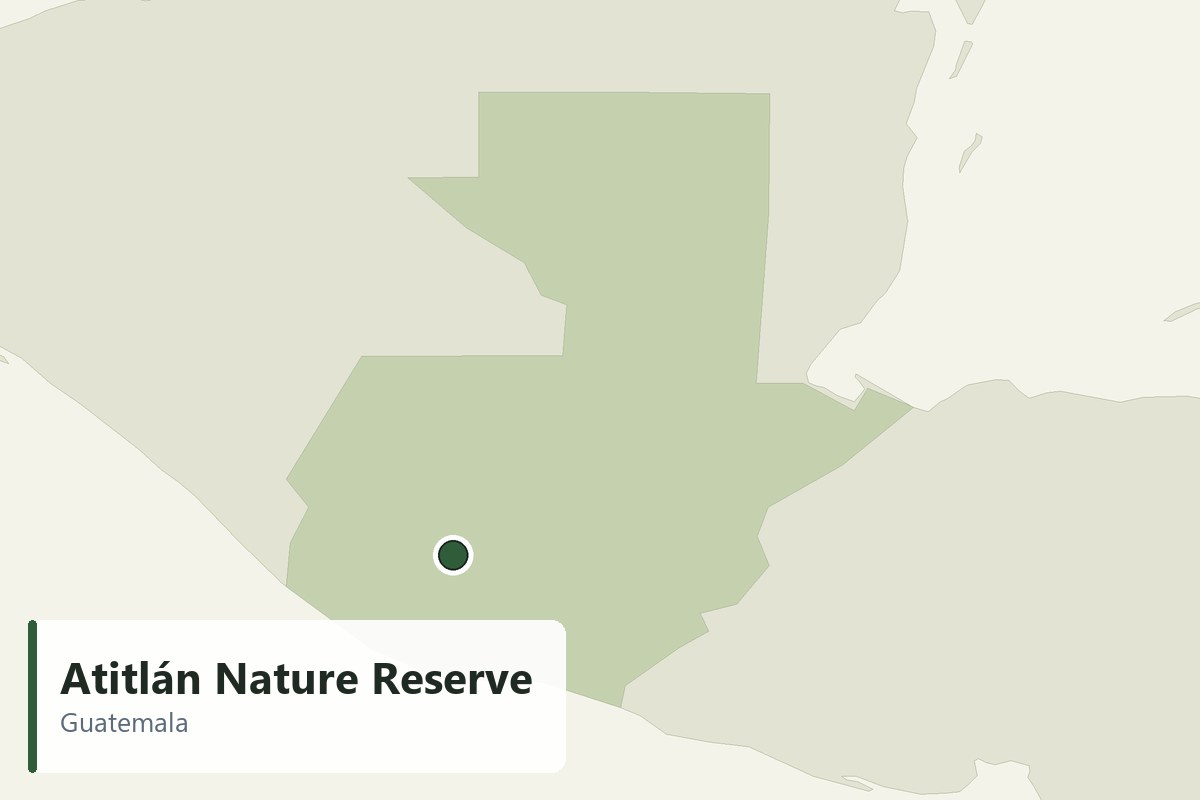
Atitlán Nature Reserve is in Guatemala. The map on this page shows the exact spot.
Guatemala
Pacaya is the active volcano an hour and a half from Antigua and an hour from Guatemala City, and the half-day hike up…
7 tickets & tours