
Altyn-Emel National Park
Kazakhstan
Altyn-Emel is the desert park in the Ili valley four to five hours north-east of Almaty, and its two great sights, the…
12 tickets & tours
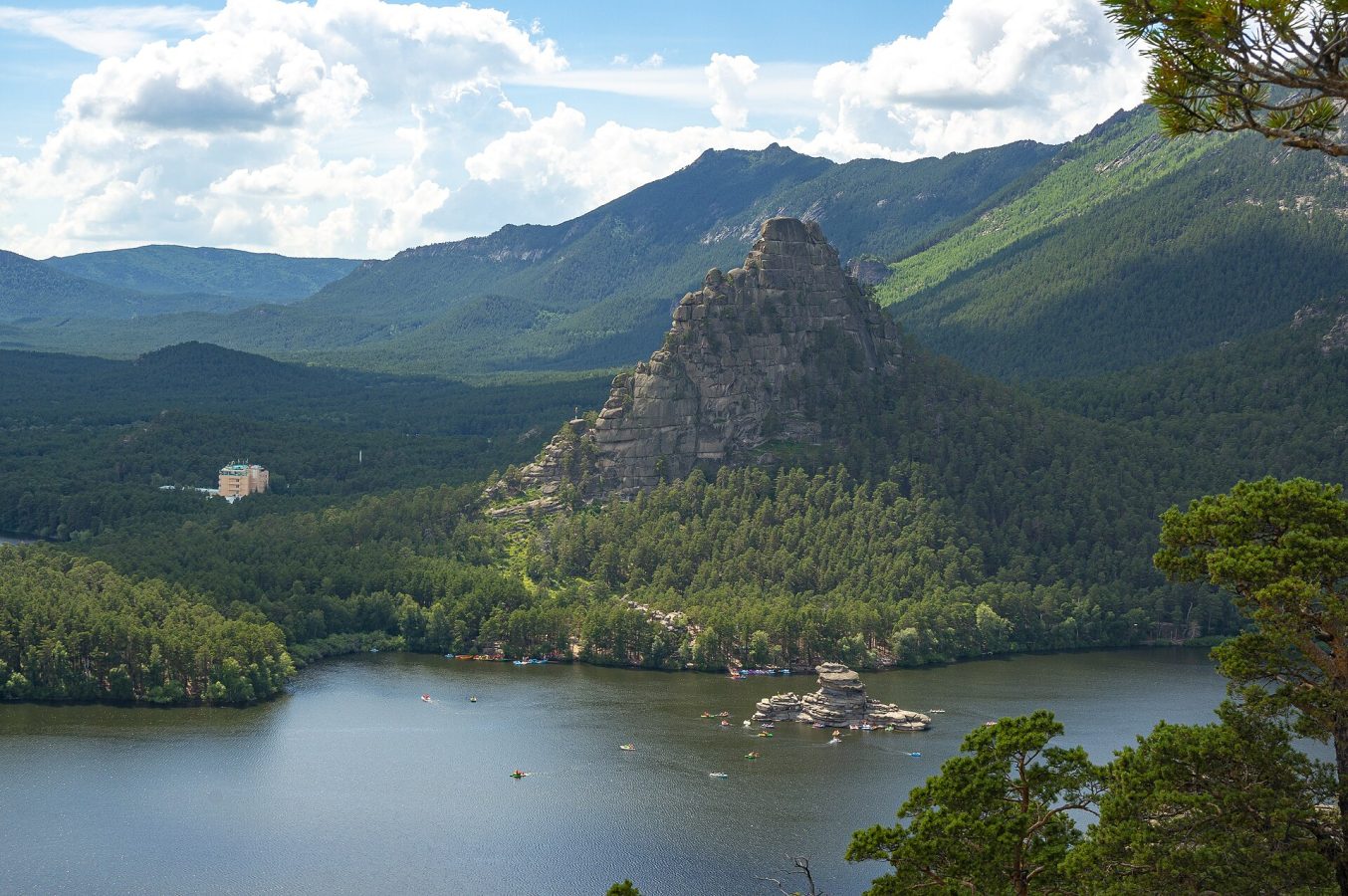
Photo: Dots foto, CC BY-SA 4.0
Burabay, which Russians and many Kazakhs still call Borovoe, is a cluster of granite hills, pine forest and clear lakes that rises unexpectedly out of the flat, treeless steppe of northern Kazakhstan, about 250 kilometres north of the capital, Astana, and it is the capital's weekend playground and the country's oldest resort, promoted, like a good many places, as the Switzerland of Kazakhstan. It is reached in about three hours on a good toll motorway, or by train to the station of Borovoe-Kurort in the town of Shchuchinsk, twenty kilometres from the lakes, from which taxis and minibuses run to the resort village of Burabay; fast trains from Astana take two and a half hours. The day trips sold in Astana, with a car, a driver-guide and lunch, leave early and spend five or six hours at the sights, which is enough for the classic circuit round Lake Borovoe;
two days, with a night in one of the many hotels, sanatoria and guesthouses, allows some proper walking and a second lake. A small ecological fee is charged per person at the entrance to the park. The sights near the village are linked by a paved lakeside path suitable for walking and cycling, with bicycle, boat and catamaran hire, horse and donkey rides for children, and stalls selling smoked fish, koumiss and pine-nut souvenirs; a visitor centre and natural history museum stands by the lake. Those who want to get away from the crowd can climb Mount Bolektau in half an hour for the classic view, or spend a half-day on the ascent of Kokshetau with a guide. In winter there is skiing, skating on the lakes and ice fishing.
Live dates and prices from GetYourGuide. Free cancellation on most tickets.
The Burabay State National Nature Park was created in 2000, on the site of protected areas going back to 1898, and covers about 1,300 square kilometres of the Kokshetau upland in Akmola region: a small, ancient, much-eroded massif of granite, whose highest point, Mount Kokshe, or Sinyukha, reaches 947 metres, surrounded by fourteen sizeable lakes and many smaller ones, of which Borovoe, Shchuchye, Bolshoe Chebachye and Maloe Chebachye are the largest, set in forests of Scots pine and birch that survive here, far to the south of the taiga, because the hills catch more moisture than the surrounding steppe. The granite has weathered into an extraordinary collection of tors, pillars and balanced rocks, each with its name and its legend. The most famous is Zhumbaktas, the riddle stone, a rock rising out of the water of the Blue Bay of Lake Borovoe, which from different angles shows the profile of a girl with flowing hair, a woman and an old crone, and is often called the Sphinx;
beside it on the shore stands Okzhetpes, a rock tower some three hundred metres high whose name means the arrow cannot reach it, from the legend of a captive Kalmyk princess who promised to marry whichever warrior could shoot an arrow to the top, where her scarf was tied, and who threw herself into the lake when her beloved failed. Others are the Three Sisters, the Sleeping Knight, the Camel and the Dancing Birches, a grove of birch trees whose trunks grow in curves and spirals. The glade of Abylai Khan, with a granite throne and a tall monument, commemorates the eighteenth-century ruler who united the three Kazakh hordes and is said to have held council here. The forests shelter elk, red deer, roe deer, wild boar, lynx, wolves, foxes, badgers and squirrels, and more than two hundred bird species, including the black grouse and the golden eagle. The dry, resin-scented air and the koumiss cure made Borovoe a resort for consumptives from the 1910s, and during the Second World War a group of evacuated Soviet academicians, Vernadsky among them, lived and worked here.
The park is open all year. June to August is the season, warm, 20 to 27 degrees, with swimming in the lakes, which are cool and clean, and great crowds at weekends and during the school holidays, when the lakeside path is a promenade; September brings clear skies, golden birches and peace, and is the best month;
winter is long and severe, with temperatures of minus fifteen to minus thirty from December to February, deep snow, frozen lakes, and the forest at its most beautiful for those dressed for it. Mosquitoes and ticks are active in early summer. Go on a weekday. Allow a full day, better two. Shchuchinsk and its ski-jump complex are twenty minutes away, Kokshetau an hour north, and Astana three hours south.
Yes. GetYourGuide lists 3 tickets and tours for Burabay National Park, with live dates and prices and free cancellation on most of them.
A small ecological fee is charged per person at the entrance to the park.
The park is open all year.
Allow a full day, better two.
Burabay National Park covers 1 295 km².
Burabay National Park was established in 2000.
Burabay National Park is in Kazakhstan. The map on this page shows the exact spot.
Kazakhstan
Altyn-Emel is the desert park in the Ili valley four to five hours north-east of Almaty, and its two great sights, the…
12 tickets & tours
Kazakhstan
Charyn Canyon lies two hundred kilometres east of Almaty, three to three and a half hours by road across the steppe…
6 tickets & tours
