Than Bok Khorani National Park
Thailand
Than Bok Khorani is a national park in the north of the province of Krabi, in southern Thailand, and it consists of two…
79 tickets & tours
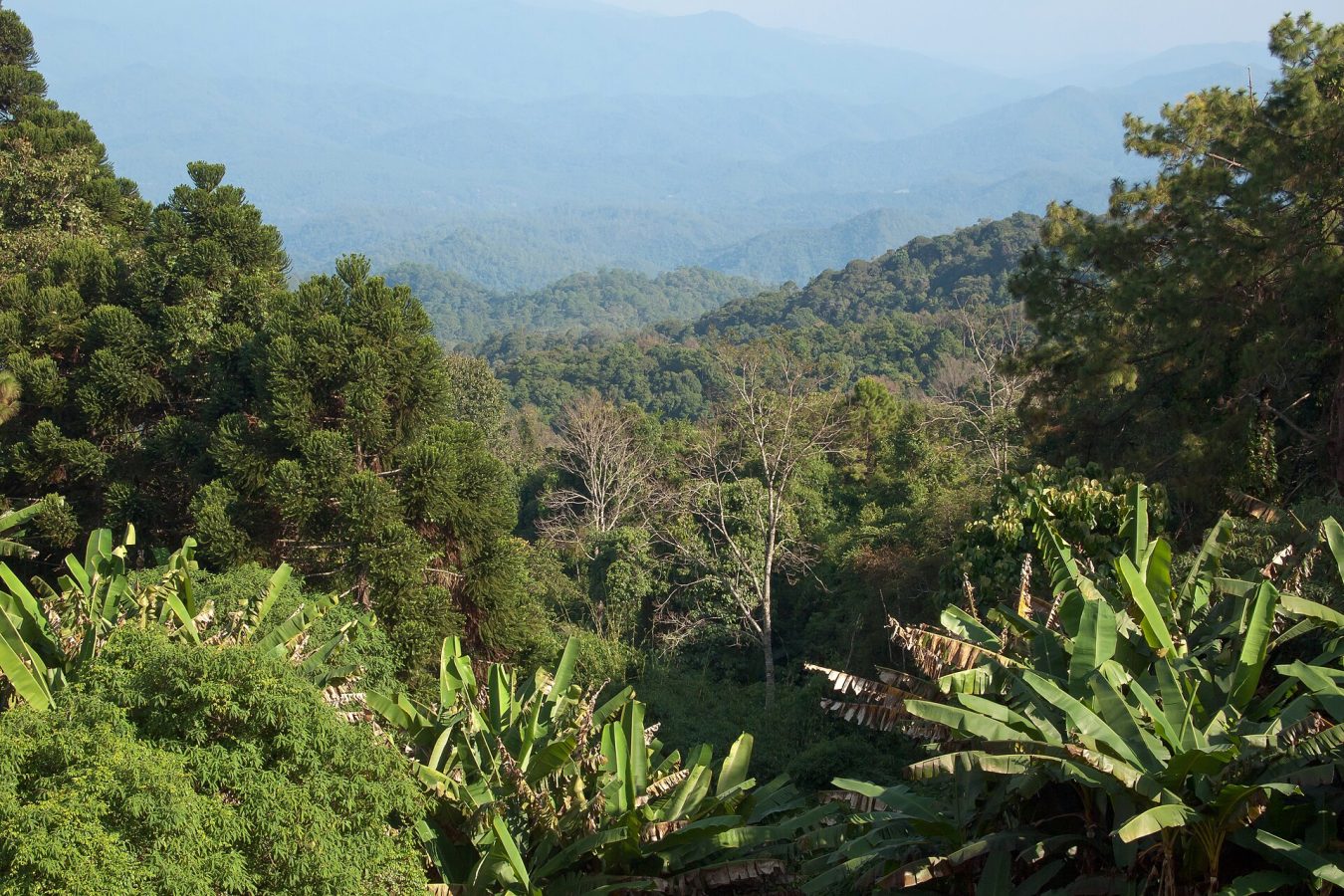
Photo: Vyacheslav Argenberg, CC BY 4.0
Doi Suthep is the forested mountain that rises directly behind the city of Chiang Mai, in northern Thailand, and the park that covers it begins at the city's western edge, by the zoo and the university, fifteen kilometres and half an hour by a winding road from the old town to the famous temple near the summit. Most visitors go up once, for the temple, by one of the red shared pickup trucks that leave when full from the zoo, the university gate or the north gate of the old city, by hired scooter, or on a half-day tour, and the tours follow a standard sequence up the mountain road: Wat Phra That Doi Suthep, which charges foreigners a small admission and is reached from the road by a staircase of 306 steps flanked by undulating naga serpents, or by a funicular lift; Bhubing palace, four kilometres further, the winter residence of the royal family, whose rose and fern gardens are open when no one is in residence;
and the Hmong village of Doi Pui, at the end of the road, now largely a market of textiles and souvenirs with a small flower garden and museum. Some tours add a visit to a so-called long-neck village elsewhere in the province, a staged settlement of Kayan refugees from Burma, which many travellers prefer, for good reason, to avoid. The national park fee is charged not on the road but at the waterfalls and camping areas: Huay Kaew falls, at the very foot of the mountain, free and popular with students; Monthathan falls, part of the way up; and, in the separate northern section, Mae Sa falls, a staircase of ten cascades. Walkers can climb from behind the university by the Monk's trail, a forest path of forty-five minutes marked by strips of saffron cloth tied to the trees, to the hidden temple of Wat Pha Lat, and continue, more steeply, to Doi Suthep.
Live dates and prices from GetYourGuide. Free cancellation on most tickets.
The national park was declared in 1981, the twenty-fourth in Thailand, and covers about 260 square kilometres in two sections, rising from 330 metres at the edge of the city to 1,685 at the summit of Doi Pui. The mountain, a mass of granite, has been sacred since before the Thais arrived: its name commemorates the hermit Sudeva, who is said to have lived on its slopes in the seventh century, and the Lawa people venerated its guardian spirits, to whom a buffalo is still sacrificed each year at its foot. Wat Phra That Doi Suthep was founded in 1383 by King Kuena of Lanna. According to the chronicle, a monk from Sukhothai had brought the king a relic of the Buddha, a fragment of shoulder bone, which miraculously divided in two; one half was enshrined in the city, and the other was placed on the back of a white elephant, which was set free, climbed the mountain, trumpeted three times, turned round three times, knelt and died on the spot where the temple now stands. Its centre is a chedi, a bell-shaped reliquary tower twenty-four metres high, entirely covered in gilded copper plates, which blazes in the sun, surrounded by four filigree parasols, cloisters with murals of the Buddha's life, bells that pilgrims strike for luck, and a terrace from which, when the air is clear, the whole city and valley lie spread below.
Until 1935 the only way up was a rough footpath of five hours. In that year the revered monk Kruba Srivichai called for volunteers to build a road, and thousands of villagers from all over the north came with hoes and baskets, each village completing a few metres, so that the eleven kilometres were finished in less than six months; his statue stands at the foot of the mountain and every driver salutes it. The forest changes with height, from dry deciduous woodland of teak and dipterocarps, leafless in the hot season, on the lower slopes, to evergreen hill forest of oaks, chestnuts and magnolias, hung with orchids and ferns, above a thousand metres, with pines on the ridges. More than two thousand species of flowering plants have been recorded, which is more than in the whole of Britain, and over 360 species of birds, which makes the mountain one of the best birdwatching sites in the country, with some five hundred kinds of butterflies and the Himalayan newt, known as the crocodile salamander, in the summit ponds. Large mammals have gone, but macaques, barking deer, wild boar and civets remain. The Hmong of Doi Pui grew opium until the 1970s, when royal projects introduced lychees, coffee and flowers.
The temple is open daily from about 6 am to 8 pm, and the park's sites from 8 am to late afternoon. The cool season, from November to February, is the best time, with clear air, daytime temperatures in the high twenties, cold mornings at the summit, and, in January, the pink blossom of the wild Himalayan cherry at Khun Chang Khian, above the Hmong village. From late February to April farmers burn the fields across the region, and the smoke is so thick that the city is invisible from the terrace and the air unhealthy, which makes this the worst time to come.
The rains, from May to October, clear the air and fill the waterfalls, with showers mostly in the afternoon. The temple is most atmospheric at dawn or at dusk, when the monks chant and the tour groups have gone. Shoulders and knees must be covered, and shoes removed on the upper terrace. Allow half a day. The old city is half an hour away, and the Mae Sa valley, with its botanic garden, forty minutes north.
Yes. GetYourGuide lists one ticket or tour for Doi Suthep-Pui National Park, with live dates and prices and free cancellation on most of them.
The national park fee is charged not on the road but at the waterfalls and camping areas: Huay Kaew falls, at the very foot of the mountain, free and popular with students; Monthathan falls, part of the way up; and, in the separate northern section, Mae Sa falls, a staircase of ten cascades.
The temple is open daily from about 6 am to 8 pm, and the park's sites from 8 am to late afternoon.
The cool season, from November to February, is the best time, with clear air, daytime temperatures in the high twenties, cold mornings at the summit, and, in January, the pink blossom of the wild Himalayan cherry at Khun Chang Khian, above the Hmong village.
Doi Suthep-Pui National Park covers 261 km².
Doi Suthep-Pui National Park was established in 1981.
Doi Suthep-Pui National Park receives about 328 659 a year (2019).
Doi Suthep-Pui National Park is in Thailand. The map on this page shows the exact spot.
Thailand
Than Bok Khorani is a national park in the north of the province of Krabi, in southern Thailand, and it consists of two…
79 tickets & tours
Thailand
Ao Phang Nga is the bay of limestone towers between Phuket and Krabi that Hollywood made famous as the setting for a…
73 tickets & tours
Thailand
Doi Inthanon is the highest mountain in Thailand and the most visited national park in the north, sixty kilometres from…
72 tickets & tours
Thailand
The Phi Phi islands are protected as the Hat Noppharat Thara–Mu Ko Phi Phi National Park, and the park fee is collected…
37 tickets & tours
Thailand
Tarutao is a marine park of fifty-one islands in the Andaman Sea, in the far south-west of Thailand, off the coast of…
31 tickets & tours
Thailand
Khao Yai is Thailand's first national park, two and a half to three hours north-east of Bangkok, and it is sold…
27 tickets & tours