Manuel Antonio National Park
Costa Rica
Manuel Antonio is the most visited national park in Costa Rica, a small patch of rainforest and beach on the Pacific…
137 tickets & tours
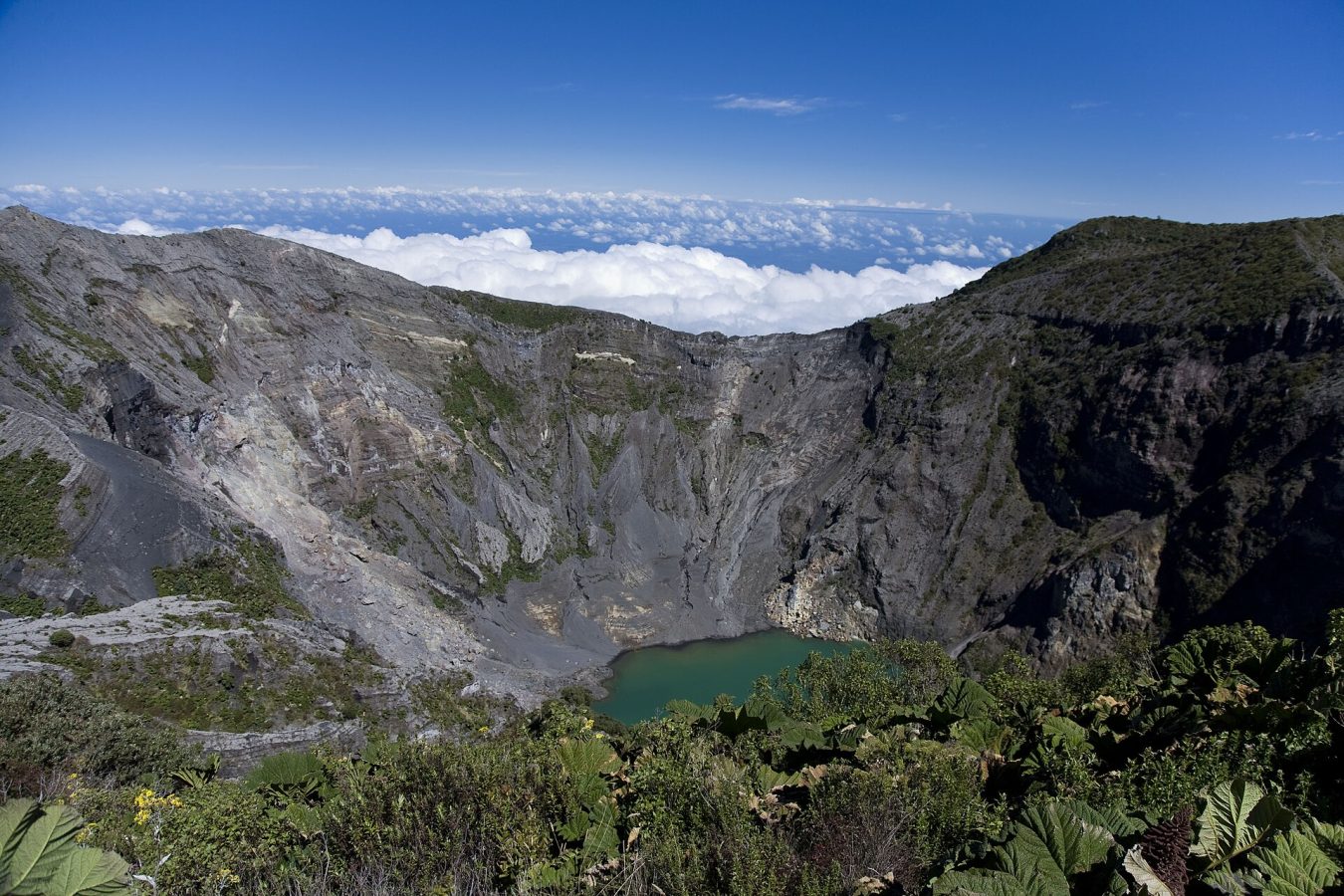
Photo: Rafael Golan, CC BY-SA 3.0
Irazu is the highest volcano in Costa Rica, and a paved road runs to within a few hundred metres of its summit craters, which makes it, with Poas, one of the two classic volcano excursions from the capital. It stands above the old colonial capital of Cartago, thirty-one kilometres and about an hour's drive from that town, and fifty-five kilometres, an hour and a half to two hours, from San Jose, the road climbing through fields of potatoes, onions and carrots and dairy pastures that owe their fertility to the volcano's ash. A public bus leaves central San Jose once each morning and returns in the early afternoon, but most visitors come by hired car or on a half-day or full-day tour, which usually adds the basilica and ruins of Cartago and often the Orosi valley or a garden.
Tickets must be bought in advance online from the national parks service, for a given day, and are checked at the gate, where a separate charge is made for parking. The visit to the crater sector is short and easy: from the car park, with its cafe, shop and toilets, a level, paved path suitable for wheelchairs leads in ten minutes across the edge of a grey plain of ash to the fenced rim of the principal crater and the smaller crater beside it, and an hour suffices. A steep side road, or a stiff walk of twenty minutes, climbs to the highest point, among telecommunications masts, from which the view is widest, though part of this area has been closed since a large landslide in 2020. Visitors who want to walk should drive, on the way down, to the separate Prusia sector, entered by another road and with its own ticket, where several hours of trails wind through tall, misty forest.
Live dates and prices from GetYourGuide. Free cancellation on most tickets.
The national park was created in August 1955, the first in the country to be established by law, and covers about 2,300 hectares round the summit, which reaches 3,432 metres. Irazu is a broad, complex stratovolcano, the southernmost of the chain that forms the central cordillera, and its name is thought to derive from that of an indigenous village on its slopes. The summit area contains several craters. The principal crater is a nearly circular pit, 1,050 metres across and some 300 deep, with vertical walls banded in grey, ochre and rust; for decades its floor held a lake of a startling pea green or, at times, red, coloured by dissolved minerals, which is the image on every postcard, but the lake drained away in 2013, reappeared, and has since come and gone with the rains and the state of the fractures beneath it, so that visitors should not count on it. Beside it, the Diego de la Haya crater, shallower and older, is named after the Spanish governor who wrote a detailed account of the eruption of 1723, the first on record, which showered Cartago with ash for months; and between the car park and the rim stretches Playa Hermosa, the beautiful beach, a flat expanse of dark ash on which almost nothing grows. The most famous eruption in the country's history began here on 13 March 1963, the very day on which President John F.
Kennedy arrived in San Jose on a state visit, and continued for two years: ash fell on the capital and the whole central valley almost daily, blocking gutters, collapsing roofs, ruining the coffee harvest and killing cattle, people went about with umbrellas and handkerchiefs over their faces, and in December 1963 a mudflow down the Reventado river destroyed some three hundred houses on the edge of Cartago and killed about twenty people. There has been only minor activity since 1994. The vegetation round the craters is a sparse, stunted scrub adapted to cold, wind, intense radiation and acid soil, a fragment of the high-altitude paramo, with myrtle, blueberry relatives, the huge-leaved gunnera and tough grasses, among which live the volcano junco, a small bird confined to the highest peaks of Costa Rica and Panama, the volcano hummingbird, sooty thrushes, rabbits and coyotes. The Prusia sector was stripped bare by the eruption and replanted in the following years, largely with foreign pines, cypresses and eucalyptus, which have grown into a tall and atmospheric forest, now slowly being replaced by native oaks and alders. It is said that on a perfectly clear morning both the Pacific and the Caribbean can be seen from the summit.
The park is open daily from 8 am to about 3.30 pm. As on all the high volcanoes of Costa Rica, cloud decides everything: the summit is most often clear in the first hour or two after opening and is usually wrapped in mist by ten or eleven, so the earliest ticket is the one to buy, and the dry season, from December to April, offers the best chance, with January to March the most reliable, though clear mornings occur in the wet season too.
At over 3,400 metres it is cold at any time, between 3 and 15 degrees, with a cutting wind and occasional frost, and the sun burns quickly in the thin air, so bring a warm jacket, a windproof, a hat and sunscreen, and walk slowly if coming straight from sea level. Sundays are busy with local families. Allow an hour at the craters, half a day with Prusia. Cartago and its basilica, the goal of a great pilgrimage on 2 August, are an hour away, the Orosi valley and the Lankester botanical garden a little further, and San Jose under two hours.
Yes. GetYourGuide lists one ticket or tour for Irazu Volcano National Park, with live dates and prices and free cancellation on most of them.
The park is open daily from 8 am to about 3.30 pm.
Allow an hour at the craters, half a day with Prusia.
Irazu Volcano National Park covers 23 km².
Irazu Volcano National Park was established in 1955.
Irazu Volcano National Park is in Costa Rica. The map on this page shows the exact spot.
Costa Rica
Manuel Antonio is the most visited national park in Costa Rica, a small patch of rainforest and beach on the Pacific…
137 tickets & tours
Costa Rica
Tortuguero is the park of canals and sea turtles on Costa Rica's Caribbean coast, reachable only by boat or light…
53 tickets & tours
Costa Rica
Arenal is the volcano above La Fortuna, three hours from San José, and the town has become Costa Rica's adventure…
35 tickets & tours
Costa Rica
Corcovado is the great rainforest park on the Osa Peninsula in the far south of Costa Rica, and since 2014 everyone…
32 tickets & tours
Costa Rica
Rincón de la Vieja is the volcano park an hour north of Liberia in Guanacaste, and it is sold in two different ways…
27 tickets & tours
Costa Rica
Cahuita is the small coastal park next to the village of the same name on Costa Rica's southern Caribbean coast,…
26 tickets & tours