
Abisko National Park
123 km away
Abisko is the Swedish Lapland park at the head of the Torneträsk lake, an hour and a half by train or road from Kiruna…
19 tickets & tours
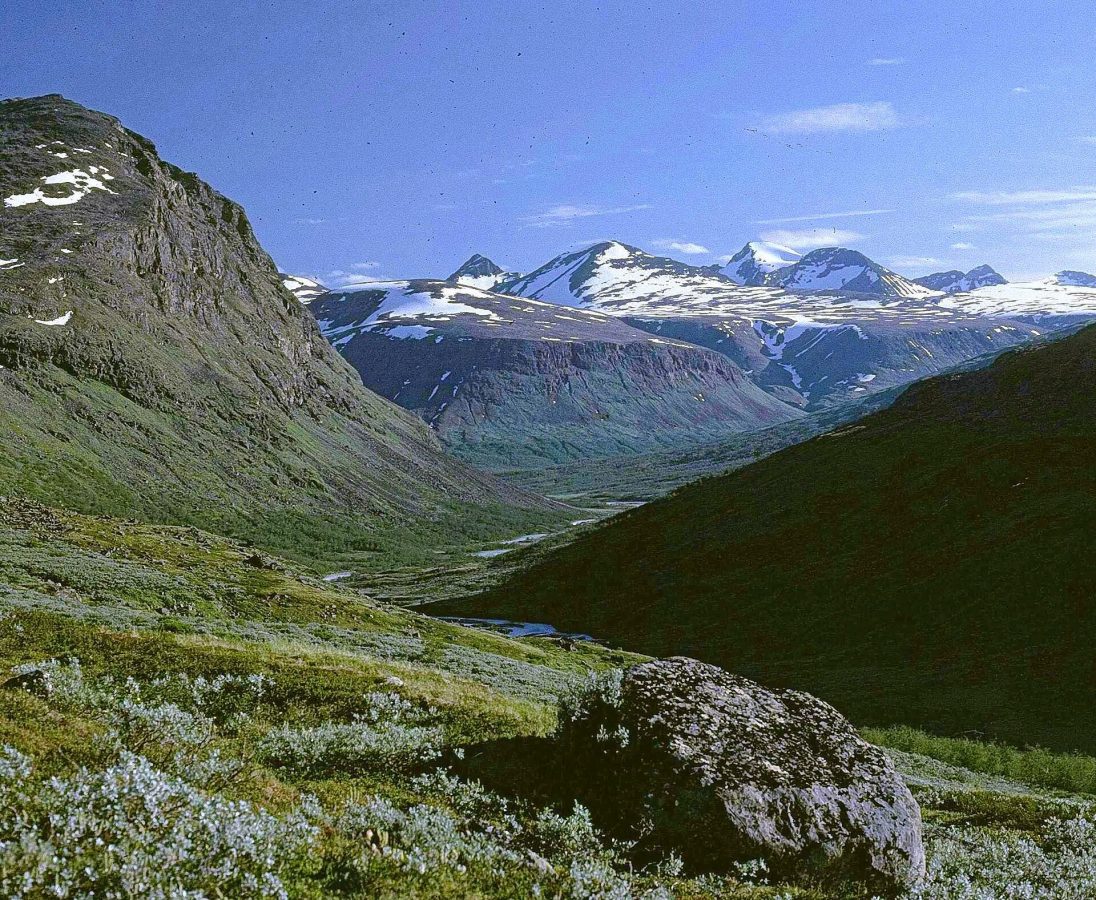
Sarek, in Swedish Lapland, north of the Arctic Circle, is the wildest mountain country in western Europe and the most demanding national park in Sweden, and it is often called the last wilderness of the continent. The description is meant literally. There are no roads into it or within it, no marked trails, no huts or shelters, no bridges beyond two or three over the most dangerous rivers, no signposts, no telephone coverage and no supplies, and it is officially recommended only to experienced mountain walkers, who must carry a tent, food for the whole trip and everything else they need, be able to navigate with map and compass in cloud, and know how to ford glacial rivers. Merely to reach its boundary takes a day's walk. The approaches are from the east and south, from the village of Kvikkjokk, reached by bus from the railway at Murjek or from the town of Jokkmokk, and from the mountain station of Saltoluokta and the roadhead of Ritsem, on the road from Gallivare, which is on the railway from Stockholm and has an airport;
from these points the Kungsleden and Padjelanta trails, which are marked and have huts, run along the park's edges, and walkers leave them to strike into the interior. A summer boat on the Laitaure lake, and a helicopter service from Kvikkjokk and Ritsem, which may land only outside the park boundary, shorten the approach. The classic route, of seven to ten days, goes up the Rapa valley from the Aktse hut and out to the north by the Ruohtes or Guohper valleys to Suorva or Ritsem. Those who want only a glimpse can climb, from the Aktse hut on the Kungsleden, just outside the park, in a long day, the mountain of Skierfe, whose summit is the lip of a sheer cliff of seven hundred metres overlooking the delta of the Rapa river, one of the most celebrated views in Scandinavia. A few Swedish companies offer guided treks, and ski tours in spring.
Sarek was established on 24 May 1909, one of nine national parks created by the Swedish parliament on that day, the first in Europe, and it covers 1,970 square kilometres; with the adjoining parks of Padjelanta, Stora Sjofallet and Muddus and two nature reserves it forms Laponia, a World Heritage Site inscribed in 1996 for both its natural and its cultural value, as the largest area in the world in which an ancestral way of life based on the seasonal movement of livestock is still practised. It is roughly circular, some fifty kilometres across, and consists of a knot of alpine massifs separated by deep valleys radiating from the centre. It contains six of the thirteen Swedish summits over two thousand metres, among them Sarektjahkka, 2,089 metres, the second highest mountain in the country, some two hundred peaks above 1,800 metres, and about a hundred glaciers, which makes it the most heavily glaciated district of Sweden; they are all retreating, and the long series of measurements made here since the 1890s is among the oldest in the world. The heart of the park is Rapadalen, the valley of the Rapa river, thirty-five kilometres long, a broad, flat-bottomed trough between mountain walls, down which the river, milky grey with the rock flour of thirty glaciers, wanders in a maze of braided channels, green, grey and turquoise, among willow thickets, birch forest and lush meadows of tall herbs, to spread at last into the delta of Laitaure, a constantly changing mosaic of lagoons and sandbanks.
The valley, sheltered and fertile, is a refuge for wildlife of a size seen hardly anywhere else: the elk of Rapadalen are the largest in Sweden, the bulls carrying enormous antlers, because they are never hunted, and the park also holds brown bears, wolverines, lynx, arctic foxes, in very small numbers, golden eagles, gyrfalcons, rough-legged buzzards, ptarmigan and the long-tailed skua. The man who made Sarek known was Axel Hamberg, a geographer from Uppsala, who devoted his life to it from 1895 until his death in 1933, mapped it, measured its glaciers and its weather, and built, high in the mountains, a series of small observatories of sheet metal, carried up in sections on men's backs, several of which still stand. The park is not, however, an empty land. It lies within the country of the Sami, the indigenous people of the north, and three Sami communities, Sirges, Jahkagaska and Tuorpon, have grazed their reindeer in it for centuries, driving the herds up from the forests to the mountain pastures in spring and back in autumn; they retain the right to do so, to use motor vehicles and helicopters for the purpose, and to hunt and fish, and their summer camps, calf-marking corrals and sacrificial sites are part of the landscape. Walkers are asked to give the herds a wide berth, especially in the calving season.
The summer season runs from about the beginning of July, when the snow has largely gone from the valleys, to mid-September. July has continuous daylight, the rivers at their highest with meltwater, particularly in the afternoon and after warm days, and mosquitoes in great numbers in the birch forest and the willow scrub; August is generally the best month, with lower rivers, fewer insects and ripening berries; by the first half of September the birches turn gold and the ground vegetation red, the nights are dark enough for the northern lights, and the first snow arrives.
The weather is unstable and often wet, Sarek being one of the rainiest parts of Sweden, and low cloud can hide every landmark for days. River crossings are the great danger: they should be made early in the morning, at the widest and most braided point, with a stick and with the hip belt undone, and a party must be ready to wait or turn back. In March and April the park is crossed on skis by experienced winter travellers, with a serious risk of avalanches and storms. Leave a route plan with someone and carry a satellite messenger. Allow a week to ten days. Jokkmokk, with its excellent Sami museum, is the gateway town.
123 km away
Abisko is the Swedish Lapland park at the head of the Torneträsk lake, an hour and a half by train or road from Kiruna…
19 tickets & tours
No online tour for Sarek National Park is listed on GetYourGuide; entry, where it is charged, is paid at the gate or through the park authority. Nearby parks with bookable tours are listed on this page.
Allow a week to ten days.
Sarek National Park covers 1 970 km².
Sarek National Park was established in 1909.
Sarek National Park is in Sweden. The map on this page shows the exact spot.
Sweden
Abisko is the Swedish Lapland park at the head of the Torneträsk lake, an hour and a half by train or road from Kiruna…
19 tickets & tours
Sweden
Soderasen is a ridge of ancient rock rising out of the fertile plain of Scania, the southernmost province of Sweden,…
No online ticket
Sweden
Tyresta is a tract of untouched old-growth forest only twenty kilometres south of the centre of Stockholm, the capital…
No online ticket

