
Green Island National Park
Queensland, Australia
Green Island is a tiny coral cay on the Great Barrier Reef, twenty-seven kilometres off the city of Cairns in tropical…
7 tickets & tours
Waterfall & Lake Park · Queensland · Australia
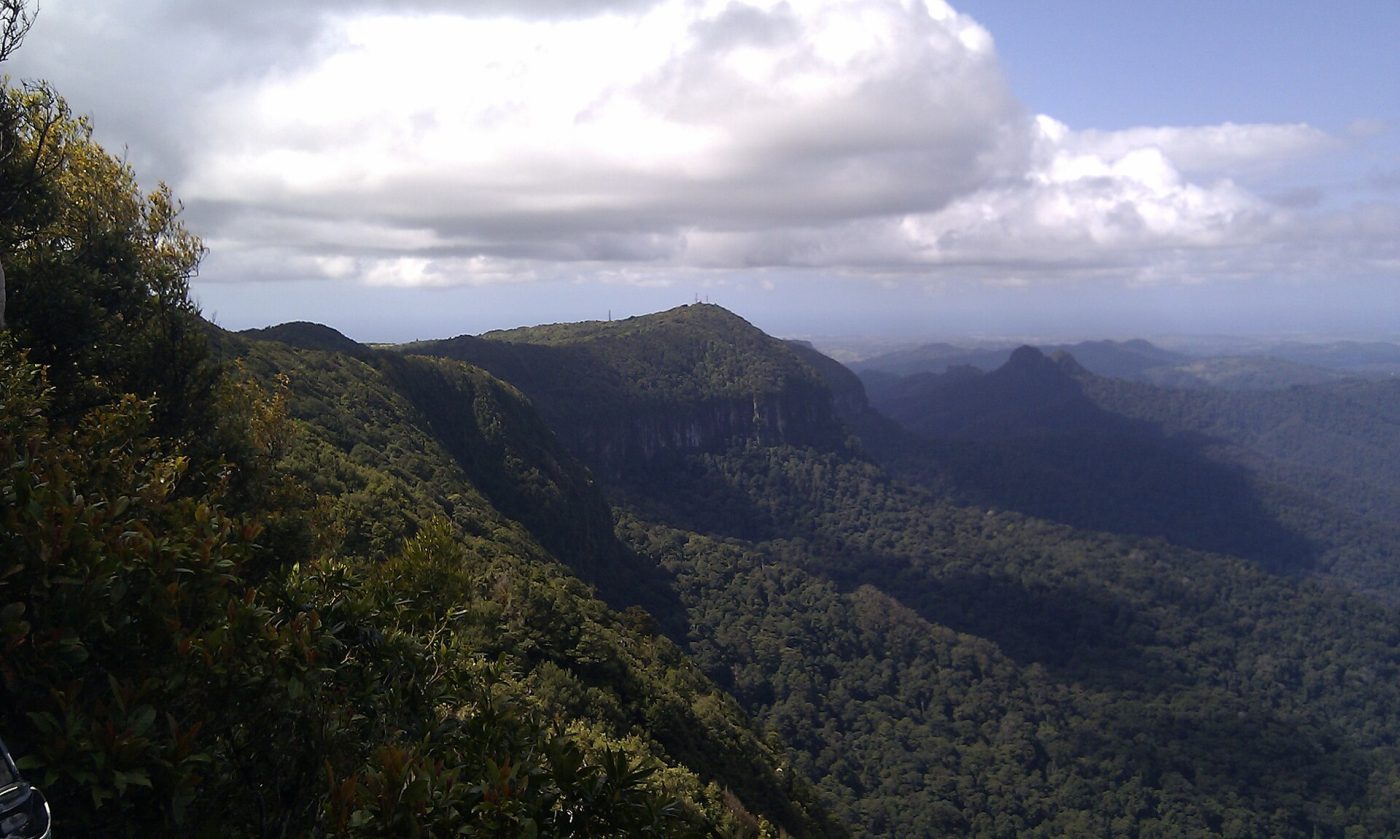
Photo: Knödelbaum, CC BY-SA 3.0
Springbrook is a high, wet, forested plateau in the hinterland of the Gold Coast, in the south-east corner of Queensland, on the border of New South Wales, and the national park that covers its cliffs and gorges lies only forty-five minutes to an hour by road from the beaches of Surfers Paradise and Burleigh, and about a hundred kilometres, an hour and a half, from Brisbane. There is no public transport, and visitors either drive, by winding mountain roads from Mudgeeraba or Nerang, or take one of the half-day and evening tours from the Gold Coast, the most popular of which go in the late afternoon to the plateau's lookouts and then, after dark, to the glow-worms of Natural Bridge. Entry is free. The park is in several sections, and the two that matter lie half an hour's drive apart by road.
On the plateau itself, a string of lookouts and short tracks runs along the rim: Purling Brook falls, where a lookout a few minutes from the car park faces a waterfall of more than a hundred metres, and a circuit of four kilometres, about two hours, with many steps, descends through the forest to its foot, crosses a suspension bridge and climbs back; the Twin Falls circuit, of similar length, from the Canyon lookout or Tallanbana picnic area, which passes behind two waterfalls and through clefts in the rock; the Goomoolahra falls lookout; and, at the very end of the road, the Best of All lookout, reached by a level path of three hundred metres through a grove of ancient Antarctic beeches. The long Warrie circuit, seventeen kilometres, takes a full day. The Natural Bridge section, in the Numinbah valley on the western side, has a sealed circuit path of one kilometre, with steps, down to a cave into which a creek plunges through a hole in the roof.
Live dates and prices from GetYourGuide. Free cancellation on most tickets.
The first reserves on Springbrook date from the 1930s, and the separate small parks were consolidated as Springbrook National Park in 1990, the date of 2016 found in some databases referring only to a later adjustment; it covers about 6,200 hectares, and since 1994 has belonged to the Gondwana Rainforests of Australia, a World Heritage Site. The plateau is a remnant of the northern flank of the Tweed volcano, a vast shield volcano, more than a hundred kilometres across, which was active about twenty-three million years ago and whose centre, the plug of Mount Warning, called Wollumbin by the Bundjalung people, stands across the border in the middle of an erosion caldera among the largest in the world. The southern edge of Springbrook is the rim of that caldera, a line of cliffs nine hundred to a thousand metres above the sea, and from the Best of All lookout one gazes straight into it, to Mount Warning and beyond to the coast. The layers of basalt and rhyolite of the old volcano form the steps over which the plateau's streams fall, and the plateau, thrust up into the moist onshore winds, receives more than three metres of rain a year, the highest rainfall in southern Queensland.
It supports warm and cool subtropical rainforest, with booyongs, figs, carabeens, piccabeen palms, tree ferns, staghorns and orchids, and on the highest, mistiest point a small stand of Antarctic beech, gnarled, mossy trees which have been renewing themselves from the same root stocks for perhaps two thousand years, and whose nearest relations grow in Tasmania, New Zealand and South America, the living proof of the former union of the southern continents; open eucalypt forest and heath occupy the drier ridges. At Natural Bridge, Cave Creek once fell over a ledge of hard basalt, and the swirling stones in its plunge pool gradually drilled through into a cavern that the water had hollowed beneath, so that the stream now drops through the roof of its own cave, leaving the old lip as a bridge of rock. In the damp, dark roof lives one of the largest colonies in Australia of glow-worms, which are not worms but the larvae of a small fly, a fungus gnat: each builds a tube of mucus, lets down dozens of sticky threads like fishing lines, and produces a steady blue-green light in its tail to lure midges and mosquitoes into them, and after nightfall the ceiling of the cave and the banks along the path shine like a starry sky. Luminous fungi and fireflies appear in the wet season. The animals of the park include red-necked pademelons, which graze the picnic grounds, Albert's lyrebird, the paradise riflebird, the noisy pitta, the blue spiny crayfish, the Richmond birdwing butterfly, carpet pythons and koalas in the eucalypt forest.
The park is open all year. The waterfalls are at their best in the wet season, from December to March, and after any heavy rain, when they thunder, but this is also the time of heat, humidity, leeches, mist that may hide every view for days, and of storms that close tracks and sometimes the roads, which were badly damaged by landslides in the floods of 2022. The glow-worms shine all year but are brightest and most numerous in the warm, wet months from December to March.
The cooler, drier season, from May to October, has the clearest views from the lookouts, comfortable walking and cold nights on the plateau, which lies up to ten degrees below the coast. At the glow-worm cave, torches must be kept pointed at the ground and switched off near the colony, flash photography, smoking and insect repellent are forbidden, since all of them harm the larvae, and swimming in the creek is prohibited. Carry a waterproof and warm layer. Allow half a day to a day. The Gold Coast is under an hour away, Lamington National Park an hour by road, and Tamborine Mountain forty-five minutes.
Yes. GetYourGuide lists one ticket or tour for Springbrook National Park, with live dates and prices and free cancellation on most of them.
The park is open all year.
Allow half a day to a day.
Springbrook National Park covers 62 km².
Springbrook National Park was established in 1990.
Springbrook National Park is in Queensland, Australia. The map on this page shows the exact spot.
Queensland, Australia
Green Island is a tiny coral cay on the Great Barrier Reef, twenty-seven kilometres off the city of Cairns in tropical…
7 tickets & tours
Queensland, Australia
Noosa National Park begins where Hastings Street, the smart beachfront strip of Noosa Heads on Queensland's…
5 tickets & tours
Queensland, Australia
Great Sandy National Park, on the coast of southern Queensland, consists of two separate sections which visitors…
2 tickets & tours
Queensland, Australia
Lamington lies on a high plateau of the McPherson Range, on the border of Queensland and New South Wales, in the…
2 tickets & tours
Queensland, Australia
The Whitsundays are a group of seventy-four islands lying just off the coast of central Queensland, inside the Great…
2 tickets & tours
Queensland, Australia
Barron Gorge is the deep, rainforested ravine by which the Barron river drops from the Atherton tableland to the…
1 ticket or tour


