Bohemian Switzerland National Park
213 km away
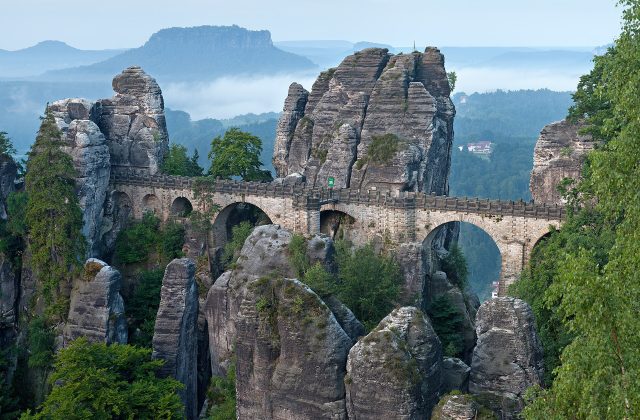
Bohemian Switzerland is the sandstone park on the Czech–German border north of Prague, an hour and a half from the…
16 tickets & tours

The Sumava, known in German as the Bohmerwald and in English as the Bohemian Forest, is a long, gently rounded, heavily wooded range along the south-western frontier of the Czech Republic with Bavaria and Austria, and its national park is the largest in the country, a region of spruce forest, peat bog, glacial lakes and half-abandoned villages, best explored on foot, by bicycle and, in winter, on cross-country skis. It is about two and a half to three hours by road from Prague and an hour and a half from Ceske Budejovice or Plzen, and is served by slow, scenic local railways and, in summer and winter, by a network of green buses, some carrying bicycles, which link the villages and the trailheads, so that it is possible to manage without a car. Entry is free, only car parks being charged for. The park is long and thinly populated, and one chooses a base: Zelezna Ruda, in the north-west, a small resort at the foot of the ski slopes, near the Black and Devil's lakes;
the central plateau, the wildest and highest part, with the hamlets of Kvilda, Modrava, Srni and Prasily; and the south-east, round the villages of Stozec, Nova Pec and Horni Plana on the Lipno reservoir, from which the Plechy massif and its lake are reached. The classic easy outings on the plateau are the walk from Kvilda to the source of the Vltava, six kilometres each way on a level forest road; the boardwalks over the raised bogs, the Jezerni slat near Kvilda, with a viewing tower, the Trijezerni slat near Modrava, and the Chalupska slat near Borova Lada, with its bog lake; the valley of the Vydra river below Antygl, where a path follows the torrent among giant boulders; and the climb from Prasily to the tower on Polednik. Several hundred kilometres of marked cycle routes use old forest and border-patrol roads, and the upper Vltava is canoed, under a permit system, from Soumarsky Most.
The Sumava was declared a protected landscape area in 1963, a UNESCO biosphere reserve in 1990, and a national park in 1991, covering about 680 square kilometres, surrounded by a protected landscape of a further thousand; across the frontier it adjoins the Bavarian Forest National Park, the oldest in Germany, and the two together form the largest continuous forest in central Europe, sometimes called the green roof of Europe, from which rivers flow to both the North Sea and the Black Sea. The range is very old, a worn-down massif of gneiss and granite, whose summits are broad and rounded, the highest on the Czech side, Plechy, reaching 1,378 metres, and whose central part is a high, rolling plateau at about a thousand metres, cold, wet and snowy, the village of Kvilda being known as the coldest in the country. The ice age left five small lakes on the Czech side, lying in steep-walled cirques under the highest ridges, dark, still and legend-haunted, and the plateau is dotted with raised peat bogs, called slate, of a kind more usual in Scandinavia, with pools, dwarf pines and birches, sundews, cranberries and cotton grass. On its eastern slope the Vltava, the national river of the Czechs, rises as a spring in the forest. The human history of the mountains is one of settlement and sudden emptiness. From the Middle Ages they were colonised by German-speaking woodcutters, glassmakers, whose forest glassworks supplied half Europe, and farmers; in the eighteenth century the Schwarzenberg princes had a canal forty-four kilometres long, with a tunnel, built across the watershed, to float the timber of these forests to Vienna.
In 1945 and 1946 the German inhabitants, the great majority of the population, were expelled to Germany, and from 1948 the whole frontier became the Iron Curtain: a forbidden zone several kilometres deep, fenced with electrified wire, patrolled by border guards, and cleared of people, in which dozens of villages and hamlets were demolished, some used as targets by the army. Their sites, marked by lilac bushes, fruit trees, a ruined chapel or a graveyard, are passed on many walks, and the border guards' asphalt tracks are now the cycle paths. The enforced solitude of forty years preserved the forests and the wildlife. Most of the forest is spruce, much of it planted in the nineteenth century in place of the original mixed forest of spruce, fir and beech, of which the Boubin primeval forest, protected since 1858, is the famous remnant. In January 2007 a hurricane felled great swathes of it, and an outbreak of bark beetle followed, killing the mature spruce over large areas; whether to fell the infested trees or to leave nature to take its course became the bitterest environmental dispute in the country, with activists chaining themselves to trees in 2011, and the grey, dead stands on the ridges, beneath which a dense new forest is growing, are its visible result. The lynx, reintroduced in the 1980s, has established here one of the strongest populations in central Europe, wolves have returned, a few elk live near Lipno, and the capercaillie, the black grouse, the pygmy owl, Tengmalm's owl and the three-toed woodpecker are present.
The park is open all year. Summer, from June to early September, is the main season, with mild temperatures of 17 to 23 degrees on the plateau, long days, bilberries in July and August, and the buses running; July and August weekends are busy at the source of the Vltava and the bog boardwalks. September and early October bring clear weather, mushrooms, which the Czechs gather with passion, and autumn colour in the beech and maple woods of the lower slopes.
Winter, from December to March, is long and snowy, and the plateau becomes one of the best cross-country skiing areas of central Europe, with several hundred kilometres of machine-groomed tracks round Kvilda, Modrava and Churanov; some of the bog and lake paths are then closed. In the core zones one must keep to the marked trails, and certain paths are closed in spring for the sake of the capercaillie. The weather is changeable and rain frequent, so bring a waterproof and warm layer. Allow three to four days. Cesky Krumlov, a World Heritage town, is forty-five minutes from Lipno, and the town of Prachatice lies at the foot of the range.
213 km away
Bohemian Switzerland is the sandstone park on the Czech–German border north of Prague, an hour and a half from the…
16 tickets & tours
214 km away
Saxon Switzerland is the sandstone park on the Elbe south-east of Dresden, forty minutes from the city by train and two…
13 tickets & tours
299 km away
Triglav is Slovenia's only national park, the Julian Alps between Bled, Kranjska Gora and Bovec, and it is sold…
16 tickets & tours
No online tour for Sumava National Park is listed on GetYourGuide; entry, where it is charged, is paid at the gate or through the park authority. Nearby parks with bookable tours are listed on this page.
Entry is free, only car parks being charged for.
The park is open all year.
Allow three to four days.
Sumava National Park covers 685 km².
Sumava National Park was established in 1991.
Sumava National Park is in Czech Republic. The map on this page shows the exact spot.
Czech Republic
Bohemian Switzerland is the sandstone park on the Czech–German border north of Prague, an hour and a half from the…
16 tickets & tours