Mtirala National Park
214 km away
Mtirala is the rainforest mountain behind the Black Sea resort of Batumi in Georgia's Adjara region, only about…
6 tickets & tours
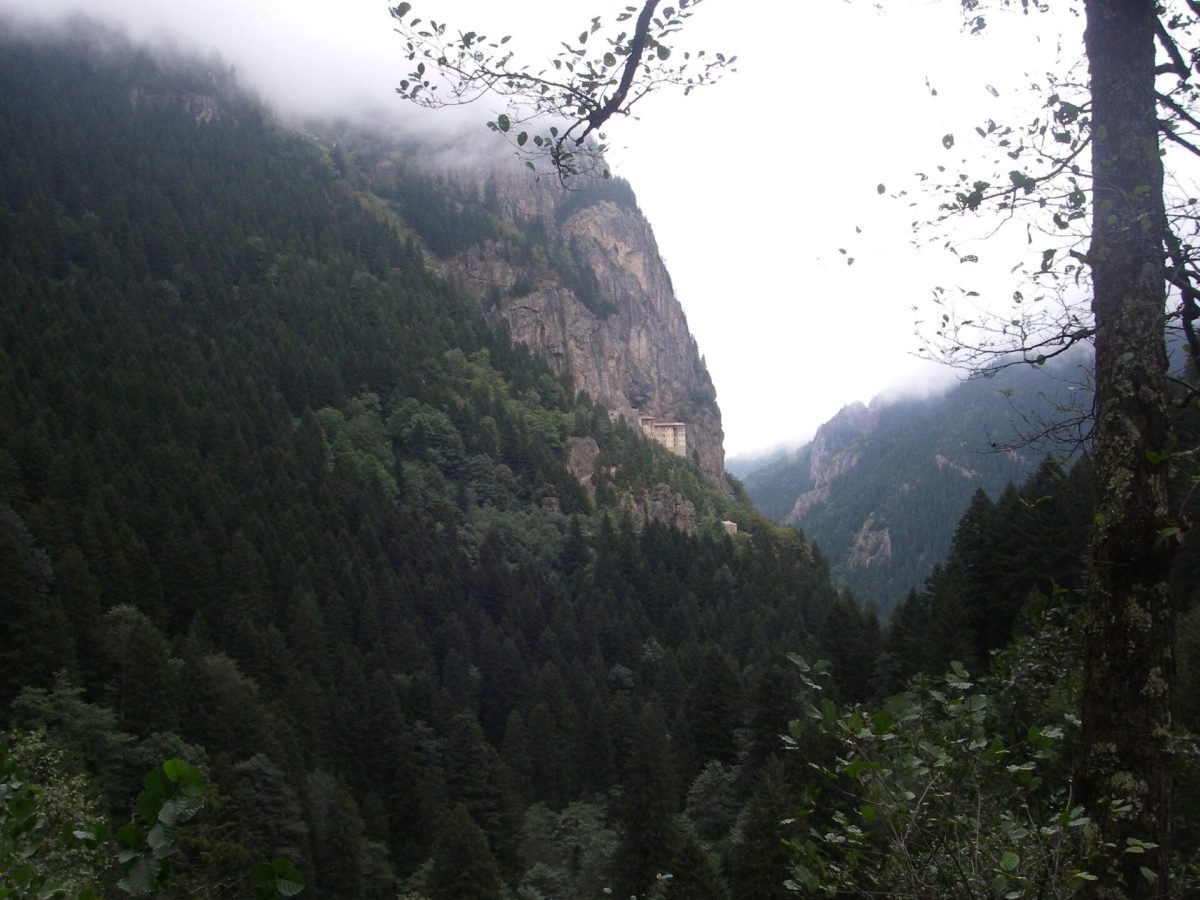
Photo: Jean & Nathalie, CC BY 2.0
The Altindere valley is a deep, densely forested gorge in the Pontic mountains behind the Black Sea coast of north-eastern Turkey, and it is known to everyone for the building that clings to its cliff, the monastery of Sumela, which is the most visited monument of the region. It lies forty-seven kilometres, about an hour by road, south of the port city of Trabzon, which has an airport with flights from Istanbul and Ankara, by way of the small town of Macka, and is reached by hired car, taxi, the minibuses that run from Trabzon and Macka in the season, or any of the day tours sold in the city. At the entrance to the national park a fee is charged for vehicles, and the road then follows the rushing stream up the valley, past trout restaurants and picnic places, to a lower car park and, by a steep, narrow continuation, to an upper one.
Private cars are generally required to stop at the lower car park in the busy months, from where park minibuses shuttle visitors up to the end of the road; the last three hundred metres or so are covered on foot, along a level path through the forest and up a long stone staircase to the gatehouse. Those who prefer to walk the whole way can take the old pilgrims' path from the valley floor, about a kilometre of steep zigzags through the trees, thirty to forty minutes. The monastery is a state museum with its own ticket, separate from the park fee, and the national museum pass is valid. Inside, stairs descend into a courtyard ranged with the ruined cells, guest rooms, kitchen, library and aqueduct, and at its back the rock church, its outer and inner walls covered with frescoes. The classic photograph of the monastery is taken from a viewpoint on the road opposite. Marked trails lead on into the forest.
Live prices from GetYourGuide for tours whose route includes this park. Free cancellation on most of them.
The valley was declared a national park in 1987 and covers about 4,470 hectares, from some 1,000 metres on the valley floor to summits over 3,000 in the Zigana range. According to its foundation legend, the monastery was established in the year 386, in the reign of Theodosius, by two Athenian monks, Barnabas and Sophronios, who were led by a vision to a cave in this remote cliff, where they found an icon of the Virgin painted by St Luke; its name comes from the Greek for the black mountain, the Panagia tou Melas. Whatever its true origin, it owes its present form and its fame to the empire of Trebizond, the Byzantine successor state that ruled this coast from 1204 to 1461, whose emperors were crowned there and endowed it richly, above all Alexios III, in the fourteenth century, who was saved, it was said, by the Virgin of Sumela from a storm at sea. Unusually, its privileges were confirmed by the Ottoman sultans after the conquest, several of whom sent gifts, and it remained a place of pilgrimage for the Pontic Greeks, and for local Muslims too, for another four and a half centuries, being largely rebuilt and enlarged in the eighteenth and nineteenth. The buildings stand on a narrow ledge, some 270 metres above the stream at an altitude of about 1,200 metres, so that from below the long facade of the residential block seems pasted to the vertical rock.
The cave church, the heart of the place, is painted inside and out with scenes from the life of Christ and the Virgin, the Last Judgment and rows of saints, in several layers, the visible one mostly of the eighteenth century, with fragments of the fourteenth; they were shockingly defaced, by shepherds, soldiers and generations of visitors carving their names, in the decades when the ruin lay open. It was abandoned in 1923, when the Greek Orthodox population of the Black Sea was expelled to Greece under the exchange of populations; the monks buried the icon and other treasures, and in 1931 one of them was allowed to return to dig them up, the icon being installed in a new monastery of the same name in the mountains of Greek Macedonia, the focus of Pontic Greek memory. On 15 August 2010, the feast of the Dormition, the Ecumenical Patriarch celebrated the liturgy at Sumela for the first time in eighty-seven years, by special permission, an event repeated in some later years. The site was closed from 2015 for several years while the cliff above was stabilised against rockfall and the buildings restored, and it has reopened in stages. The forest is the temperate rainforest of the Colchic type, dripping, mossy and dark: oriental spruce, oriental beech, chestnut, hornbeam, alder and fir, with an undergrowth of cherry laurel, holly and two rhododendrons, the purple and the yellow, from whose nectar bees make the intoxicating mad honey of the region. Roe deer, chamois, wild boar, brown bears, wolves and jackals live in the park.
The monastery is open daily, from about 8 am to 7 pm in summer and until 5 pm in winter, though it may close in heavy snow or when restoration requires. The season runs from May to October. The Black Sea coast is rainy in every month, and the valley is often filled with mist, which hides the view but suits the place; June to September are the warmest and driest months, and the busiest, with coach parties from Trabzon arriving from mid-morning, so that the first hour after opening is the time to come, and the days round 15 August are very crowded.
In May and June the rhododendrons are in flower, and in October the beeches and chestnuts turn. In winter the road is sometimes closed by snow and ice, and the monastery under snow is a memorable sight for those who can reach it. The stairs are steep and slippery when wet. Bring a waterproof and shoes with a good grip. Allow three hours, half a day from Trabzon. Trabzon's church of Hagia Sophia is an hour away, and the Zigana pass and the village of Hamsikoy lie up the main road.
214 km away
Mtirala is the rainforest mountain behind the Black Sea resort of Batumi in Georgia's Adjara region, only about…
6 tickets & tours
309 km away
Sataplia is a small hilltop reserve of forest, caves and dinosaur footprints about ten kilometres, twenty minutes by…
2 tickets & tours
Yes. GetYourGuide sells tickets and guided tours whose route includes Altindere Valley National Park; live prices are shown on this page.
The monastery is a state museum with its own ticket, separate from the park fee, and the national museum pass is valid.
The site was closed from 2015 for several years while the cliff above was stabilised against rockfall and the buildings restored, and it has reopened in stages.
Allow three hours, half a day from Trabzon.
Altindere Valley National Park covers 44.7 km².
Altindere Valley National Park was established in 1987.
Altindere Valley National Park is in Turkey. The map on this page shows the exact spot.
Turkey
Marmaris National Park is the pine-forested peninsula and hills that surround the resort of Marmaris on Turkey's…
32 tickets & tours
Turkey
Saklıkent is the gorge in the mountains fifty kilometres from Fethiye and sixty-five from Kaş on Turkey's Lycian…
14 tickets & tours
Turkey
Göreme National Park is the core of Cappadocia, in central Turkey, reached by air to Kayseri or Nevşehir, an…
4 tickets & tours
Turkey
The Dilek peninsula is a wooded mountain that thrusts westwards into the Aegean from the Turkish coast, thirty…
1 ticket or tour
Turkey
Uludag, the great mountain, rises directly behind the city of Bursa, the first capital of the Ottoman empire, in…
1 ticket or tour
Turkey
Altinbesik, the golden cradle, is a cave with an underground lake in the Taurus mountains of southern Turkey, in the…
No online ticket


