Marmaris National Park
Turkey
Marmaris National Park is the pine-forested peninsula and hills that surround the resort of Marmaris on Turkey's…
32 tickets & tours
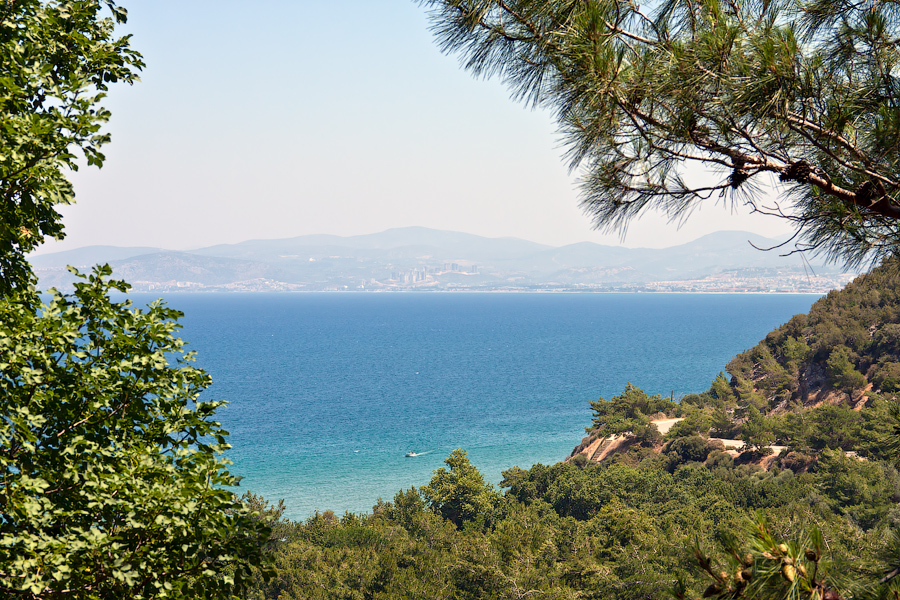
Photo: ahenobarbus, CC BY 2.0
The Dilek peninsula is a wooded mountain that thrusts westwards into the Aegean from the Turkish coast, thirty kilometres, about thirty to forty minutes by road, south of the cruise port and resort of Kusadasi, and it is where the people of that crowded coast go for clean water and shade; in full its name is the Dilek Peninsula and Buyuk Menderes Delta National Park, the delta to the south having been added later. Its entrance is just beyond the village of Guzelcamli, to which minibuses run frequently from Kusadasi and from Soke, some of them continuing into the park in summer, and at the gate a modest fee is charged per person and per vehicle. A single tarred road runs along the northern shore for about ten kilometres, passing in turn four coves, each with a car park, picnic tables under the pines, simple toilets, showers and a kiosk: Icmeler, the first and the only sandy one, shallow and crowded with families;
Aydinlik, of pebbles, a few kilometres on; Kavakliburun; and Karasu, the furthest and usually the quietest, with the clearest water. Beyond Karasu the road is barred, the rest of the peninsula being a military zone. Wild boars, entirely unafraid, wander among the picnickers in the late afternoon looking for scraps, and should not be fed or approached. Just outside the gate, a short path leads to the cave of Zeus, a grotto with a pool of cold, blue, slightly brackish water in which people swim. Walkers have a marked trail up the Olukdere canyon, from near Aydinlik, through dense forest towards the ridge and across to the village of Doganbey, a long day for which a guide may be required. The jeep safaris from Kusadasi combine the park with mountain villages. There is no accommodation or camping inside, and the park closes at dusk.
Live dates and prices from GetYourGuide. Free cancellation on most tickets.
The park was established in 1966 on the peninsula, some eleven thousand hectares, and extended in 1994 to the delta of the Buyuk Menderes, giving about 27,600 in all. The peninsula is the ancient Mount Mycale, now Samsun or Dilek Dagi, a ridge of marble and schist twenty kilometres long and 1,237 metres high, whose tip is separated from the Greek island of Samos by a strait barely a mile wide, the narrowest gap anywhere between Greece and Turkey. It was on the shore beneath this mountain that, in 479 BC, by tradition on the same day as the battle of Plataea, a Greek fleet landed, stormed the camp where the Persians had beached their ships, and burned them, completing the defeat of Xerxes' invasion and freeing Ionia; and on the northern slope near Guzelcamli lay the Panionion, the sanctuary of Poseidon at which the twelve cities of the Ionian league held their assembly and festival, of which a few courses of the council house and altar remain. The mountain's botanical interest is out of proportion to its size. The northern slope, steep, humid and cut by canyons, carries a vegetation that belongs partly to the Mediterranean and partly to the Black Sea coast and the Balkans, so that within a few kilometres one passes from maquis of myrtle, arbutus, laurel, kermes oak and carob, and forests of Calabrian pine, to chestnut, lime, plane, hornbeam and even a few relict species of the north, more than eight hundred kinds of plants in all, some thirty of them endemic to Turkey.
The fauna includes wild boar in great numbers, jackals, lynx, caracal, striped hyenas, porcupines, and formerly the Anatolian leopard, the last of which in this region were shot within living memory; the Mediterranean monk seal, one of the rarest mammals on earth, breeds in sea caves on the inaccessible southern and western shores, which the military presence has kept undisturbed, and dolphins and sea turtles are seen offshore. The delta to the south is a wholly different landscape, a wide, flat mosaic of lagoons, salt marsh, reed beds, dunes and fish traps built by the silt of the Meander, the river whose windings gave the language a word and whose deposits stranded the great harbour cities of Miletus and Priene miles inland. About 250 species of birds occur there, including breeding Dalmatian pelicans, one of the most important colonies of this threatened bird in Turkey, flamingos in thousands in winter, pygmy cormorants, spoonbills, stilts, avocets and terns. At Doganbey, a stone-built Greek village emptied in the exchange of populations of 1923 and since restored, the park has a visitor centre.
The park is open daily from 8 am until dusk, with last entry in the late afternoon. The swimming season runs from late May to October, with sea temperatures of 22 to 26 degrees; July and August are hot, above 33 degrees, and on summer weekends and during the religious holidays the gate may close by late morning once the car parks are full, so come on a weekday and early, and drive to the furthest coves.
April to early June and late September to October are the best times for walking and for the flowers, and winter and spring for the birds of the delta, which is reached from the Soke to Didim road, not through the peninsula gate. In periods of extreme fire danger the forest trails are closed. Bring food, water, shoes for the pebbles and a mask, and take rubbish away. Allow a day. Kusadasi is half an hour away, Ephesus forty-five minutes, Priene twenty-five minutes from the gate, Miletus and Didyma an hour, and Lake Bafa an hour.
Yes. GetYourGuide lists one ticket or tour for Dilek Peninsula National Park, with live dates and prices and free cancellation on most of them.
Its entrance is just beyond the village of Guzelcamli, to which minibuses run frequently from Kusadasi and from Soke, some of them continuing into the park in summer, and at the gate a modest fee is charged per person and per vehicle.
The park is open daily from 8 am until dusk, with last entry in the late afternoon.
Dilek Peninsula National Park covers 277 km².
Dilek Peninsula National Park was established in 1966.
Dilek Peninsula National Park is in Turkey. The map on this page shows the exact spot.
Turkey
Marmaris National Park is the pine-forested peninsula and hills that surround the resort of Marmaris on Turkey's…
32 tickets & tours
Turkey
Saklıkent is the gorge in the mountains fifty kilometres from Fethiye and sixty-five from Kaş on Turkey's Lycian…
14 tickets & tours
Turkey
Göreme National Park is the core of Cappadocia, in central Turkey, reached by air to Kayseri or Nevşehir, an…
4 tickets & tours
Turkey
Uludag, the great mountain, rises directly behind the city of Bursa, the first capital of the Ottoman empire, in…
1 ticket or tour
Turkey
Altinbesik, the golden cradle, is a cave with an underground lake in the Taurus mountains of southern Turkey, in the…
No online ticket
Turkey
The Altindere valley is a deep, densely forested gorge in the Pontic mountains behind the Black Sea coast of…
No online ticket