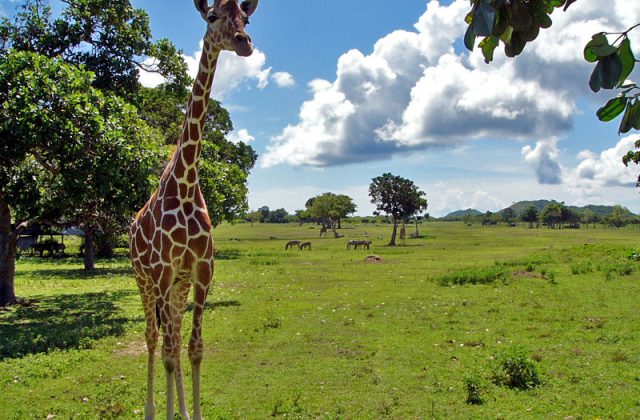
Calauit Safari Park
Philippines
Calauit is one of the oddest wildlife attractions in Asia, a small island off the north-western tip of Busuanga, in the…
3 tickets & tours

Photo: Francisco M. Pajares, Jr., CC BY-SA 4.0
The twin lakes of Balinsasayao and Danao lie high in the forested mountains of Negros Oriental, in the central Philippines, above the town of Sibulan and about twenty-five kilometres, an hour or so by road, north-west of Dumaguete, the easy-going university city and provincial capital, which has an airport with daily flights from Manila and Cebu and fast ferries to the neighbouring islands. They make the classic half-day excursion from the city, and are included in most countryside tours from Dumaguete. The way there follows the coastal highway north for about twelve kilometres and then turns inland, in the municipality of San Jose, on to a concrete road, steep and winding but in good condition, which climbs for some fourteen kilometres through farmland and then forest to about nine hundred metres above the sea.
Those without a car take a bus or jeepney to the junction and one of the motorbike taxis, called habal-habal, that wait there, agreeing a price for the return journey and the waiting time; hired cars, vans and tours drive all the way. Small fees, for entry, the vehicle and the environment, are collected at a checkpoint and at the park's gate. On the way up, a short path leads to Kabalin-an, a small pond in which the trunks of dead trees stand in the water. At the end of the road are a car park, a visitor shelter with a simple restaurant on a terrace overlooking the first lake, and steps down to a jetty, where kayaks and paddle boats are hired by the hour and boatmen ferry visitors across the lake, in ten minutes or so, to the far shore, from which a stepped path climbs in a few minutes to a viewing deck on the narrow ridge that divides the two lakes, the only place from which both can be seen. A footpath also leads round part of the shore through the forest.
Live dates and prices from GetYourGuide. Free cancellation on most tickets.
The protected area was proclaimed a natural park in November 2000 and covers a little over eight thousand hectares on the northern flanks of the Cuernos de Negros, the horns of Negros, a volcanic massif whose highest summit, Mount Talinis, reaches 1,903 metres and whose underground heat is tapped by a geothermal power station in the next valley. The two lakes occupy adjoining basins at about 850 metres, generally described as craters or calderas, though some geologists prefer to see them as valleys dammed by volcanic debris: Balinsasayao, the larger, to the north-west, of some seventy-six hectares and as much as ninety metres deep, and Danao, to the south-east, of about thirty, separated by a steep, wooded ridge only a few hundred metres wide. Their water is fresh, cool, dark green and perfectly still, enclosed on every side by slopes covered with forest that comes down to the water's edge, and mist commonly drifts across them by late morning. Local legend makes the lakes the work of a quarrel between lovers or of the tears of an abandoned woman, in several versions. The importance of the park is biological.
Negros has lost all but a few per cent of its original forest, the rest having gone to sugar cane and upland farming, and this is one of the largest of the fragments that remain, a lower montane rainforest of dipterocarps, the almaciga, a relative of the kauri which yields a valuable resin, tree ferns, rattans, pandans, wild orchids and, in the higher parts, mossy forest. It shelters some of the most endangered animals in the world, found only on Negros and the neighbouring island of Panay: the Visayan warty pig, the Visayan spotted deer, the Negros bleeding-heart, a ground pigeon with a blood-red patch on its white breast, the Visayan hornbill, the tarictic, the flame-templed babbler, the Negros striped babbler, several fruit bats, among them giant flying foxes, and a shrew and frogs known from nowhere else. More than a hundred and eighty species of birds have been listed, and the early morning, before the day trippers arrive, is rewarding for birdwatchers, who can arrange a local guide through the park office. The lakes themselves hold tilapia and carp, introduced for the local people to fish. Scientists from Silliman University in Dumaguete, which has a long tradition of field biology, have studied the area since the 1950s, and their work led to its protection.
The park is open daily from about 8 am to 5 pm. The drier months, from December to May, are the best, with February to April the most reliable; from June to November there is heavy rain, particularly in the afternoons, the road can be affected by landslides after typhoons, and the lakes are often wrapped in cloud. At any season come early: the water is calm and clear of mist until ten or eleven, the birds are active, and the weekend crowds from the city have not yet arrived.
It is several degrees cooler than on the coast, so a light jacket is welcome, with a waterproof, repellent and shoes that can cope with mud. Swimming is discouraged. Allow half a day. The Pulangbato falls and hot springs in the red-rock valley of Valencia, and the Casaroro falls, are an hour away, Dumaguete and its seafront boulevard an hour, and the marine sanctuary of Apo island, for turtles, an hour and a half by road and boat.
Yes. GetYourGuide lists one ticket or tour for Balinsasayao Twin Lakes Natural Park, with live dates and prices and free cancellation on most of them.
The park is open daily from about 8 am to 5 pm.
Balinsasayao Twin Lakes Natural Park covers 80.2 km².
Balinsasayao Twin Lakes Natural Park was established in 2000.
Balinsasayao Twin Lakes Natural Park is in Philippines. The map on this page shows the exact spot.
Philippines
Calauit is one of the oddest wildlife attractions in Asia, a small island off the north-western tip of Busuanga, in the…
3 tickets & tours
Philippines
The underground river of Puerto Princesa is the best-known natural attraction of the island of Palawan, in the west of…
1 ticket or tour
