Theth National Park
Albania
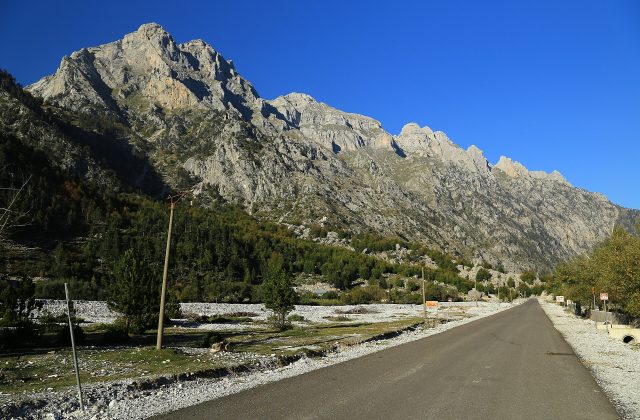
Theth is the valley village at the heart of the Albanian Alps, three hours from Shkodër and five from Tirana by a road…
20 tickets & tours

Photo: Reklo18, CC BY-SA 4.0
Butrint lies at the southern tip of Albania, eighteen kilometres and half an hour from the resort town of Sarandë, opposite Corfu, and although the national park covers a whole landscape of lagoon, channel, marsh and islands, what visitors come for is the ancient city at its centre, which has its own gate and ticket, payable in lek, at the end of the road beyond Ksamil. The half-day tours from Sarandë drive there with a guide, spend two hours on the shaded circuit through the ruins, and stop at Ksamil's beaches for photographs or a swim; the full-day versions add the Blue Eye spring inland and the castle of Lëkurësi above Sarandë at sunset, or a lunch of mussels at one of the farms on Lake Butrint, where they are grown on ropes and cooked within minutes of leaving the water, a local speciality worth the detour.
From Corfu, day trips cross by hydrofoil or ferry in thirty to seventy minutes, with passports, and bus their passengers to the site and back for the afternoon boat, which works well and is how a large share of Butrint's visitors arrive. Going independently is simple: the municipal bus from Sarandë's centre runs roughly hourly through Ksamil to the gate. A licensed guide can be hired at the entrance, and the site is well signed in English; the museum in the Venetian castle on the acropolis is included. Beside the gate a hand-hauled cable ferry carries cars across the Vivari channel towards the Greek border and the triangular fortress on the far bank.
Live dates and prices from GetYourGuide. Free cancellation on most tickets.
The archaeological site has been a World Heritage Site since 1992, and the national park, created in 2000 and enlarged since to about 94 square kilometres, protects its setting, which is also a Ramsar wetland: the brackish Lake Butrint, the Vivari channel that joins it to the Straits of Corfu, salt marshes, reed beds, the Vrina plain, wooded hills and the islets of Ksamil. The city stands on a low wooded peninsula almost surrounded by water, and its charm, unlike most ancient sites, is that the ruins lie in a forest of laurel, oak and eucalyptus, cool in summer and loud with frogs and nightingales. Virgil has Aeneas land at Buthrotum and find it a Troy in miniature, founded by Trojan exiles; in fact it was a town of the Epirote Chaonians, with a sanctuary of the healing god Asclepius that drew pilgrims from the fourth century BC, a Roman colony under Caesar and Augustus, a Byzantine bishopric, a Venetian outpost guarding Corfu's fisheries, and a possession of Ali Pasha of Ioannina, abandoned at last to malaria.
The circuit passes the Hellenistic theatre, its lower seats often standing in groundwater with terrapins, where manumission decrees are carved on the walls; the Roman forum, baths and nymphaeum; a sixth-century baptistery, whose mosaic floor of seven rings of animals and birds is among the finest of early Christendom and is kept under protective sand, uncovered only on rare occasions; the great basilica; the Lion Gate, with its relief of a lion devouring a bull; and walls of massive polygonal masonry, up to the Venetian castle and its museum. The Italian mission of Luigi Maria Ugolini excavated here from 1928, and the Butrint Foundation in the 1990s and after. The lagoon holds mullet, eels and mussels, 246 bird species are recorded, and loggerhead turtles and dolphins use the strait.
The site is open daily from about 8 am to sunset, with the museum closing earlier. April to June and September to October are the best months, with wild flowers among the stones in spring and warm sea in autumn; July and August are hot, humid and crowded between ten and two, when the Corfu boats and the beach crowds coincide, so come at opening or after four; winter is mild, wet and empty, and parts of the lower town flood. Mosquitoes are keen at dusk. Allow two to three hours for the ruins, a day with Ksamil and the mussel farms. Sarandë is half an hour north, the Blue Eye forty-five minutes, Gjirokastër's Ottoman old town an hour and a half, and Corfu half an hour by sea.
Yes. GetYourGuide lists 7 tickets and tours for Butrint National Park, with live dates and prices and free cancellation on most of them.
The site is open daily from about 8 am to sunset, with the museum closing earlier.
Allow two to three hours for the ruins, a day with Ksamil and the mussel farms.
Butrint National Park covers 94.2 km².
Butrint National Park was established in 2000.
Butrint National Park is in Albania. The map on this page shows the exact spot.
Albania
Theth is the valley village at the heart of the Albanian Alps, three hours from Shkodër and five from Tirana by a road…
20 tickets & tours
Albania
Valbona is the valley on the eastern side of the Albanian Alps, reached from Shkodër by the ferry along the Koman lake…
14 tickets & tours
Albania
Llogara is a small park of pine forest around a mountain pass on the coast road of southern Albania, and nearly…
3 tickets & tours
Albania
Shebenik, in full Shebenik-Jabllanice, is a large mountain park in eastern Albania, along the border with North…
2 tickets & tours
Albania
The Fir of Hotova, in full the Hotova-Dangelli National Park, covers the hills and mountains north-east of the small…
1 ticket or tour