
Kemeri National Park
Latvia
Ķemeri is the bog and forest park behind the Baltic resort of Jūrmala, forty-five minutes west of Riga, and its single…
8 tickets & tours
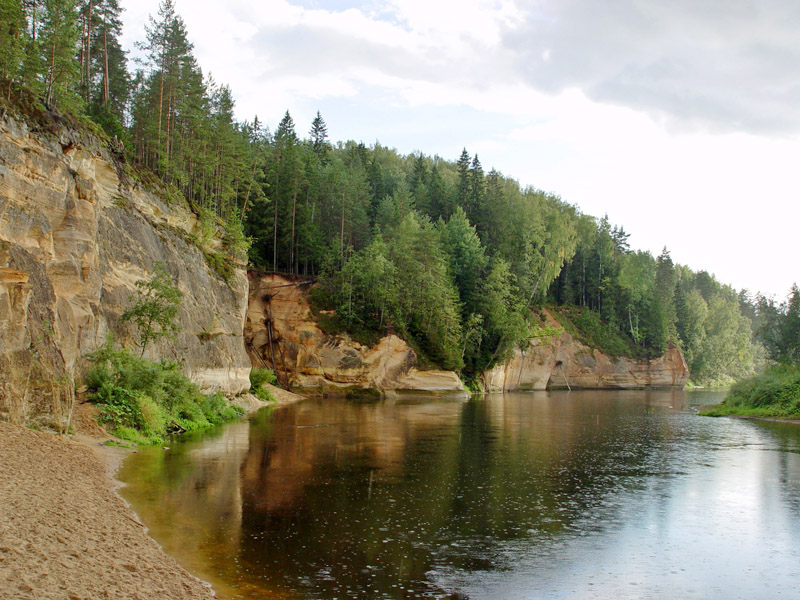
Photo: Gatis Pāvils, CC BY-SA 3.0
Gauja is the oldest and largest national park in Latvia, a wooded river valley in the region of Vidzeme north-east of Riga, and its gateway, the town of Sigulda, is only an hour from the capital by frequent trains and buses or fifty minutes by car, so that it is the standard day trip for visitors to Riga. The park is free and open, with charges only at its museums and castles. The classic circuit, which the day tours from Riga follow by minibus and which can be done independently on foot in a long day or with the help of local buses and taxis, links three places on either side of the valley at Sigulda: the ruins of the castle of the Livonian Brothers of the Sword and the New Castle in Sigulda itself; a cable car that swings across the valley, forty-odd metres above the river, to Krimulda, with the ruins of a bishop's castle and a manor;
a walk down through the woods to the Gutman's cave; and on to the Turaida museum reserve, with its restored red-brick castle tower, wooden church, sculpture garden and the grave of the Rose of Turaida. The fuller tours continue to Cēsis, forty minutes further north, a well-preserved medieval town with the most impressive castle ruins in the country, explored by lantern light, and to the sandstone cliffs at Līgatne, where a Soviet nuclear bunker for the Latvian leadership, hidden under a sanatorium, can be visited by guided tour. For the active there are canoe and raft trips down the Gauja, from a few hours to three days with camping on the banks, cycle hire, walking trails, a bobsleigh and luge track at Sigulda on which visitors can ride, and an adventure park.
Live dates and prices from GetYourGuide. Free cancellation on most tickets.
The park was founded in 1973, the first in Latvia, and covers about 917 square kilometres along nearly a hundred kilometres of the Gauja, the longest river wholly within the country, between Valmiera and Murjāņi. At the end of the last ice age, meltwater cut a broad, steep-sided trench into the plain here, up to eighty-five metres deep and two and a half kilometres wide at Sigulda, which gave rise to the affectionate and exaggerated label of the Switzerland of Vidzeme, and in doing so exposed the underlying Devonian sandstone, some 350 to 370 million years old, laid down in the delta of a vanished river: soft, fine-grained rock in shades of red, orange, yellow and white, which forms cliffs, outcrops, overhangs and caves all along the river and its tributaries, more than five hundred in all. The Gutman's cave, the largest in the Baltic states, nineteen metres deep and ten high, with a spring running out of it, has been a place of pilgrimage and a tourist sight for centuries, and its walls are covered with carved inscriptions, the oldest from the 1660s.
The Zvārtes rock, the Ērgļu cliffs, seven hundred metres long, and the Sietiņiezis, a white sandstone outcrop, are the finest of the others. The valley was the frontier, in the thirteenth century, between the lands of the crusading Order and those of the Archbishop of Riga, which is why castles face one another across it, and it was the homeland of the Livs of the Gauja, whose chief Kaupo was baptised and whose hillforts stand in the woods. The legend of the Rose of Turaida concerns a girl named Maija, found as a baby on a battlefield in 1601, who in 1620 chose death at the hands of a would-be seducer in the Gutman's cave rather than betray her betrothed, and newly married couples still lay flowers on her grave. Nearly half the park is forest, of pine, spruce and mixed broadleaves, with some nine hundred plant species, black storks, lesser spotted eagles, kingfishers, otters, beavers, elk and lynx.
The park is open at all times, and the Turaida reserve daily, from 9 or 10 am, until 8 pm in summer and 5 pm in winter. May, when the valley is white with bird-cherry blossom and the nightingales sing, and late September to mid-October, when the maples, limes and oaks turn and all Latvia comes to Sigulda for what is called the golden autumn, are the best times, the latter very crowded at weekends; summer is green and warm, with canoeing at its best; winter brings skiing on short slopes, the bobsleigh track in operation and the cliffs hung with ice. Allow a full day from Riga, two with Cēsis. Sigulda is the base, Cēsis forty minutes north, Līgatne between them, and Riga an hour south-west.
Yes. GetYourGuide lists 3 tickets and tours for Gauja National Park, with live dates and prices and free cancellation on most of them.
The park is open at all times, and the Turaida reserve daily, from 9 or 10 am, until 8 pm in summer and 5 pm in winter.
Allow a full day from Riga, two with Cēsis.
Gauja National Park covers 918 km².
Gauja National Park was established in 1973.
Gauja National Park is in Latvia. The map on this page shows the exact spot.
Latvia
Ķemeri is the bog and forest park behind the Baltic resort of Jūrmala, forty-five minutes west of Riga, and its single…
8 tickets & tours
Latvia
Slitere lies at the northern tip of Courland, the western peninsula of Latvia, where the open Baltic meets the gulf of…
No online ticket
