Aggtelek National Park
Hungary
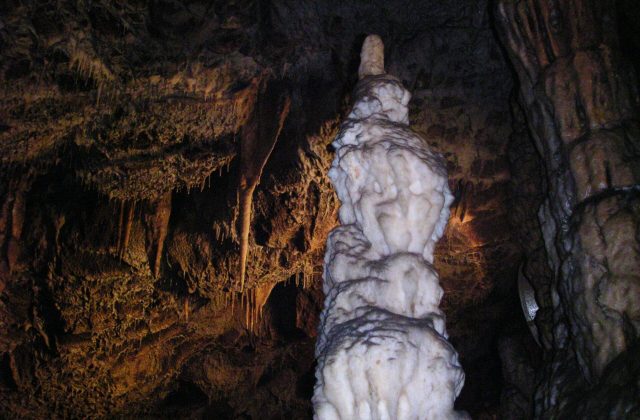
Aggtelek is a park of wooded limestone hills in the far north of Hungary, on the Slovak border, and what visitors come…
No online ticket

Photo: Andreas Poeschek, fotografikus.hu, CC BY 2.0 at
The Hortobagy is the great treeless plain of eastern Hungary, the puszta of song and legend, and its national park lies about 180 kilometres east of Budapest, two to two and a half hours by the M3 motorway and road 33, and thirty-five kilometres west of Debrecen, the country's second city, which has the nearest railway connections; day trips with transport are run from Budapest, but they are long, and a night in the area is better. The centre for visitors is the village of Hortobagy, on the main road, where within a few hundred metres one finds the park's visitor centre, with an exhibition and the ticket office for the areas where a permit is needed, the celebrated nine-arched stone bridge, the old roadside inn, the herdsmen's museum in a former cart shed, a craft yard and a small bird hospital. The rest is seen on organised programmes, since most of the plain can be entered only with a permit or a guide.
At the Mata stud farm, two kilometres away, horse-drawn wagons take visitors out on to the grassland for an hour and a half to see the herds of grey cattle, the twisted-horned sheep and the water buffalo, and to watch the csikos, the mounted herdsmen in wide blue robes and black hats, show their skills, making their horses lie down and sit, cracking long whips, and, as the finale, driving five horses at a gallop while standing on the backs of the hindmost two. A wild animal park, visited by safari bus, keeps the fauna of the ancient steppe, Przewalski's horses, reconstructed aurochs, wolves, jackals, vultures and pelicans. For birdwatchers, the great fishponds a few kilometres to the west are reached by a narrow-gauge railway that runs five kilometres between the ponds to observation towers; bicycles can be hired, and specialist guides arranged. At night, the park is one of the darkest places in central Europe.
Live dates and prices from GetYourGuide. Free cancellation on most tickets.
The Hortobagy was declared Hungary's first national park in 1973, covers a little over eight hundred square kilometres, and was inscribed as a World Heritage Site in 1999, as a cultural landscape shaped by more than four thousand years of pastoral use. It is the largest continuous natural grassland in Europe, a dead-flat alkaline steppe, lying at about ninety metres above the sea, with marshes, shallow soda lakes and oxbows in its hollows. It was long believed that this was a man-made wasteland, created by medieval deforestation and then by the nineteenth-century regulation of the river Tisza, which ended the annual floods; research has shown that, on the contrary, the saline soils and the grassland date from the end of the ice age, ten thousand years ago and more, and were maintained by the grazing of wild herds long before the domestic ones. The low mounds that break the horizon here and there are kurgans, the burial mounds of nomads of the Copper and Bronze ages. From the Middle Ages the plain belonged to the city of Debrecen, whose burghers grew rich by fattening cattle on it and driving them on the hoof to the markets of Vienna, Nuremberg and Venice, and a strict hierarchy of herdsmen grew up, the horse-herds at the top, then the cattlemen, the shepherds and, lowest, the swineherds, each with its costume, which survives, though now largely for show.
The old breeds are kept as a living gene bank: the Hungarian grey cattle, tall, silver-white, with lyre-shaped horns up to eighty centimetres long; the racka sheep, whose corkscrew horns stand out in a V; the curly-coated mangalica pig; the Nonius horse, bred at Mata since the stud was founded in 1671; and the komondor, puli and mudi dogs. The landmarks are the sweep wells, with their long counterweighted poles, the thatched shelters of the shepherds, and the inns built at a day's drive apart along the old salt road, of which that at Hortobagy dates from 1699. The nine-arched bridge, 167 metres long, the longest stone road bridge of historic Hungary, was built between 1827 and 1833 to replace a wooden one, its approaches flared so that herds could be funnelled on to it. About 340 species of birds have been recorded, which is why ornithologists come from all over Europe: great bustards, sakers, red-footed falcons, imperial and white-tailed eagles, spoonbills, pygmy cormorants, glossy ibis, whiskered and white-winged terns, stone curlews, and, in autumn, the common cranes that rest here on migration in numbers that have reached a hundred thousand and more, flying in at dusk to roost on the drained fishponds. On hot summer days the plain produces the delibab, a true mirage. Between 1950 and 1953 the communist government deported some ten thousand people to forced labour camps on the puszta, a history now commemorated.
The park is open all year, though the horse shows, the railway and most programmes operate from about April to October. April and May are the best months for the breeding birds and the flowering steppe, and for mild weather; June to August are hot, 30 to 36 degrees, without a scrap of shade, with mosquitoes near the water, the mirage, and festivals, among them the great bridge fair on the twentieth of August and the national equestrian days in early July;
late September to early November is the season of the cranes, with the peak in mid-October, when guided evening excursions to the roosts should be booked ahead. Winter is bleak, windswept and empty, with wintering geese and eagles. Bring binoculars, a hat, water and repellent. Allow a full day, two for birdwatchers. Debrecen, with its great Calvinist church, is half an hour away, the thermal baths of Hajduszoboszlo half an hour, Lake Tisza forty minutes west, and the wine town of Eger an hour and a half.
Yes. GetYourGuide lists one ticket or tour for Hortobagy National Park, with live dates and prices and free cancellation on most of them.
The park is open all year, though the horse shows, the railway and most programmes operate from about April to October.
Allow a full day, two for birdwatchers.
Hortobagy National Park covers 801 km².
Hortobagy National Park was established in 1973.
Hortobagy National Park is in Hungary. The map on this page shows the exact spot.
Hungary
Aggtelek is a park of wooded limestone hills in the far north of Hungary, on the Slovak border, and what visitors come…
No online ticket