
Manas National Park
Assam, India
Manas lies at the foot of the Himalaya in the west of the Indian state of Assam, along the border of Bhutan, where the…
No online ticket
Safari Park · Assam · India
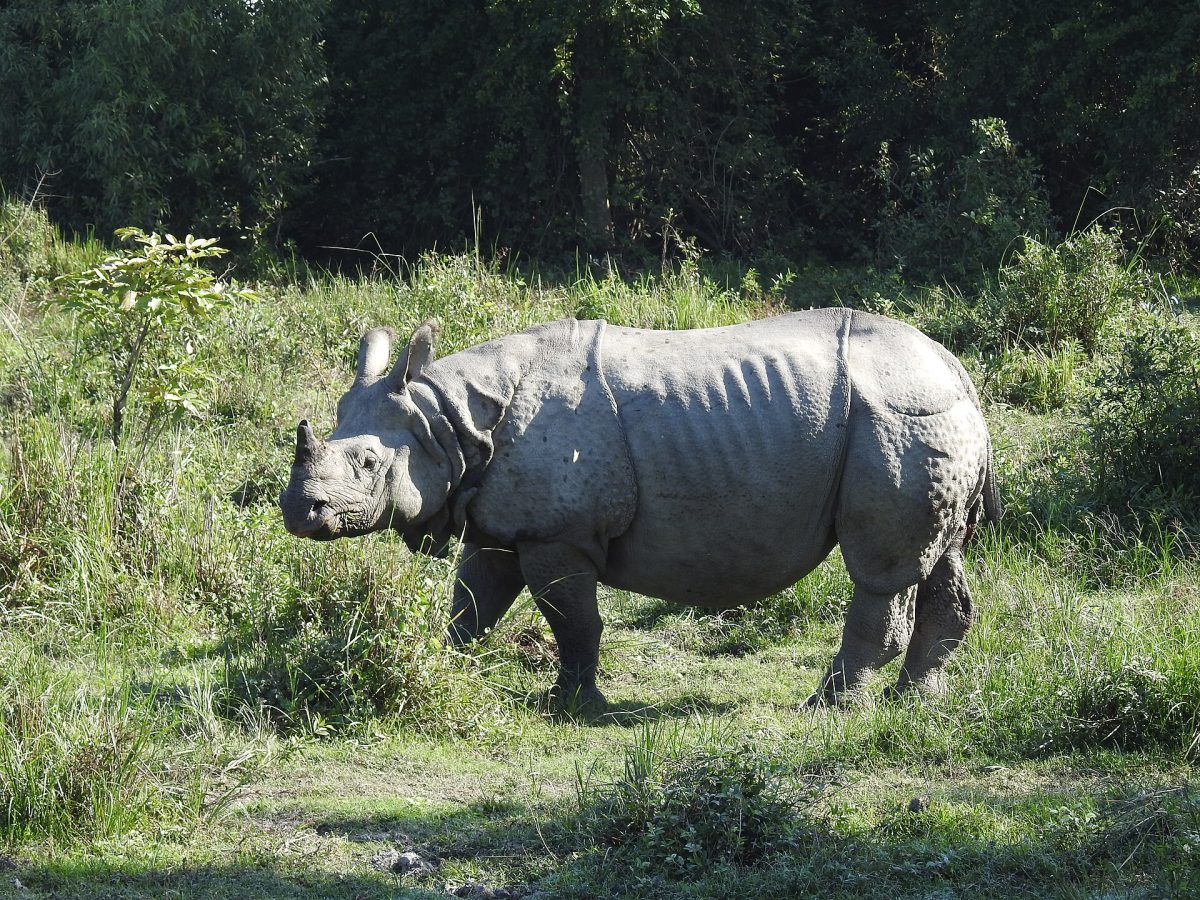
Photo: Dr. Raju Kasambe, CC BY-SA 4.0
Kaziranga lies on the southern bank of the Brahmaputra in the state of Assam, in the north-east of India, and it is the best place in the world to see the great Indian one-horned rhinoceros, which can be counted on, in numbers, on every outing. The usual approach is by air to Guwahati, the chief city of Assam, and then four to five hours by road, 200 kilometres along the highway that runs the length of the park's southern boundary; the smaller airport of Jorhat is two hours to the east. The lodges, hotels and homestays are strung along this highway, most of them round the village of Kohora, where the park's offices are, and package tours of three nights from Guwahati are the common arrangement. The park is divided into ranges, each with its own gate and safari route: the Central range, at Kohora, the most convenient, with a good mixture of grassland, forest and wetlands;
the Western range, at Bagori, twenty minutes west, the most open, with the greatest concentration of rhinos and wild buffalo; the Eastern range, at Agaratoli, forty minutes east, quieter, with large wetlands and the best birdwatching, including a colony of pelicans; and the hilly Burapahar range. Visits are by open jeep, hired with a driver at the gate or through the hotel, with an armed forest guard, for about two hours in the morning, from half past seven, and two in the afternoon. At dawn, elephant-back rides of an hour are offered in the Western and Central ranges, which bring visitors within a few metres of rhinos in the tall grass; they are popular, must be booked the evening before, and are avoided by those who object to the use of captive elephants. Boat safaris on the Brahmaputra to look for river dolphins, walks in the Panbari forest for hoolock gibbons, and visits to tea estates and an orchid park fill the rest of a stay.
Live dates and prices from GetYourGuide. Free cancellation on most tickets.
Kaziranga's history as a protected area begins with a disappointment. In 1904 Mary Curzon, the American-born wife of the viceroy of India, came here to see the famous rhinoceros and saw nothing but tracks, the animal having been hunted down to perhaps a dozen individuals, and she urged her husband to act; in 1905 the area was proposed as a reserve forest, in 1916 it became a game sanctuary, in 1974 a national park, in 1985 a World Heritage Site, and in 2006 a tiger reserve. The core covers 430 square kilometres, and successive additions have more than doubled that. It is a creation of the river. The park is a flat flood plain of the Brahmaputra, a mosaic of grassland, in which elephant grass grows five or six metres tall, of shallow lakes called beels, left by the river's old channels, of swamp, and of patches of tropical forest on the slightly higher ground, and every year during the monsoon the river rises and floods most of it, for weeks, to a depth of metres. The flood is a catastrophe and a necessity: it drowns hundreds of animals, including rhino calves and hog deer, and drives the rest across the highway to the Karbi Anglong hills to the south, where many are killed by traffic, which is why speed limits, sensor cameras and proposals for an elevated road occupy the courts;
but it also renews the grassland and the wetlands, flushes out weeds and restocks the fish, and without it the ecosystem would cease to exist. In this habitat live more than 2,600 rhinoceroses, according to the census of 2022, about two thirds of all that survive; the largest population anywhere of the wild water buffalo, with immense sweeping horns; some twelve hundred wild elephants; the eastern swamp deer; and tigers at one of the highest densities recorded in any protected area, though, in grass of that height, they are seen only rarely. Guides speak of Kaziranga's own big five. Hog deer, sambar, wild boar, gaur, otters, the hoolock gibbon, India's only ape, the capped langur and, in the river, the Gangetic dolphin, blind and long-snouted, are also present, with nearly five hundred species of birds, among them the Bengal florican, the greater adjutant stork, the swamp francolin, fishing eagles and great flocks of bar-headed geese in winter. The rhino's horn, worth more than gold on the black market, made the park for decades a battlefield between armed guards and poaching gangs, and the forest department's readiness to shoot suspected poachers has been sharply criticised by human rights groups; poaching has fallen dramatically, to none at all in 2022, and in 2021 the state publicly burned its stockpile of nearly 2,500 horns.
The park is open from about the beginning of November to the end of April, sometimes with a partial opening in October, and is closed throughout the monsoon, when it is flooded. From November to January the weather is cool and pleasant, the beels are full of migratory waterfowl, and the grass is still tall, so that animals are seen mainly at the water's edge; the mornings can be foggy and cold on an open vehicle.
In January and February the forest department burns the grassland in patches, and from February to April the fresh green shoots on the burnt ground draw rhinos, buffalo and deer into the open in large numbers, which makes this the best time for viewing, though April is hot and thundery. Book elephant rides and the better lodges ahead for the Christmas and New Year period. Bring binoculars, warm clothing for winter mornings, and a dust mask. Allow two nights and three or four safaris. Guwahati, with the Kamakhya temple, is four to five hours away, Majuli island, in the Brahmaputra, three hours east, and the tea country of Jorhat two.
Yes. GetYourGuide lists one ticket or tour for Kaziranga National Park, with live dates and prices and free cancellation on most of them.
The park is open from about the beginning of November to the end of April, sometimes with a partial opening in October, and is closed throughout the monsoon, when it is flooded.
Allow two nights and three or four safaris.
In January and February the forest department burns the grassland in patches, and from February to April the fresh green shoots on the burnt ground draw rhinos, buffalo and deer into the open in large numbers, which makes this the best time for viewing, though April is hot and thundery.
Kaziranga National Park covers 430 km².
Kaziranga National Park was established in 1905.
Kaziranga National Park is in Assam, India. The map on this page shows the exact spot.
Assam, India
Manas lies at the foot of the Himalaya in the west of the Indian state of Assam, along the border of Bhutan, where the…
No online ticket