
Masaya Volcano National Park
Nicaragua
Masaya is one of the very few volcanoes in the world where an ordinary visitor can drive to the edge of an active…
3 tickets & tours
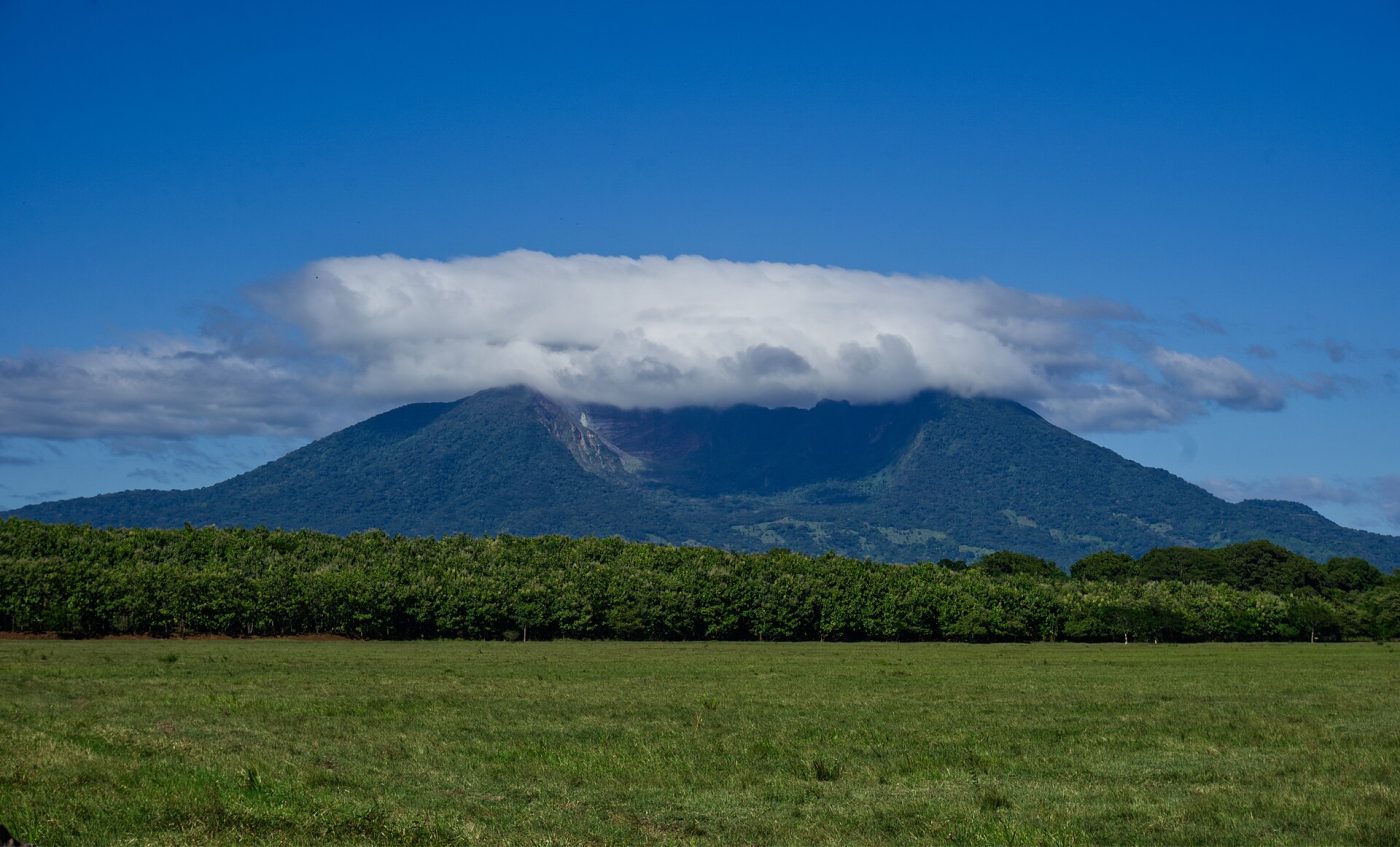
Photo: FurlongWiki, CC BY-SA 4.0
Mombacho is the broad, forested, cloud-capped volcano that stands behind the colonial city of Granada in Nicaragua, its reserve entrance ten kilometres and twenty minutes from the central square, and it is the city's standard half-day excursion. From the entrance at the foot, the reserve's own lorries, fitted with benches, grind up a cobbled track of alarming steepness to the biological station at 1,100 metres, at fixed times in the morning and early afternoon, for a fee that includes entry; private vehicles are allowed only if they are genuine 4x4s, and walking up the road takes two hours. The tours from Granada bundle the transfer, the lorry and a bilingual guide, and often a stop at a coffee estate halfway up, where the lorry pauses anyway. At the top there are three trails.
The Crater trail, a kilometre and a half round one of the forested craters, with a tunnel-like fissure, fumaroles and lookouts over Granada, the lake and the isletas, takes an hour and a half and may be walked without a guide. The Tigrillo is steeper and longer, and the Puma trail, four kilometres and three to four hours of relentless wooden stairs up and down through the dwarf forest to the highest viewpoints, requires one of the reserve's guides. Night walks, to look for the volcano's endemic salamander, red-eyed tree frogs and sleeping birds, can be arranged with a stay in the station's bunkhouse. On the lower slopes, outside the reserve proper, are a zip-line canopy tour, coffee tours and ATV rides. Check your government's travel advice on Nicaragua before going.
Live dates and prices from GetYourGuide. Free cancellation on most tickets.
The reserve was declared in 1983 and has been managed since the 1990s by a Nicaraguan foundation, which built the station and the trails; it protects the upper slopes, above about 850 metres, of a stratovolcano 1,344 metres high with four craters, all of them long since filled with forest. Mombacho's last violent event was in 1570, when part of the southern crater wall collapsed and an avalanche of debris buried an indigenous village of some four hundred people; a much older collapse on the north-east side flung the mountain's flank into Lake Nicaragua and made Las Isletas, the 365 tiny islands off Granada that visitors tour by boat without knowing where they came from. Because the summit stands alone in the trade winds, isolated from other high ground, it is wrapped in cloud for most of the year and carries one of only two cloud forests on Nicaragua's Pacific side, the other being on Maderas on Ometepe island, and, on the wind-beaten crests, an elfin forest of gnarled trees a few metres high;
every branch is loaded with moss, ferns, bromeliads and orchids, of which some 87 species grow here among more than 750 plants. Isolation has also made species: the Mombacho salamander, a small lungless amphibian found nowhere else on earth, and an endemic butterfly. Howler monkeys roar around the station at dawn, white-faced capuchins and two- and three-toed sloths are commonly seen, and the 170 or so birds include the emerald toucanet, trogons, motmots and, in winter, North American warblers. The coffee farms below the reserve, shaded by big forest trees, are among the oldest in the country. On a clear morning the view takes in Granada's red roofs, the whole of the great lake with Ometepe's twin cones, the Apoyo crater lagoon and the smoking Masaya volcano.
The reserve is open from about 8 am to 5 pm, daily in the high season and with reduced days at other times, and the lorries leave the entrance at fixed hours, the first at about 8.30; take the first, because cloud usually closes over the summit by late morning. The dry season, from November to April, gives the best chance of views, with December to February the clearest and windiest;
in the rains, May to October, the trails are muddy and the forest at its most beautiful, dripping and full of frogs. It is ten degrees cooler at the top than in Granada, and damp, so carry a light jacket. Allow a half-day. Granada and the isletas are twenty minutes away, the Masaya volcano with its lava lake forty minutes, the Apoyo lagoon for swimming half an hour, and Ometepe a ferry ride from San Jorge.
Yes. GetYourGuide lists 7 tickets and tours for Mombacho Volcano Nature Reserve, with live dates and prices and free cancellation on most of them.
The reserve is open from about 8 am to 5 pm, daily in the high season and with reduced days at other times, and the lorries leave the entrance at fixed hours, the first at about 8.30; take the first, because cloud usually closes over the summit by late morning.
The Crater trail, a kilometre and a half round one of the forested craters, with a tunnel-like fissure, fumaroles and lookouts over Granada, the lake and the isletas, takes an hour and a half and may be walked without a guide.
Mombacho Volcano Nature Reserve was established in 1983.
Mombacho Volcano Nature Reserve is in Nicaragua. The map on this page shows the exact spot.
Nicaragua
Masaya is one of the very few volcanoes in the world where an ordinary visitor can drive to the edge of an active…
3 tickets & tours