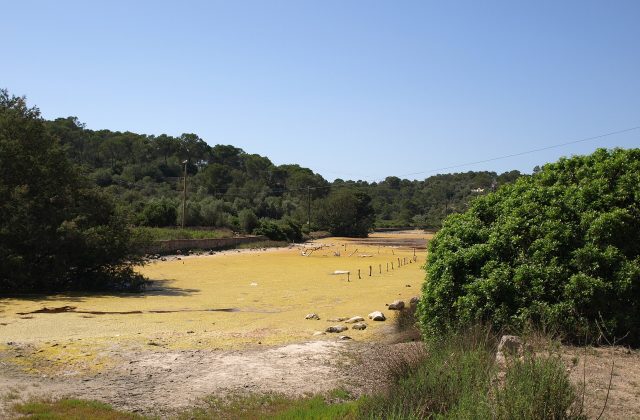
Mondragó Natural Park
Balearic Islands, Spain
Mondragó is a small natural park on the south-eastern coast of Mallorca, in the municipality of Santanyí, about an…
1 ticket or tour
Island Park · Balearic Islands · Spain

Photo: CC BY-SA 3.0
Sa Dragonera is a long, narrow, uninhabited island lying a few hundred metres off the south-western tip of Mallorca, shaped, from certain angles, like a dragon asleep in the sea, though its name probably comes from the lizards that swarm over it, and it is one of the pleasantest half-day outings on the island for anyone who likes walking. It is reached by small passenger boats from the little harbour of Sant Elm, a quiet resort at the end of the road, about forty minutes' drive from Palma beyond Andratx, which cross in fifteen to twenty minutes several times a day from about February or March to October, and in summer also from Port d'Andratx; the ticket is a return, with a choice of times, and entry to the park itself is free.
Boats land at the tiny natural harbour of Cala Lladó, where there is a small information centre and museum, toilets, and nothing else: no café, no shop and no drinking water, so everything must be brought. Four signed paths start there. The shortest leads in twenty minutes to the hamlet ruins and viewpoint of Na Miranda; one runs north-east, about an hour each way, to the Tramuntana lighthouse; another south-west, about an hour and a half each way, to the lighthouse of Llebeig; and the most demanding climbs by a well-graded zigzag track in about an hour and a half to the old lighthouse of Na Pòpia, on the summit. Organised excursions combine the crossing with a guided walk, a swim and sometimes lunch on board; others are coastal hikes on the mainland opposite, from Sant Elm to the ruined monastery of La Trapa, with the island as the view. Swimming is not encouraged at the landing, and the island has no beaches.
Live dates and prices from GetYourGuide. Free cancellation on most tickets.
The island is about 4.2 kilometres long and at most 900 metres wide, some 288 hectares, a detached fragment of the Serra de Tramuntana, the mountain range that runs along the north-west coast of Mallorca and is a World Heritage landscape, separated from it by a channel 800 metres across. Its profile is a tilted wedge: on the south-east side, facing Mallorca, it slopes gently to low cliffs and coves, and on the north-west it drops to the open sea in a wall of vertical limestone precipices more than three hundred metres high, with Na Pòpia, 353 metres, at the top. Its modern history is a celebrated one in Spain. In 1974 the island was bought by a development company, which planned to build a luxury resort with a marina, a casino and villas; in July 1977, in the first years after Franco, a group of young anarchists and ecologists from the group Terra i Llibertat landed and occupied it, the first act of environmental direct action in the Balearics, and set off a campaign, fought through the courts for a decade, that ended in 1987 with the island being bought by the island council of Mallorca for the public, and in 1995 with its declaration as a natural park, together with the islets of Pantaleu and Sa Mitjana.
The island's most conspicuous inhabitant is Lilford's wall lizard, in a dark subspecies found nowhere else, a species extinct on Mallorca itself since the Romans brought cats, weasels and snakes, which survives on the offshore islets; here it numbers in the tens of thousands, is entirely fearless, and will climb onto a walker's boots and into an open rucksack. The cliffs hold the largest colony in the Balearics of Eleonora's falcon, a slender, dark falcon that winters in Madagascar and breeds late, in August and September, to feed its young on the small migrant birds crossing the sea in autumn, along with Balearic and Cory's shearwaters, Audouin's gulls, ospreys, shags and peregrines; rats were eradicated from the island in 2011 to protect them. Watchtowers of the sixteenth century, built against Barbary corsairs, and three lighthouses, of which Na Pòpia's, of 1850, proved too often hidden in cloud and was abandoned, mark the skyline. The vegetation is low garrigue of rosemary, wild olive, lentisk and the Balearic endemics of the cliffs.
Boats generally run from February or March to October, daily in the main season, from about 10 am, with the last return in mid-afternoon, and are cancelled in strong wind or swell; the island is closed to landings in winter except by arrangement. Spring, from March to May, is the best time, with flowers, mild temperatures and clear air; June and September are good;
July and August are very hot, and the summit path, entirely without shade, should be started on the first boat or not at all. The falcons are present from late April to October. Bring at least a litre and a half of water a person, a hat and proper shoes. Allow four to five hours. Sant Elm is the departure point, the ruined Trappist monastery of La Trapa an hour's walk above it, Port d'Andratx fifteen minutes away, and Palma forty.
Yes. GetYourGuide lists 3 tickets and tours for Sa Dragonera Natural Park, with live dates and prices and free cancellation on most of them.
Allow four to five hours.
Spring, from March to May, is the best time, with flowers, mild temperatures and clear air; June and September are good; July and August are very hot, and the summit path, entirely without shade, should be started on the first boat or not at all.
Sa Dragonera Natural Park covers 2.8 km².
Sa Dragonera Natural Park was established in 1995.
Sa Dragonera Natural Park is in Balearic Islands, Spain. The map on this page shows the exact spot.
Balearic Islands, Spain
Mondragó is a small natural park on the south-eastern coast of Mallorca, in the municipality of Santanyí, about an…
1 ticket or tour