Mosi-oa-Tunya National Park
Zambia
Mosi-oa-Tunya is the Zambian park at Victoria Falls, on the Livingstone side of the river, and it has two parts that…
22 tickets & tours
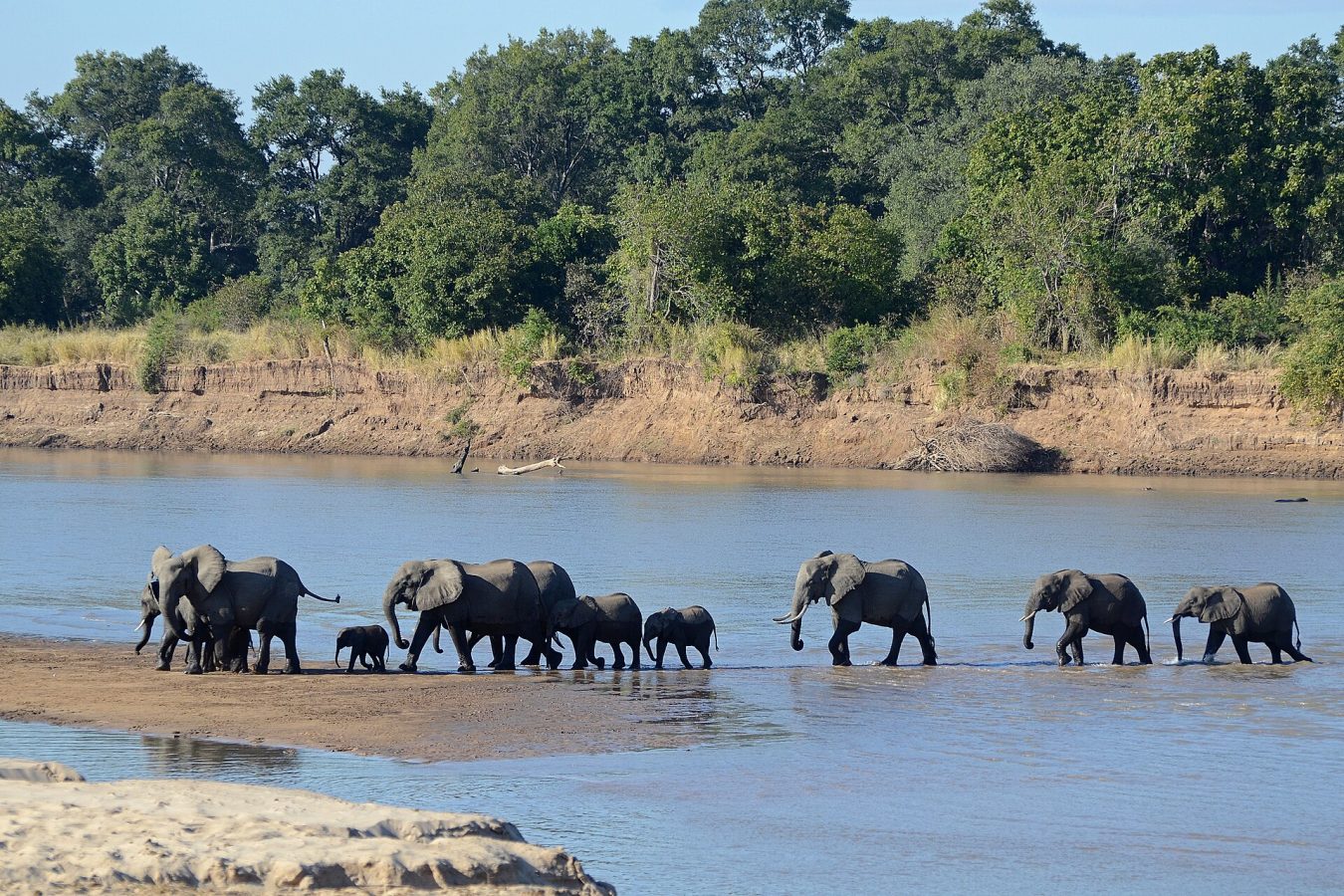
Photo: Geoff Gallice, CC BY 2.0
South Luangwa is the finest wildlife park in Zambia and one of the great parks of Africa, in the valley of the Luangwa river in the east of the country, and it is reached through the small airport of Mfuwe, which has daily scheduled flights from Lusaka, an hour and ten minutes, and seasonal ones from Livingstone and from Lilongwe in Malawi; the main gate, over a bridge across the river, is half an hour from the airstrip. By road it is a long day from Lusaka, some nine to ten hours by way of Chipata, which is how the overland and budget packages travel, breaking the journey on the way. The valley offers safaris at every price. Around the Mfuwe gate, on the riverbank outside the park, are a number of relaxed, inexpensive lodges and campsites, from which day and night game drives go into the busy central sector;
inside the park and along its remoter northern and southern reaches are some of the most admired small bush camps on the continent, reed-and-thatch structures rebuilt each dry season, reached by light aircraft or a long drive, and all-inclusive. The park's conservation fee is charged per person per day and is generally built into package prices. Two things distinguish a Luangwa safari. One is the walking safari, which was invented here: a morning on foot, in single file and in silence, behind an armed scout and a guide, reading tracks and approaching animals, and, for those who wish, multi-day walks between simple camps. The other is the night drive, permitted here with a spotlight, which makes this the best place in Africa for seeing leopards. The Zambian guides, trained and examined to a very high standard, are a reason in themselves.
Live dates and prices from GetYourGuide. Free cancellation on most tickets.
The Luangwa valley was protected as a game reserve from 1938 and declared a national park in 1972, covering 9,050 square kilometres of the floor of a rift valley, a southern extension of the Great Rift, bounded on the west by the Muchinga escarpment and on the east by the river itself, which is one of the last large rivers in Africa never to have been dammed, and which therefore still behaves as a wild river: each rainy season it floods, shifts its sandy bed and cuts off its meanders, leaving behind a chain of oxbow lagoons that hold water through the dry months and draw the animals. The valley floor is a mosaic of mopane and miombo woodland, groves of ebony and mahogany, open grassy plains and thickets. It was here, in 1950, that the game ranger Norman Carr persuaded the paramount chief Nsefu to set aside land as a reserve from which his people would earn the revenue, built a camp of rondavels, and began to take paying visitors into the bush on foot to look at animals and not shoot them, the origin of both the walking safari and the idea of community-based conservation.
The river holds the densest concentration of hippos anywhere, about fifty to the kilometre in the dry season, packed into the shrinking pools, along with very large crocodiles. Leopards are seen on most night drives; lions live in large prides that prey on buffalo, which move in herds of several hundred; wild dogs have increased markedly in recent years and the valley is now their stronghold in Zambia; and elephants, greatly reduced by ivory poaching in the 1970s and 1980s, which also exterminated the valley's black rhinos by 1987, are everywhere. Three animals are found only here or nearly so: Thornicroft's giraffe, a few hundred strong, Crawshay's zebra, with narrow stripes and no shadow stripes, and Cookson's wildebeest. More than 400 species of birds have been recorded; in September and October thousands of southern carmine bee-eaters nest in colonies in the sheer sand banks of the river, and the first rains bring crowned cranes and storks to the lagoons.
The park is open all year, though most bush camps operate only from late May or June to the end of October or mid-November. The dry season is the classic time: June to August is cool and clear, the best months for walking; September and October are hot, up to 40 degrees, dusty and dramatic, with the animals crowded along the river and the bee-eaters nesting.
The rains, from late November to April, which Zambians call the emerald season, flood the valley, close most roads and camps, and offer instead boat safaris along the swollen river from the few lodges that stay open, migrant birds, newborn impala and low prices. Malaria precautions are necessary. Allow four nights at the least. Mfuwe is the gateway, North Luangwa, wilder still and visited only on foot, lies up the valley, and Lake Malawi is a day's journey east.
Yes. GetYourGuide lists 3 tickets and tours for South Luangwa National Park, with live dates and prices and free cancellation on most of them.
The park's conservation fee is charged per person per day and is generally built into package prices.
The park is open all year, though most bush camps operate only from late May or June to the end of October or mid-November.
Allow four nights at the least.
The dry season is the classic time: June to August is cool and clear, the best months for walking; September and October are hot, up to 40 degrees, dusty and dramatic, with the animals crowded along the river and the bee-eaters nesting.
South Luangwa National Park covers 9 050 km².
South Luangwa National Park was established in 1972.
South Luangwa National Park is in Zambia. The map on this page shows the exact spot.
Zambia
Mosi-oa-Tunya is the Zambian park at Victoria Falls, on the Livingstone side of the river, and it has two parts that…
22 tickets & tours
Zambia
Kafue is the oldest and largest national park in Zambia, the size of Wales or New Jersey, in the west of the country,…
4 tickets & tours
Zambia
Lochinvar is a small, flat, remote park on the southern edge of the Kafue Flats, the great floodplain of the Kafue…
3 tickets & tours
Zambia
Lusaka National Park is the small fenced park on the south-eastern edge of Zambia's capital, half an hour from the…
3 tickets & tours
Zambia
Lower Zambezi is the Zambian park on the north bank of the river opposite Zimbabwe's Mana Pools, and it should not…
2 tickets & tours