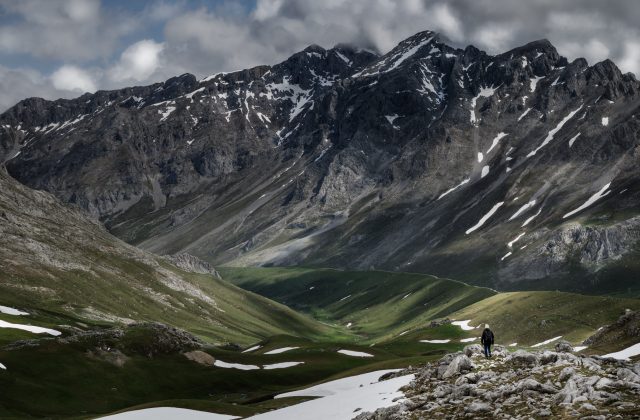
Picos de Europa National Park
176 km away
The Picos de Europa are a compact block of limestone peaks twenty kilometres from the Bay of Biscay, shared by…
8 tickets & tours
Wetland Park · Basque Country · Spain

Photo: Telle, CC BY-SA 3.0
Urdaibai is the estuary of the little river Oka and the green hills and sea cliffs round it, on the coast of the Basque Country, in the north of Spain, about thirty-five to forty kilometres, under an hour by road or by the narrow-gauge Euskotren railway, north-east of Bilbao, whose airport is the nearest. It is a biosphere reserve, not a national park, which means a lived-in landscape of towns, farms, fishing ports and beaches in which nature, farming and tourism are meant to coexist, and it has no gates or fees. Its natural centre is the estuary, a drowned valley twelve kilometres long, which at low tide becomes a wide expanse of golden sand, channels and salt marsh, running from the historic town of Gernika to the sea between the surfing village of Mundaka and the beaches of Laida and Laga. The visitor's programme is varied.
For nature, the first stop is the Urdaibai Bird Center, at Gautegiz Arteaga on the eastern shore, an observatory and research station with a tall glass tower overlooking the marshes, telescopes, an exhibition and guides, from which the spoonbills, ospreys and waders that use the estuary can be watched; boat trips and guided kayak and paddleboard excursions explore the channels from Mundaka, Sukarrieta and Laida. Near by are the painted forest of Oma, reached by a walk of about three kilometres from a car park at Lezika, and, beside it, the cave of Santimamine, where guided visits show the entrance chamber and a virtual reconstruction of the paintings, the painted gallery itself being closed. On the coast, the hermitage of San Pedro de Atxarre, above Laida, gives the classic view over the mouth of the estuary after a climb of half an hour, and the headland of Ogono and Cape Matxitxako are the wild extremities. Gernika, with its assembly house and oak tree, its museum of peace and its Monday market, and the fishing ports of Bermeo, Mundaka and Elantxobe are the towns. Guided day tours from Bilbao combine these sights.
Live prices from GetYourGuide for tours whose route includes this park. Free cancellation on most of them.
Urdaibai was declared a biosphere reserve by UNESCO in 1984, the first in the Basque Country, was given its own protective law by the Basque parliament in 1989, and covers about 220 square kilometres, the whole catchment of the Oka, in which some forty-five thousand people live; its marshes were listed under the Ramsar convention in 1993. The estuary is the largest and best preserved wetland on the Basque coast, a shoreline otherwise steep and heavily industrialised, and its position, at the inner corner of the Bay of Biscay, where the coast of France meets that of Spain, makes it a vital resting place for birds migrating between northern Europe and Africa, which funnel along this coast to avoid crossing the Pyrenees or the open sea. More than three hundred species have been recorded. The Eurasian spoonbill, whose whole Dutch population passes this way each autumn, rests here in flocks, the osprey, which a project based at the bird centre has reintroduced as a breeding bird, using chicks brought from Scotland, fishes in the channels, and grey herons, little egrets, curlews, whimbrels, godwits, plovers, cormorants and wintering ducks and divers feed on the flats. The estuary's habitats change with the salt: sand flats and dunes at the mouth, then salt marsh of cordgrass and glasswort, then reed beds, then the wet meadows, reclaimed in past centuries, which are being allowed to flood again, and on the limestone cliffs on either side grow woods of evergreen holm oak, a Mediterranean tree that survives here, far from its usual range, on the dry, rocky ground, among the best such Cantabrian holm oak woods in existence, while the hills behind are covered with plantations of Monterey pine and eucalyptus and the scattered farmhouses, the caserios, of the Basque countryside.
At Mundaka the river's sandbar, shaped by the outgoing tide, produces a long, hollow, left-breaking wave that is considered the best of its kind in Europe and has been the scene of world championship surfing contests; dredging of the estuary in 2003 destroyed it for two years, to general alarm, until the bar rebuilt itself. The human record is long. The cave of Santimamine, discovered by boys in 1916, contains some fifty charcoal drawings of bison, horses, ibex, a bear and a deer, about fourteen thousand years old, and is one of the group of northern Spanish painted caves inscribed with Altamira as a World Heritage Site. In the pine woods above it the Basque artist Agustin Ibarrola painted, between 1982 and 1985, the trunks of hundreds of trees with bands, eyes and figures that compose into pictures only when seen from particular spots; the original trees having died of disease, the work was repainted on a neighbouring plantation and reopened in 2023. And Gernika, the ancient meeting place of the assemblies of Biscay, under whose oak tree the lords of the province swore to respect Basque liberties, was destroyed on 26 April 1937, a market day, by German and Italian aircraft flying for Franco, the first deliberate destruction of an undefended town from the air, which Picasso made the subject of his most famous painting.
The reserve can be visited all year, the Basque coast having a mild, oceanic climate, with rain possible in any month. The bird migrations are the high points for naturalists: from late August to October, when spoonbills, ospreys and waders pass south, and in March and April on their return, with wintering wildfowl from November to February; the bird centre is open most days, with shorter hours in winter. Summer, from June to September, is warm, 22 to 26 degrees, and the beaches of Laida and Laga are crowded with people from Bilbao at weekends, when the roads and car parks are congested.
The wave at Mundaka works best in autumn and winter, from October to March, on a big north-westerly swell and a falling tide. The appearance of the estuary depends entirely on the tide, the sand flats being exposed at low water and the channels full at high water, which is when the boats and kayaks go out. Visits to the cave of Santimamine must be booked in advance. Allow one to two days. The islet of San Juan de Gaztelugatxe is twenty minutes from Bermeo, and Bilbao under an hour away.
176 km away
The Picos de Europa are a compact block of limestone peaks twenty kilometres from the Bay of Biscay, shared by…
8 tickets & tours
234 km away
Ordesa y Monte Perdido lies in the central Pyrenees, in the province of Huesca in Aragon, in the north of Spain,…
4 tickets & tours
289 km away
Somiedo is a district of deep green valleys and high limestone mountains in the south-west of Asturias, on the northern…
1 ticket or tour
Yes. GetYourGuide sells tickets and guided tours whose route includes Urdaibai Biosphere Reserve; live prices are shown on this page.
The bird migrations are the high points for naturalists: from late August to October, when spoonbills, ospreys and waders pass south, and in March and April on their return, with wintering wildfowl from November to February; the bird centre is open most days, with shorter hours in winter.
Allow one to two days.
Urdaibai Biosphere Reserve covers 220 km².
Urdaibai Biosphere Reserve was established in 1984.
Urdaibai Biosphere Reserve is in Basque Country, Spain. The map on this page shows the exact spot.

