Picos de Europa National Park
Asturias, Spain
The Picos de Europa are a compact block of limestone peaks twenty kilometres from the Bay of Biscay, shared by…
8 tickets & tours
Mountain Park · Asturias · Spain
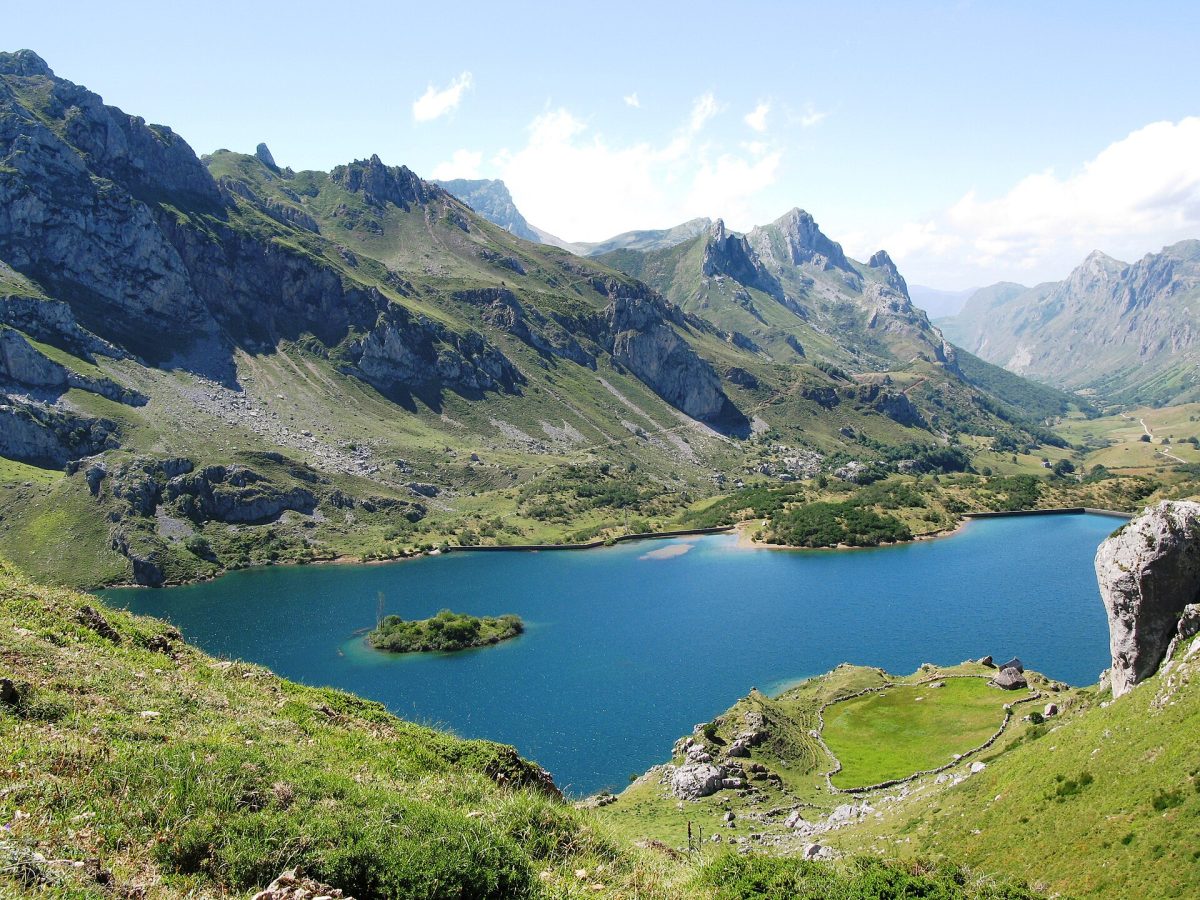
Photo: ALusitana, CC BY-SA 3.0 es
Somiedo is a district of deep green valleys and high limestone mountains in the south-west of Asturias, on the northern side of the Cantabrian range in the north of Spain, and it is the best place in western Europe to see a wild brown bear. Its little capital, Pola de Somiedo, lies eighty-five kilometres, about an hour and a half by a road that ends in a long, narrow, winding gorge, from Oviedo, the regional capital, whose airport has flights from Madrid, Barcelona and abroad; buses from Oviedo are few, and although day tours of the park and its hamlets are offered from the city, the bears, which are seen at dawn and at dusk, require at least one night, and a car. The park is free and has no gates. Five valleys radiate from Pola, those of Somiedo, Saliencia, Valle de Lago, Perlunes and the Pigueña, each a cul-de-sac ending in a hamlet and a trailhead, and an information centre and a small ecomuseum in Pola explain the routes.
Bear watching is done with telescopes from the roadside or from recognised viewpoints, such as those at La Peral, Gua and above Pola, scanning the opposite mountainside, at distances of a kilometre or more; several local companies provide guides with good optics for a morning or evening session, which greatly improves the odds and keeps watchers where they cause no disturbance, and walking off the paths in the core bear areas is forbidden. The classic walks are easy. From the hamlet of Valle de Lago a broad track leads in six kilometres, two hours, to the Lago del Valle, the largest lake in Asturias; from the pass of La Farrapona, at the head of the Saliencia valley, a nearly level path visits three more lakes in an hour or two; and from Villar de Vildas an hour's walk reaches La Pornacal, the finest of the thatched herders' settlements.
Live dates and prices from GetYourGuide. Free cancellation on most tickets.
Somiedo was declared a natural park in 1988, the first in Asturias, and a UNESCO biosphere reserve in 2000, and its 291 square kilometres coincide with the municipality of the same name, which has some eleven hundred inhabitants in nearly forty villages and hamlets. The relief is violent: the rivers have cut from summits of over two thousand metres, the highest being El Cornon, 2,194 metres, down to four hundred metres in a few kilometres, producing long, steep slopes clothed in beech, oak, birch, holly and hazel, above which lie broom and heather scrub, limestone crags and high pastures, with glacial lakes in the hollows. This mosaic of forest, scrub and open ground, rich in acorns, beechnuts, hazelnuts, bilberries, ants and carrion, is ideal bear country, and Somiedo is the heart of the western and much the larger of the two populations of the Cantabrian brown bear, which were reduced by the 1980s to perhaps seventy or eighty animals in all, isolated from every other bear in Europe, and genetically distinct. Strict protection, the pursuit of poachers, compensation to farmers and beekeepers, and a change in local attitudes, to which the income from visitors has contributed, have allowed numbers to rise to some 370 in the whole range, of which about three quarters belong to the western group, and the two populations have begun to exchange individuals.
In spring, from April to June, the bears feed on fresh grass on the open slopes, the females with cubs of the year or yearlings, and the males court; in late August and September they climb into the thickets of alder buckthorn above the trees to gorge on the berries, and these are the two windows in which they are reliably seen. The park also holds wolves, chamois in large numbers, red and roe deer, wild boar, wildcats, otters, the Pyrenean desman, golden eagles, Egyptian vultures, the wallcreeper and, barely, the Cantabrian capercaillie, which is on the verge of extinction. Its human heritage is as distinctive. The vaqueiros de alzada were a caste of transhumant cattle herders, who spent the summer with their cows on the high pastures of Somiedo and the winter near the coast, and who, until the twentieth century, were treated as outcasts by the settled villagers, made to stand behind a beam in church and to be buried apart. Their summer settlements, the branas, consist of clusters of low stone cabins with steep roofs thatched with broom, called teitos, a building type of prehistoric origin, of which several hundred survive here, some still in use; Mumian, La Pornacal and the cabins round the Lago del Valle are the best examples. At La Malva, in the gorge below Pola, a hydroelectric station of 1917, fed by the lakes, still operates.
The park is open all year. For bears, the two seasons are spring, from mid-April to mid-June, with May the best month, and late summer, from about 20 August to the end of September; the first and last two hours of daylight are the time to be at the telescopes, and patience is needed, since there is never a guarantee. For walking and the lakes, June to October is the season: June is green and full of flowers, July and August are warm, 20 to 26 degrees, and busy at the Spanish holidays, when the road to Valle de Lago and La Farrapona may be regulated, and October brings superb autumn colour in the beech woods and the roaring of stags.
Winter is snowy, the high passes close, and the district is very quiet. The weather is Atlantic and changeable, with mist and rain possible in any month, so bring waterproofs and warm clothing. Book rooms and guides ahead for May and September. Allow two to three days. Oviedo, with its pre-Romanesque churches, is an hour and a half away, and the Roman gold mines of Las Medulas two hours south.
Yes. GetYourGuide lists one ticket or tour for Somiedo Natural Park, with live dates and prices and free cancellation on most of them.
The park is open all year.
Allow two to three days.
For bears, the two seasons are spring, from mid-April to mid-June, with May the best month, and late summer, from about 20 August to the end of September; the first and last two hours of daylight are the time to be at the telescopes, and patience is needed, since there is never a guarantee.
Somiedo Natural Park covers 290 km².
Somiedo Natural Park was established in 1988.
Somiedo Natural Park is in Asturias, Spain. The map on this page shows the exact spot.
Asturias, Spain
The Picos de Europa are a compact block of limestone peaks twenty kilometres from the Bay of Biscay, shared by…
8 tickets & tours