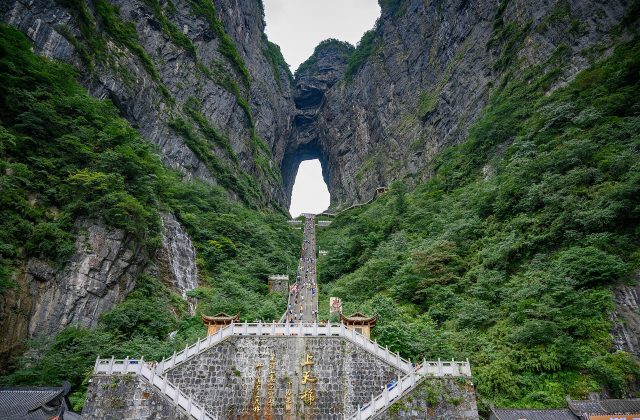
Zhangjiajie National Forest Park
China
Zhangjiajie is the park of sandstone pillars in Hunan that inspired the floating mountains of Avatar, and it is sold in…
29 tickets & tours

Wolong, the crouching dragon, is the oldest and most famous of China's giant panda reserves, a great tract of forested mountains on the eastern edge of the Tibetan plateau in Sichuan province, and it is reached from the provincial capital, Chengdu, in two to two and a half hours, about 130 kilometres by the expressway past Dujiangyan and then up the gorge of the Pitiao river through Yingxiu and Gengda. It should be understood at once that visitors do not see wild pandas, which are so few, so solitary and so well hidden in the bamboo that even researchers rarely meet one; what is visited is the breeding centre. Since 2016 this has been the Shenshuping panda base, near the village of Gengda at the reserve's entrance, a large, modern establishment built into a wooded hillside, with dozens of spacious, naturalistic enclosures connected by paths and stairways, holding some thirty to fifty animals, adults, adolescents and, in the nursery from late summer, the cubs of the year, together with a small exhibition.
It has a ticket office, requires a passport, and takes two to three hours to see; by comparison with the panda base in the suburbs of Chengdu it receives a fraction of the visitors, and the setting, in real panda country with mist on the ridges, is incomparably finer. The older centre at Hetaoping, further up the valley, is now devoted to preparing captive-born pandas for release and is generally closed to the public. Those with more time, which is why tours of two days are usual, go on up the valley to the little town of Wolong and beyond, to walk in the Dengsheng valley's old forest and to drive up the hairpins towards the Balang pass, at 4,480 metres, for the alpine meadows and the view to Mount Siguniang, and they generally combine the trip with the ancient irrigation works of Dujiangyan on the way.
Live dates and prices from GetYourGuide. Free cancellation on most tickets.
The reserve was established in 1963, with two hundred square kilometres, and enlarged in 1975 to about two thousand, in the Qionglai mountains of Wenchuan county, between 1,150 metres and the 6,250 of the summit of Siguniang; it is administered as a special region of its own, with some five thousand residents, mostly Tibetan and Qiang farmers, and since 2006 it has been a central part of the World Heritage Site of the Sichuan giant panda sanctuaries, and is now included in the Giant Panda National Park. About a hundred to a hundred and fifty wild pandas live in it, something like a tenth of all that survive. The steep valleys, soaked by the summer monsoon, carry one of the richest temperate forests on earth, with more than four thousand species of plants: evergreen and deciduous broadleaved forest below, then mixed forest with hemlock, maple and birch, then fir and spruce hung with lichen, with a dense understorey of the arrow and umbrella bamboos on which the pandas feed, then rhododendron thickets, and finally alpine meadow and scree. It was here, between 1980 and 1985, that the first serious field study of the wild panda was carried out, by the American zoologist George Schaller and the Chinese biologist Hu Jinchu, in a joint project of the Chinese government and the World Wildlife Fund, the first that China had allowed with a western conservation body, from a tented camp in the snow;
and here that the research and breeding centre was founded at Hetaoping in 1980. For years it failed, since captive pandas would not mate and their cubs died, until in the 1990s its staff worked out the techniques of artificial insemination, hand-rearing of twins, by swapping the cubs between the mother and an incubator, and enriched husbandry that have since raised the captive population to several hundred. On 12 May 2008 the great Wenchuan earthquake, whose epicentre lay only a few kilometres away, brought the mountainside down on Hetaoping, killing five members of staff and one panda, destroying most of the enclosures and cutting the road for months; the animals were evacuated to Bifengxia, near Ya'an, and the new base was built, with funds given by Hong Kong, on safer ground. The present ambition is to return captive-born animals to the wild. The first, a male called Xiang Xiang, released in 2006, was killed within a year, apparently in a fight with wild males; since then the cubs chosen are raised by their mothers in large forested enclosures, never seeing a human, the keepers who approach them wearing panda costumes smeared with panda urine, and several have been released successfully elsewhere in Sichuan. The reserve also holds the red panda, the golden snub-nosed monkey, the takin, the white-lipped deer, the Chinese monal and other pheasants, and, above the forest, one of the highest densities of snow leopards recorded by camera traps anywhere in China.
The panda base is open daily, from about 8.30 am to 5 pm. Pandas are most active in the morning, when they are fed, from about nine to eleven, and spend the afternoon asleep, so that an early start from Chengdu, or a night in Gengda or Wolong, pays; they are livelier in cool weather, and positively playful in snow, while on hot summer days they retreat to their air-conditioned quarters. The cubs, born in July and August, are shown in the nursery from about September and are at their most endearing through the autumn and winter.
Spring and autumn, from April to early June and from September to November, are the most agreeable seasons, with rhododendrons in May and fine colours in October. July and August are the rainy season, when landslides and mudflows repeatedly close the valley road, sometimes for days, and the situation should be checked before leaving; in winter the road to the Balang pass may be closed by snow and ice. Bring a passport, warm and waterproof clothing, and allow a day, better two. Dujiangyan and Mount Qingcheng are an hour back towards Chengdu.
Yes. GetYourGuide lists one ticket or tour for Wolong National Nature Reserve, with live dates and prices and free cancellation on most of them.
The panda base is open daily, from about 8.30 am to 5 pm.
Wolong National Nature Reserve covers 2 000 km².
Wolong National Nature Reserve was established in 1963.
Wolong National Nature Reserve is in China. The map on this page shows the exact spot.
China
Zhangjiajie is the park of sandstone pillars in Hunan that inspired the floating mountains of Avatar, and it is sold in…
29 tickets & tours
China
Tianmen Mountain rises directly behind the city of Zhangjiajie in Hunan, and it is a separate site, with a separate…
7 tickets & tours
China
Jiuzhaigou is a valley of coloured lakes and waterfalls in the mountains of northern Sichuan, on the edge of the…
4 tickets & tours
China
Xixi is a wetland of ponds, canals and wooded dykes in the western suburbs of Hangzhou, the capital of Zhejiang…
2 tickets & tours