Monte Cristi National Park
339 km away
Monte Cristi lies in the far north-west of the Dominican Republic, close to the Haitian border, a dry, sun-struck…
3 tickets & tours
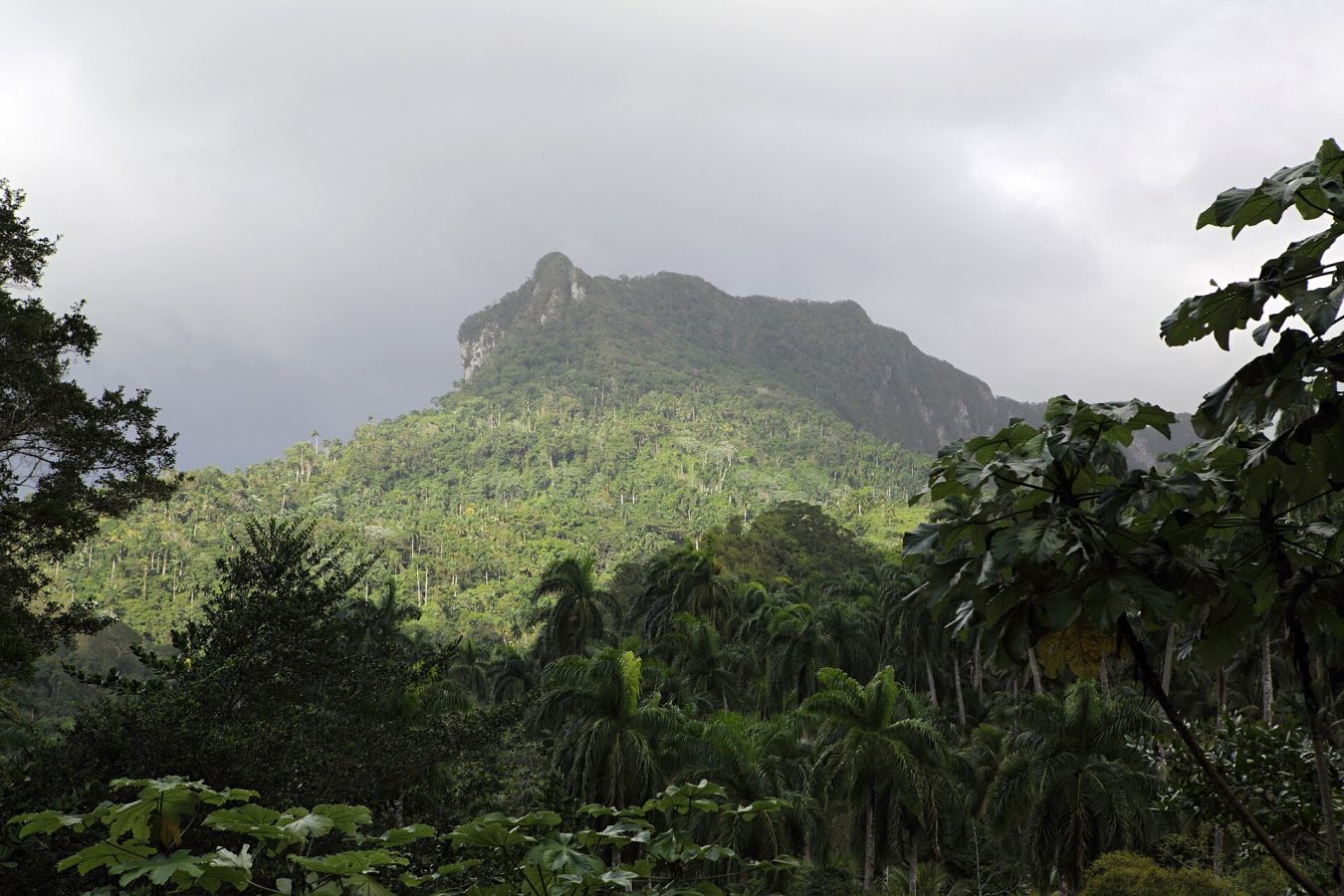
Photo: Martin Cígler, CC BY-SA 3.0
The Alejandro de Humboldt park covers the wettest, wildest and least accessible mountains of Cuba, at the eastern end of the island on the border of the provinces of Holguin and Guantanamo, and it is visited from the small, isolated and highly individual town of Baracoa, the first settlement founded by the Spaniards in Cuba, in 1511. Baracoa itself takes some reaching: about five hours by road from Santiago de Cuba, over the spectacular mountain highway of La Farola, which until the 1960s did not exist, the town having been accessible only by sea, or by the occasional and unreliable flight from Havana. From Baracoa the park's visitor centre, at the Bay of Taco, lies forty kilometres to the north-west along the coast road towards the nickel town of Moa, a road so broken that the journey takes an hour to an hour and a half.
Independent entry is not permitted: all visits are made with an official park guide, on one of a few fixed trails, and the simple way to arrange it is through the state tour agencies in Baracoa, which supply the vehicle, the entrance fee and the guide, or by hiring a taxi and engaging a guide at the centre. The options are, in ascending order of effort, a boat trip of an hour or so round the mangrove-fringed bay, in a rowing boat or a quiet electric launch, in the hope of seeing a manatee; the El Recreo trail, about three kilometres, two hours, of easy walking round the bay and through the forest; and the Balcon de Iberia trail, seven kilometres and four to five hours, which climbs through different types of forest, crosses streams, and ends at a waterfall with a natural pool for a swim. The guides, mostly local men of long experience, are skilled at finding the tiny frogs, the painted snails and the birds. Day tours often stop on the return at the beach of Maguana.
The national park was created in 2001 and inscribed as a World Heritage Site in the same year; it covers about 711 square kilometres, including a small marine sector, and forms the core of the much larger biosphere reserve of the Cuchillas del Toa, rising from sea level and coral reefs to 1,175 metres at the peak of El Toldo. It is named after the Prussian naturalist Alexander von Humboldt, who spent some months in Cuba in 1800, 1801 and 1804 and wrote the first scientific account of the island, for which Cubans call him its second discoverer, though he never came near these mountains. UNESCO's evaluation described the park as one of the most biologically diverse tropical island sites on earth, and the reason is a conjunction of rain and rock. The north-east trade winds, striking the mountains, deposit more than three and a half metres of rain a year, the highest rainfall in Cuba, feeding the Toa, the island's largest river by volume, and dozens of other clear, fast streams; and much of the underlying rock is serpentine and peridotite, slices of the ocean floor thrust up on to the island, which weather to soils poor in nutrients and loaded with nickel, chromium and other metals that are poisonous to most plants.
Over tens of millions of years, for these mountains were never drowned and served as a refuge through every change of climate, the vegetation has adapted to these hostile soils by evolving new species, with the result that of some thirteen hundred seed plants recorded in the park more than nine hundred are found only in Cuba and several hundred only in this district, a degree of local endemism hardly matched anywhere in the world. The forests range from lowland rainforest with trees of forty metres to cloud forest, pine forest of a Cuban species on the serpentine, and a thorny, small-leaved scrub. The animals are equally peculiar. The Cuban solenodon, the almiqui, a nocturnal, shrew-like insectivore the size of a small cat with a long flexible snout and a venomous bite, a relic of the age of the dinosaurs, was believed extinct until it was rediscovered in these mountains in the 1970s and survives only here. In 1996 a frog was found on Monte Iberia that measures about ten millimetres when fully grown and is one of the smallest four-legged animals in the world. The Cuban trogon, the national bird, the Cuban tody, a tiny green and red jewel, the Cuban parrot, the bee hummingbird, smallest of all birds, and the critically endangered Cuban kite live in the park, and it was here that the ivory-billed woodpecker was last reliably seen, in 1987. On the tree trunks crawl the polymitas, land snails whose shells are banded in brilliant yellow, orange, red, black and white, found only in eastern Cuba and threatened by collectors. West Indian manatees feed in the Bay of Taco.
The park can be visited all year, and it rains in every month, so that one should expect to get wet and muddy at any time; the least rainy period runs from about December to April, which is also the coolest, with temperatures in the middle twenties, and is the best for walking. From May to October it is hot, very humid and wetter, with the rivers liable to rise and close the longer trail, and the hurricane season lasts from June to November, with the greatest risk from August to October;
in 2016 a hurricane struck Baracoa directly and did great damage to the town and the forest. Tours leave in the morning. Wear shoes that can be soaked, since the Balcon de Iberia trail fords streams, and bring swimming things, repellent, a waterproof, drinking water and food, as nothing is sold in the park. Supplies of fuel and transport in this part of Cuba are uncertain, so plans should be flexible. Allow a full day from Baracoa. The flat-topped mountain of El Yunque, the Yumuri canyon and the cocoa farms are the other excursions from the town.
339 km away
Monte Cristi lies in the far north-west of the Dominican Republic, close to the Haitian border, a dry, sun-struck…
3 tickets & tours
No online tour for Alejandro de Humboldt National Park is listed on GetYourGuide; entry, where it is charged, is paid at the gate or through the park authority. Nearby parks with bookable tours are listed on this page.
Independent entry is not permitted: all visits are made with an official park guide, on one of a few fixed trails, and the simple way to arrange it is through the state tour agencies in Baracoa, which supply the vehicle, the entrance fee and the guide, or by hiring a taxi and engaging a guide at the centre.
Allow a full day from Baracoa.
Alejandro de Humboldt National Park covers 711 km².
Alejandro de Humboldt National Park was established in 2001.
Alejandro de Humboldt National Park is in Cuba. The map on this page shows the exact spot.
Cuba
Desembarco del Granma, the landing of the Granma, lies at the south-western tip of the old province of Oriente in…
No online ticket