Białowieża National Park
36 km away
Białowieża is the last large remnant of the primeval lowland forest that once covered the European plain, on…
3 tickets & tours

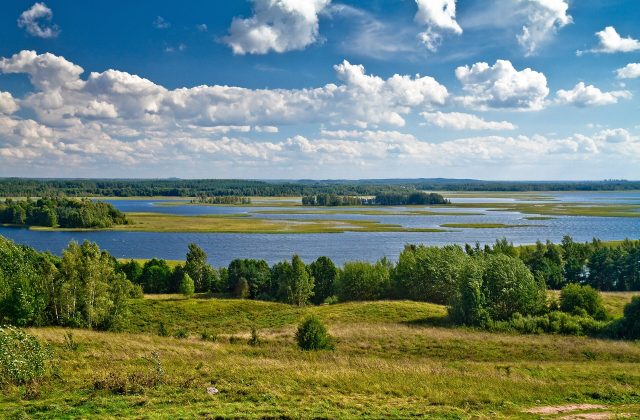
Photo: Mikhail Kapychka, CC BY-SA 4.0
Belovezhskaya Pushcha is the Belarusian and much the larger part of the primeval forest that straddles the frontier of Belarus and Poland, where it is called Bialowieza, the last great remnant of the lowland forest that once covered the European plain, and the home of the European bison. The park's entrance and administration are at the village of Kamenyuki, about sixty kilometres, an hour by road, north of the city of Brest, which is on the main railway line from Warsaw to Minsk and Moscow; buses run from Brest, and excursions are organised from Brest and Minsk. Travellers should check the current advice of their own governments on Belarus, which since 2022 has in many cases been to avoid travel there, as well as the rules on visas, and should know that the crossing between the two halves of the forest has been closed for some years and that the Polish side has been fenced.
At Kamenyuki there are hotels belonging to the park, restaurants, a nature museum with good displays on the forest, and a series of large enclosures among the trees, in which bison, red deer, wild boar, wolves, lynx, bears and other animals of the forest can be seen at close quarters, a sensible first stop, since wild bison are not easily found. Entry to the forest proper is by ticket, and private cars are not admitted: visitors go on the park's bus excursions, of three hours or so, which drive through the old forest to the oldest trees, a lake and the residence of Father Frost, or hire bicycles at the entrance and follow one of several marked circuits, of ten to twenty-seven kilometres, on level tarred forest roads, which is much the pleasantest way. Guided walks and early-morning trips to look for wild bison can be arranged. In the nearby town of Kamenets stands a brick keep of the thirteenth century.
The forest has been protected, in one way or another, for six hundred years, which is why it exists. It was the hunting ground of the grand dukes of Lithuania and the kings of Poland, who from the fifteenth century forbade felling and settlement and maintained a corps of guards, and after the partitions of Poland it became the private hunting reserve of the Russian tsars, who built a palace at Bialowieza and held great battues, one of which, that of Alexander II in 1860, is commemorated by an obelisk. It suffered badly in the twentieth century: German occupiers in the First World War built railways into it and felled millions of cubic metres of timber, and the last wild bison was killed by a poacher in 1919. The species survived only in zoos, and the whole of the present lowland population, more than seven thousand animals, descends from a handful of those captives, the first of which were returned to enclosures in the forest in 1929 and to the wild in 1952; the Belarusian side now holds some six or seven hundred, the largest free-living herd in the world, and the bison is a national emblem. A state reserve was established by the Soviet Union in 1939, when the area was annexed from Poland, and it became a national park in 1991; the Polish part was inscribed as a World Heritage Site in 1979 and the Belarusian added in 1992, and the inscribed area was much enlarged in 2014.
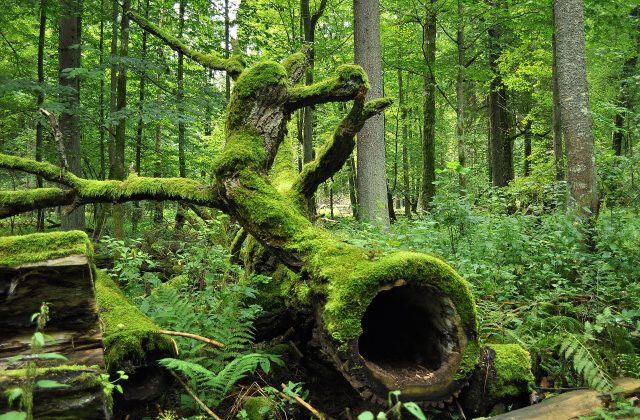
The park covers about 1,500 square kilometres. Its core is a forest that has never been clear-felled or planted, in which trees live out their natural span, fall and decay where they stand: oaks of five and six hundred years, pines of three hundred and fifty, spruces more than fifty metres tall, the tallest in lowland Europe, limes, hornbeams, ashes, alders in the swampy hollows, and an enormous quantity of dead wood, on which depend thousands of species of fungi, beetles and other invertebrates that have vanished from managed forests. Besides the bison there are elk, red and roe deer, wild boar, wolves, lynx, otters, beavers, and more than 250 species of birds, including all ten European woodpeckers, the black stork, the lesser spotted eagle, the pygmy and the great grey owl, the hazel grouse and the capercaillie. The forest has also been damaged, by the draining of surrounding marshes in the Soviet period and by logging, and its management remains controversial. In the middle of it, at Viskuli, stands a government hunting lodge built for Khrushchev, where on 8 December 1991 the leaders of Russia, Ukraine and Belarus, Yeltsin, Kravchuk and Shushkevich, signed the agreement that dissolved the Soviet Union. Since 2003 a fairy-tale estate in a clearing has housed the residence of Ded Moroz, the Father Frost of the eastern Slavs, which receives enormous numbers of families, above all in December and January.
The park is open all year. Late April to June is the best season for naturalists, with spring flowers on the forest floor before the canopy closes, bird song, the drumming of woodpeckers and long days; July and August are warm, 22 to 26 degrees, with mosquitoes, horseflies and ticks, against which repellent and long sleeves are needed; September and October bring the rut of the red deer, mushrooms and fine autumn colour.
Winter, from December to February, is cold and snowy, the season when wild bison are easiest to see, since they gather at feeding stations where hay is put out for them, and when Father Frost's residence is thronged. Dawn and dusk are the hours for wildlife. The museum and enclosures keep fixed hours and close one day a week. Allow a full day, better two. Brest, with its vast fortress memorial, is an hour away, and the castle towns of Ruzhany and Kossovo about two hours.
36 km away
Białowieża is the last large remnant of the primeval lowland forest that once covered the European plain, on…
3 tickets & tours
255 km away
Trakai is a small town on a narrow peninsula among lakes, twenty-eight kilometres west of Vilnius, the capital of…
1 ticket or tour
No online tour for Belovezhskaya Pushcha National Park is listed on GetYourGuide; entry, where it is charged, is paid at the gate or through the park authority. Nearby parks with bookable tours are listed on this page.
The park is open all year.
Allow a full day, better two.
Belovezhskaya Pushcha National Park covers 1 500 km².
Belovezhskaya Pushcha National Park was established in 1991.
Belovezhskaya Pushcha National Park is in Belarus. The map on this page shows the exact spot.
Belarus
The Braslaw Lakes are a district of blue lakes, wooded hills and quiet villages in the far north-western corner of…
No online ticket