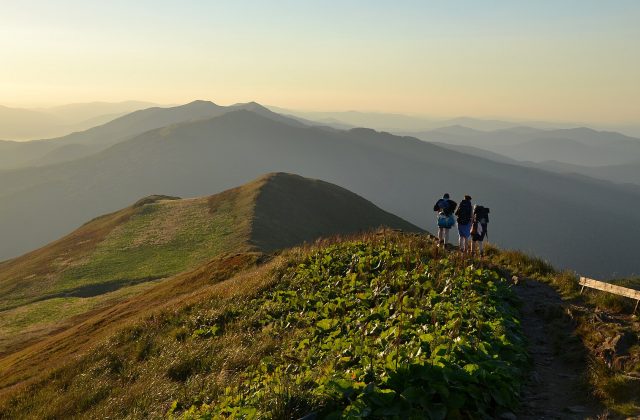
Pieniny National Park
Poland
Pieniny is a very small park in the far south of Poland, on the Slovak border two hours from Kraków and an hour east of…
5 tickets & tours

Photo: Jacek Karczmarz, CC BY-SA 3.0
Białowieża is the last large remnant of the primeval lowland forest that once covered the European plain, on Poland's border with Belarus, three and a half to four hours by road from Warsaw, the last hour from the town of Hajnówka through the forest itself to the village of Białowieża, which has hotels, guesthouses in wooden houses, and the park's headquarters. The essential fact is that the heart of the park, the Strict Reserve, which is the reason for coming, may be entered only on foot, in a group of no more than twelve, with a licensed guide; guides, English-speaking among them, are booked through the national park's tourist office in the Palace Park, the local guiding association or the hotels, for a standard walk of about three hours along some four kilometres of path and boardwalk, or a longer one of six hours, with an entrance ticket to pay besides.
The day tours from Warsaw are very long, fourteen hours or more, and usually combine that walk with the European Bison Show Reserve, a set of spacious enclosures three kilometres from the village, where bison, tarpan-like Polish konik horses, elk, red deer, roe deer, wild boar, wolves and lynx can be seen with certainty. Staying two nights is far better, for the forest at dawn. Wild bison are best looked for at sunrise, in the meadows around the villages of the forest's edge in winter and spring, with a local naturalist guide and a vehicle; birdwatching guides are in great demand in May. Bicycle hire, the narrow-gauge forest railway from Hajnówka, the Royal Oaks trail, the Żebra Żubra boardwalk and the museum in the Palace Park fill the rest.
Live dates and prices from GetYourGuide. Free cancellation on most tickets.
The Białowieża forest as a whole covers about 1,500 square kilometres on both sides of the frontier, two fifths of it in Poland, and was inscribed as a World Heritage Site in 1979, extended across the border in 1992 and again in 2014; the Polish national park, 105 square kilometres, was founded as a forest reserve in 1921 and a national park in 1932, and its strictly protected core, between the Narewka and Hwoźna rivers, has never been logged. The forest survived because for five hundred years it was a royal hunting ground, of the Polish kings and Lithuanian grand dukes and then, from 1795, of the Russian tsars, whose hunting palace in the village burned in 1944 and whose park remains. What the visitor sees in the Strict Reserve is a forest that manages itself: oaks, limes, hornbeams, ashes, elms, Norway spruces and pines of great height, fifty metres and more in the spruces, and great age, oaks of five hundred years with girths of seven metres, standing among the wreckage of their predecessors, for about a quarter of all the wood in the forest is dead, standing or fallen, mossy, fungus-covered and swarming with life.
Some twelve thousand animal species have been recorded, most of them insects and other invertebrates of rotting wood, together with four thousand species of fungi, all nine European woodpeckers, including the white-backed and the three-toed, pygmy and Tengmalm's owls, collared and red-breasted flycatchers, black storks, lesser spotted eagles, wolves, lynx, otters, beavers and elk. The emblem is the European bison, the żubr, the heaviest land animal of the continent. The last wild one in this forest was shot by a poacher in 1919, and the species survived only as fifty-four animals in zoos, descended from twelve founders; bred back from 1929 in Białowieża's enclosures and released from 1952, it now numbers more than seven hundred free-living animals on the Polish side, the largest population in the world. In 2016 and 2017 large-scale logging outside the park, justified as a response to a bark-beetle outbreak, provoked blockades and was halted by the European Court of Justice; since 2021 a steel border fence has cut the forest in two.
The park is open all year, with the Strict Reserve visited in daylight hours by arrangement. Late April to early June is the peak for birds, with woodpeckers drumming, flycatchers and owls, the forest floor covered with anemones and wild garlic, and mosquitoes arriving in June; September and October bring the rut of the red deer, mushrooms and colour;
winter, from December to March, under snow, is the best time for seeing wild bison, which gather at hay-feeding stations in the meadows, and for tracking wolves. Summer is green, warm and buggy, with ticks, for which repellent and long trousers are needed. Check the current situation in the border zone before travelling. Allow two nights. Hajnówka is twenty minutes west, the Orthodox churches and Tatar villages of Podlasie round about, the Biebrza marshes two hours north-west, and Warsaw four hours.
Yes. GetYourGuide lists 3 tickets and tours for Białowieża National Park, with live dates and prices and free cancellation on most of them.
The park is open all year, with the Strict Reserve visited in daylight hours by arrangement.
Białowieża National Park covers 105 km².
Białowieża National Park was established in 1932.
Białowieża National Park is in Poland. The map on this page shows the exact spot.
Poland
Pieniny is a very small park in the far south of Poland, on the Slovak border two hours from Kraków and an hour east of…
5 tickets & tours
Poland
The Slowinski National Park lies on the Baltic coast of northern Poland, in Pomerania, midway between the ports of…
2 tickets & tours
Poland
Wolin is the largest island of Poland, lying in the far north-western corner of the country between the Baltic and the…
1 ticket or tour
Poland
The Biebrza marshes lie in the north-east of Poland, in the region of Podlasie, along a lazy, unregulated river that…
No online ticket
Poland
The Bieszczady are the wildest and emptiest mountains in Poland, in the extreme south-eastern corner of the country,…
No online ticket
Poland
The Karkonosze, called the Giant Mountains in English, the Krkonose in Czech and the Riesengebirge in German, are the…
No online ticket