Sataplia Nature Reserve
63 km away
Sataplia is a small hilltop reserve of forest, caves and dinosaur footprints about ten kilometres, twenty minutes by…
2 tickets & tours
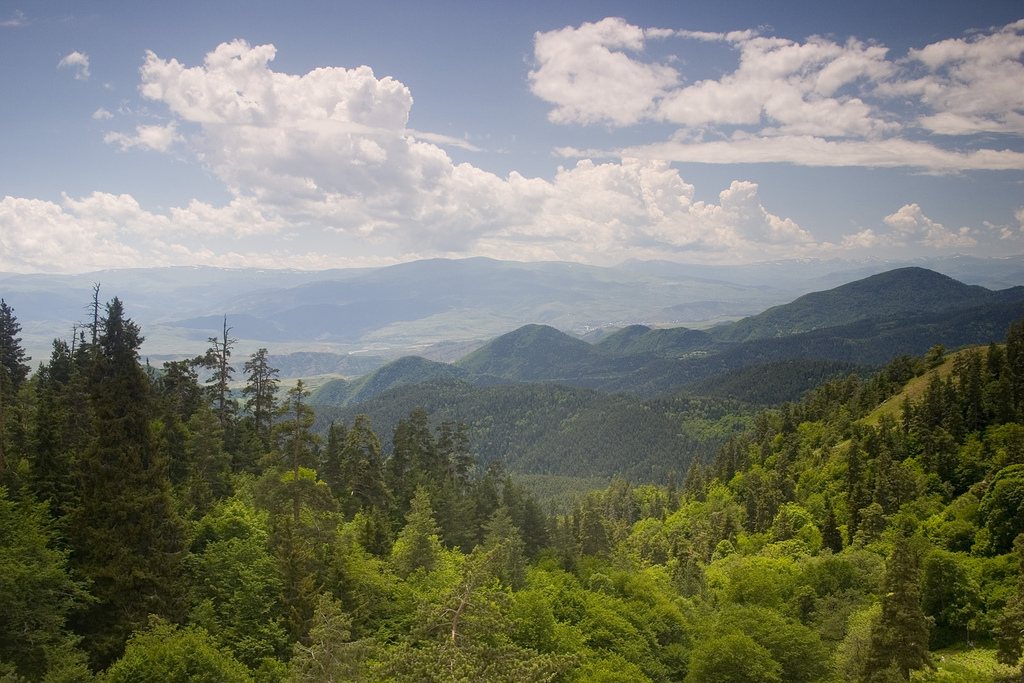
Borjomi-Kharagauli is a large park of forested mountains in the Lesser Caucasus, in the centre of Georgia, and it is the best place in the country for multi-day walking on marked trails with simple huts, a rarity in the Caucasus. Its main gateway is the old spa town of Borjomi, famous throughout the former Soviet Union for its salty mineral water, about 160 kilometres and two hours by road from Tbilisi, from which minibuses run frequently and a slow train takes four hours; the second gateway, Kharagauli, lies on the other, western side of the range, on the main railway line towards Kutaisi. Entry is free, but every visitor must register, which is done without charge at the park's visitor centre at the western edge of Borjomi, where excellent maps are sold, trail conditions explained, and places in the huts and at the campsites booked and paid for.
A dozen trails, numbered and marked with paint, start from several ranger stations, of which those at Likani, just outside Borjomi, Kvabiskhevi and Atskuri, some way down the valley, and Marelisi, on the Kharagauli side, are the most used, and one needs a taxi to reach most of them. For a day, the favourites are the short Footprint trail from Likani, three kilometres through mixed forest, and the panoramic circuit from Kvabiskhevi, fifteen kilometres and six hours, which climbs steeply through beech and fir to open meadows with a wide view. The classic trek, named after a Romanov grand duke, crosses the whole park from Likani to Marelisi in three days, forty-three kilometres, over ridges at more than two thousand metres, and others of two to four days climb to the high summer pastures. The shelters are basic wooden cabins with bunks and no supplies, so that food, a stove and a sleeping bag must be carried. Horses with guides can be hired.
Live prices from GetYourGuide for tours whose route includes this park. Free cancellation on most of them.
The national park was established in 1995 and formally opened in 2001, with the support of the German government and the World Wide Fund for Nature, as the first national park in the Caucasus to meet international standards; with the adjoining Borjomi reserve and other protected areas it covers more than 85,000 hectares, over one per cent of the territory of Georgia, which makes it one of the largest in Europe. Its history as a protected area is much older. In the 1860s and 1870s the Borjomi gorge became the summer residence of the Russian viceroy of the Caucasus, the grand duke Mikhail Nikolayevich, brother of the tsar, who acquired the surrounding forests as his private estate, enclosed them, forbade felling and hunting by anyone but himself, and employed keepers; his son built the Moorish-style palace of Likani, at the park's edge, in the 1890s, which later served Stalin and the presidents of Georgia. The mineral springs, known since antiquity and rediscovered by Russian soldiers in the 1820s, were developed by the same family, and the water, bottled from 1890, became one of the best-known brands of the Russian empire and the Soviet Union; it can still be drunk, warm, salty and slightly sulphurous, from a pavilion in the town's park, beyond which a path of three kilometres leads to open-air pools of tepid spring water.
The park covers the eastern part of the Meskheti range, from 400 metres in the valleys to 2,642 at the summit of Sametskhvario, and lies across the divide between the humid west of Georgia, open to the Black Sea, and the drier east, so that its forests are of two kinds: on the western slopes the Colchic forest, with chestnut, beech, hornbeam and an evergreen undergrowth of cherry laurel, holly and rhododendron, a relic of the Tertiary; on the eastern, forests of oriental beech, oriental spruce, Caucasian fir and pine, some of them never felled; and above about 1,800 metres subalpine meadows of tall herbs, used as summer pastures. Brown bears, wolves, lynx, red deer, which were hunted out and have been reintroduced, roe deer, chamois, wild boar, and among the birds the golden eagle, the griffon and black vultures, the Caucasian black grouse, a bird confined to these mountains, and the black woodpecker inhabit it, together with the Caucasian salamander, which lives only in the streams of this region and neighbouring Turkey. On the summit of Lomis Mta stands a small medieval church of St George, the goal of a pilgrimage each summer. In August 2008, during the war with Russia, incendiary bombs dropped near Borjomi started fires that burned several hundred hectares of the forest, and another large fire followed in 2017.
The park is open all year, but the hiking season runs from about May to October, the higher trails being free of snow from late May or June. June and July bring the alpine meadows into flower, the rhododendrons blooming in May and June; July and August are warm, 22 to 28 degrees in the valley, with afternoon thunderstorms in the mountains; September and October are the most settled and beautiful months, with the beech and chestnut forests in colour.
From November to April the mountains are under snow, and a marked snowshoe trail and some of the lower paths are usable, with equipment hired in Borjomi. The trails are steep, climbs of a thousand metres in a day being normal, and water sources are scarce on the ridges, so carry enough. Mobile coverage is patchy, and the rangers expect walkers to sign out. Allow one to four days. Borjomi's park and springs are at the gate, the ski resort of Bakuriani an hour up a narrow-gauge railway, the cave city of Vardzia two hours south, and Kutaisi two hours west.
63 km away
Sataplia is a small hilltop reserve of forest, caves and dinosaur footprints about ten kilometres, twenty minutes by…
2 tickets & tours
107 km away
Mtirala is the rainforest mountain behind the Black Sea resort of Batumi in Georgia's Adjara region, only about…
6 tickets & tours
130 km away
Kazbegi is the name that travellers still give to the mountain district around the town of Stepantsminda, at the top of…
5 tickets & tours
Yes. GetYourGuide sells tickets and guided tours whose route includes Borjomi-Kharagauli National Park; live prices are shown on this page.
Entry is free, but every visitor must register, which is done without charge at the park's visitor centre at the western edge of Borjomi, where excellent maps are sold, trail conditions explained, and places in the huts and at the campsites booked and paid for.
The park is open all year, but the hiking season runs from about May to October, the higher trails being free of snow from late May or June.
Allow one to four days.
Borjomi-Kharagauli National Park covers 850 km².
Borjomi-Kharagauli National Park was established in 1995.
Borjomi-Kharagauli National Park is in Georgia. The map on this page shows the exact spot.
Georgia
Mtirala is the rainforest mountain behind the Black Sea resort of Batumi in Georgia's Adjara region, only about…
6 tickets & tours
Georgia
Kazbegi is the name that travellers still give to the mountain district around the town of Stepantsminda, at the top of…
5 tickets & tours
Georgia
Sataplia is a small hilltop reserve of forest, caves and dinosaur footprints about ten kilometres, twenty minutes by…
2 tickets & tours
Georgia
Tbilisi National Park is the forested range of hills north of the Georgian capital between Mtskheta and the Tianeti…
2 tickets & tours