Zion National Park
Utah, United States
Zion is the most visited of Utah's parks and the closest to Las Vegas, about two and a half hours away, and the…
45 tickets & tours
Canyon Park · Utah · United States
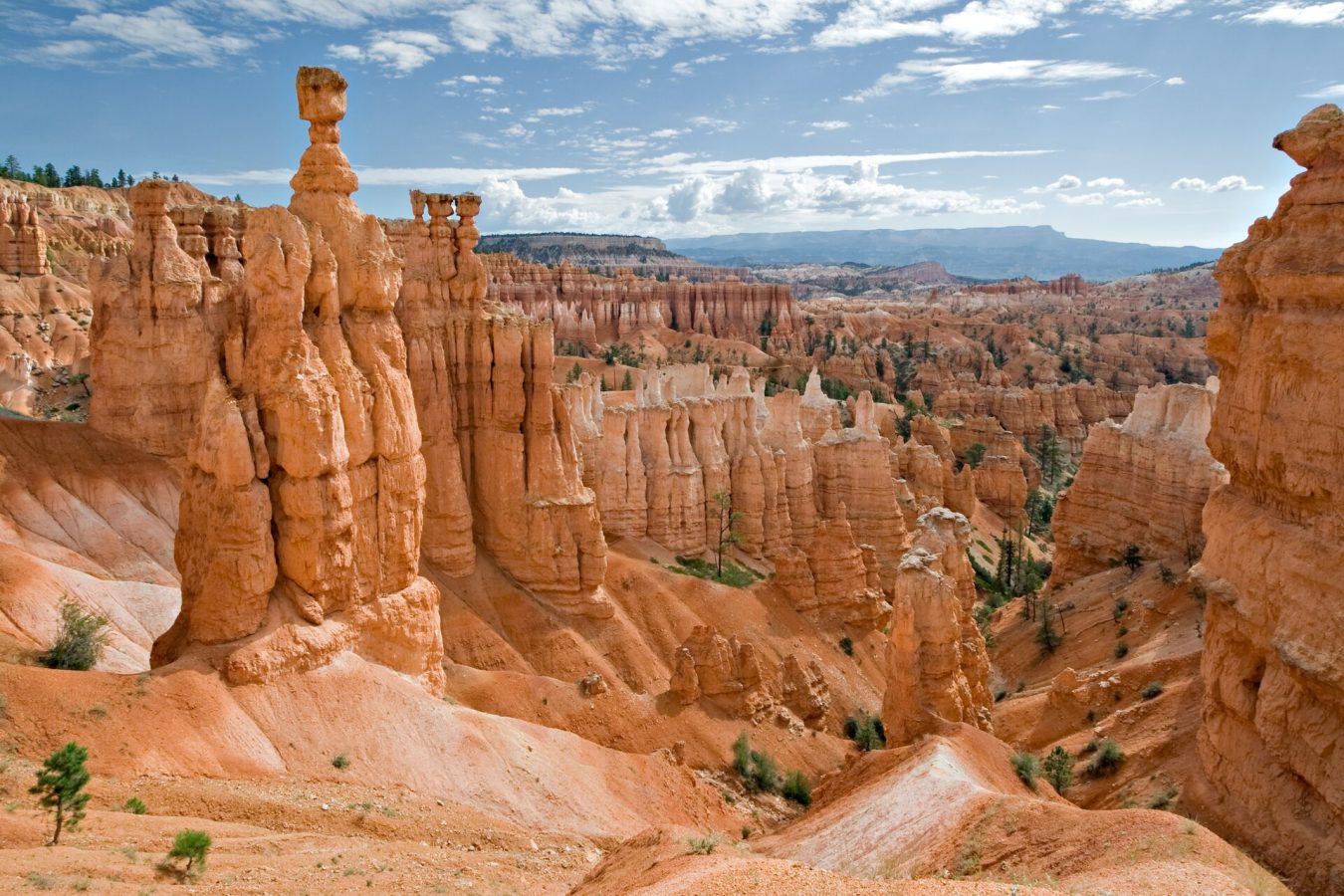
Photo: Luca Galuzzi (Lucag), CC BY-SA 2.5
Bryce Canyon, in southern Utah, is a small park with one overwhelming sight, a series of natural amphitheatres filled with thousands of slender spires of pink, orange and white rock, and it is one of the essential stops on the circuit of the national parks of the American south-west. It lies about four hours by road from both Las Vegas and Salt Lake City, an hour and a half from Zion National Park and two and a half from the north rim of the Grand Canyon, and a car is needed to reach it, though not necessarily to get about in it, since from April to October a free shuttle bus runs from the hotels of Bryce Canyon City, just outside the gate, to the visitor centre, the lodge and the main viewpoints. The entrance fee, per vehicle, is valid for seven days. The park is arranged along the rim of a plateau, and everything is seen from above or by walking down.
The four great viewpoints, Sunrise, Sunset, Inspiration and Bryce Points, overlook the principal amphitheatre and lie within a few kilometres of one another, joined by the Rim trail, which is paved and level between the first two. The walk that everyone should make, if knees and lungs permit, combines the Queen's Garden trail, down from Sunrise Point, with the Navajo Loop, up to Sunset Point, a circuit of about 4.6 kilometres and two to three hours, with a descent and climb of some 180 metres, which passes among the pinnacles, through rock tunnels, and up a series of tight switchbacks in a narrow cleft called Wall Street, where tall Douglas firs grow towards the light. The Peekaboo Loop and the Fairyland Loop are longer and quieter. A scenic drive of twenty-nine kilometres runs south along the plateau past a dozen further overlooks, among them Farview Point and the Natural Bridge, to Rainbow and Yovimpa Points. Horse and mule rides descend into the amphitheatre in summer, and the historic lodge of 1925 and two campgrounds lie within the park.
Live dates and prices from GetYourGuide. Free cancellation on most tickets.
Bryce Canyon was proclaimed a national monument in 1923 and became a national park in 1928, and it covers about 145 square kilometres. It is not a canyon at all, since no river made it: it is the eastern edge of the Paunsaugunt plateau, which is being eaten back by erosion, at a rate of up to a metre in a century, into a row of horseshoe-shaped bowls some thirty kilometres long. The rock is the Claron formation, limestones, mudstones and siltstones laid down about fifty million years ago in a system of lakes and streams, soft, unevenly cemented, and coloured by iron oxides in every shade from cream through salmon pink to deep rust, with purples from manganese. The plateau rim stands at 2,400 to 2,778 metres, high enough for the temperature to cross the freezing point on some two hundred nights of the year, and it is this that carves the spires: water from melting snow seeps into the vertical cracks of the rock by day and freezes at night, expanding and prising the rock apart, first into narrow walls, or fins, then into windows in the fins, and at last into isolated pillars, which a cap of harder stone protects for a time from the rain. These pillars are called hoodoos, a word connected with magic, and Bryce has more of them than any other place on earth.
The Southern Paiute, who hunted and gathered on the plateau, explained them as the Legend People, beings of an earlier creation, in the forms of birds, animals and lizards but looking like people, who behaved so badly that the trickster Coyote turned them to stone, where they stand in rows, some holding on to others, their faces painted red as they were in life. The name commemorates Ebenezer Bryce, a Scottish-born Mormon carpenter, who in 1875 settled with his family in the valley below, built a road into the amphitheatre to fetch timber, so that his neighbours called it Bryce's canyon, and is remembered for the remark that it was a hell of a place to lose a cow; he moved on to Arizona after five years. The Union Pacific railroad developed the park for tourists in the 1920s, building the lodge to the designs of Gilbert Stanley Underwood. The forests change with height, from pinyon and juniper among the hoodoos through ponderosa pine on the rim to spruce, fir and aspen at the southern end, where, on the exposed point of Yovimpa, stand bristlecone pines up to sixteen hundred years old. Mule deer, pronghorn, the Utah prairie dog, a threatened species found only in this part of the state, which was reintroduced here, golden-mantled ground squirrels, Steller's jays, ravens, peregrine falcons and the occasional California condor are to be seen. The air is among the cleanest in the country and the night sky among the darkest, some 7,500 stars being visible to the naked eye, and rangers hold astronomy evenings and walks by the light of the full moon.
The park is open all year. From May to September the days are warm, 20 to 28 degrees, much cooler than in the desert parks near by, and the nights cold, and this is the busy season, with car parks at the main viewpoints full from mid-morning, which the shuttle avoids; July and August bring afternoon thunderstorms with dangerous lightning on the exposed rim. April, May, September and October are ideal for walking. From November to March the park is under snow, which against the orange rock and blue sky is perhaps its most beautiful aspect;
the main road is ploughed, some side roads close, the trails below the rim are icy and need traction devices on the boots, and rangers lead snowshoe walks. Sunrise, when the low light sets the east-facing amphitheatre glowing, is the great moment of the day, and sunset is less dramatic. The altitude makes the climb back to the rim slow work, so take it gently and carry water. Allow one to two days. Red Canyon is twenty minutes west, Kodachrome Basin half an hour east, and Zion an hour and a half.
Yes. GetYourGuide lists 19 tickets and tours for Bryce Canyon National Park, with live dates and prices and free cancellation on most of them.
The entrance fee, per vehicle, is valid for seven days.
The park is open all year.
Allow one to two days.
Bryce Canyon National Park covers 145 km².
Bryce Canyon National Park was established in 1928.
Bryce Canyon National Park receives about 2.5 million a year (2024).
Bryce Canyon National Park is in Utah, United States. The map on this page shows the exact spot.
Utah, United States
Zion is the most visited of Utah's parks and the closest to Las Vegas, about two and a half hours away, and the…
45 tickets & tours
Utah, United States
Arches is the park of red sandstone arches beside Moab in eastern Utah, and its entrance has been the most managed in…
13 tickets & tours
Utah, United States
Canyonlands is the larger, emptier neighbour of Arches, outside Moab in south-eastern Utah, and the first thing to know…
8 tickets & tours
Utah, United States
Capitol Reef is the least visited and, many regular visitors think, the most rewarding of Utah's five national…
2 tickets & tours