Desert Park · New Mexico · United States
Carlsbad Caverns National Park
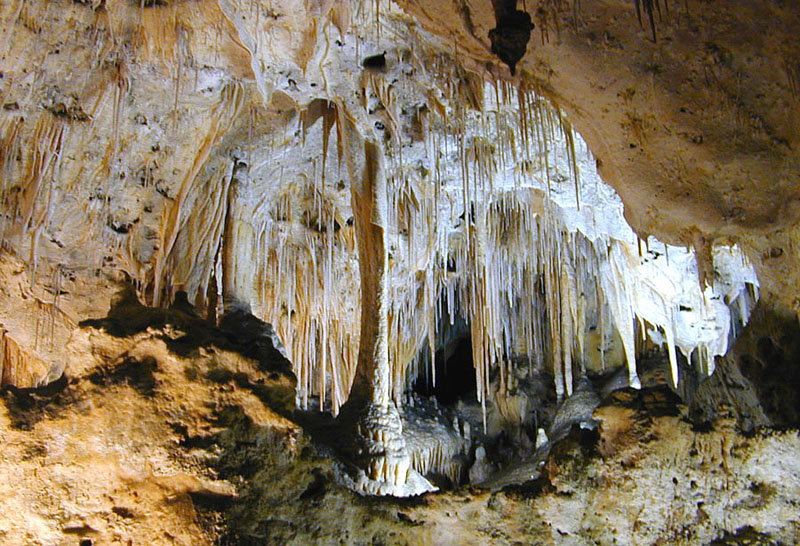
Photo: Eric Guinther, User:Marshman, CC BY-SA 3.0
- Type
- Desert Park
- Where
- New Mexico, United States
- Area
- 189 km²
- Founded
- 1930
- Visitors
- 410 778 a year (2025)
- UNESCO
- World Heritage Site
- Tickets
- No online ticket listed
- Website
- nps.gov/cave
Carlsbad Caverns National Park tickets and tours: which one to book
Carlsbad Caverns lie beneath the Guadalupe mountains in the desert of south-eastern New Mexico, close to the Texas line, and they are among the largest and most richly decorated show caves in the world, remarkable also in that the greater part can be seen at one's own pace, without a guide. The park is remote: the entrance road leaves the highway at the hamlet of Whites City, twenty miles, half an hour, south-west of the town of Carlsbad, and the nearest large airport is El Paso, two and a half hours' drive to the west; a car is essential. Two payments are required: an entrance fee per person, and, in addition, a reservation for a timed entry to the cavern, made in advance through the national reservation website for a nominal charge, without which one may not go underground, and in summer and at holidays the times fill. From the visitor centre, on the ridge, there are two ways down.
The Natural Entrance trail, a paved, steep, switchbacking path of a mile and a quarter, enters through the great yawning mouth used by the bats and descends some 750 feet, the height of a seventy-five-storey building, in about an hour, through the Bat Cave, the Devil's Spring and the Boneyard, a walk of great drama that is hard on the knees; the alternative is a lift, which drops the same distance in a minute. Both arrive at the Big Room trail, a nearly level paved circuit of a mile and a quarter, part of it suitable for wheelchairs, which takes about an hour and a half and passes the most celebrated formations, under subdued electric lighting. Everyone returns to the surface by the lift. Ranger-guided tours, separately ticketed and limited in number, visit the King's Palace, the most ornate chambers, and, for the more adventurous, several undeveloped caves by lantern or headlamp. In the evening, from spring to autumn, the bat flight is watched from an amphitheatre at the cave mouth.
Tours and activities in the United States
Visiting Carlsbad Caverns National Park: what you will see
The cave was proclaimed a national monument in 1923 and made a national park on 14 May 1930, covering about 190 square kilometres, and it was inscribed as a World Heritage Site in 1995; more than 120 caves are known within its boundaries. The mountains in which they lie are the exposed portion of the Capitan reef, a horseshoe-shaped barrier some 650 kilometres long built by sponges, algae and other organisms along the edge of an inland sea about 265 million years ago, in the Permian period, and later buried, uplifted and tilted; it is one of the best preserved fossil reefs on earth. The caves were formed in an unusual way. Most limestone caves are dissolved by weak carbonic acid in rainwater seeping down from above; here, between about four and six million years ago, hydrogen sulphide gas, rising from the great oil and gas fields of the Permian basin beneath, met oxygenated groundwater at the water table and produced sulphuric acid, a far more aggressive solvent, which ate out enormous chambers from below and left behind, as the by-product of the reaction, massive blocks of gypsum that still lie on the floors. When the water table fell and the caves drained, the slow dripping of mineral-laden water began to decorate them. The Big Room is the largest readily accessible cave chamber in North America, some 1,200 metres long, up to 190 wide and 78 high, with a floor area of more than three hectares, and it contains stalagmites such as the Giant Dome, nearly nineteen metres tall, the Twin Domes and the Rock of Ages, forests of stalactites, draperies, a so-called bottomless pit some forty-three metres deep, pools lined with cave pearls, and delicate formations of aragonite and popcorn.
In 1986 cavers digging through rubble at the bottom of a minor cave in the park, Lechuguilla, broke into a system that has since been explored for more than 240 kilometres, to a depth of 489 metres, the deepest limestone cave in the United States, filled with crystals and formations of a beauty and rarity unknown elsewhere and with microbes that live on rock; it is closed to all but scientific expeditions. The cavern was made known by Jim White, a young cowhand, who about 1898 rode over to investigate what he took for smoke rising from the hills, found it to be bats, and spent years exploring with a home-made ladder and a kerosene lamp, naming most of the features; its first visitors were lowered in the bucket used by miners who, between 1903 and 1923, removed a hundred thousand tons of bat guano for the citrus groves of California. From about late April to October several hundred thousand Brazilian free-tailed bats, which migrate from Mexico to raise their young, roost in a chamber near the entrance, and at dusk they pour out in a dense, spiralling column that may continue for half an hour or more, to feed on moths over the valleys of the Pecos and Black rivers. Above ground the park is Chihuahuan desert, with agaves, sotol, ocotillo, prickly pear and yucca, mule deer, ringtails, javelinas and cave swallows.
Carlsbad Caverns National Park: best time to go, seasons and hours
The park is open all year except on a few holidays, with cave entry from about 8.30 am and the last entry in the early afternoon, earlier for the natural entrance than for the lift. The cave remains at 13 degrees Celsius, damp and still, whatever the weather outside, so that it is a relief from the summer heat of the desert, 35 to 40 degrees, and a pleasant refuge in winter; a light jacket and shoes with a good grip are needed, the paths being wet and steep in places.
The bat flight programme runs from about Memorial Day weekend at the end of May to October, with the largest flights in August and September, when the young are flying, and no photography, telephones or electronic devices of any kind are allowed at it. Summer weekends and holidays are the busiest, and entry times should be reserved several days ahead. The lifts are occasionally out of service, in which case all visitors must walk in and out, so check beforehand. Allow half a day. Guadalupe Mountains National Park is forty minutes to the south-west, and the town of Carlsbad half an hour north.
Before you go
Do I need to book Carlsbad Caverns National Park in advance?
No online tour for Carlsbad Caverns National Park is listed on GetYourGuide; entry, where it is charged, is paid at the gate or through the park authority. Nearby parks with bookable tours are listed on this page.
How much is the entrance fee for Carlsbad Caverns National Park?
Two payments are required: an entrance fee per person, and, in addition, a reservation for a timed entry to the cavern, made in advance through the national reservation website for a nominal charge, without which one may not go underground, and in summer and at holidays the times fill.
When is Carlsbad Caverns National Park open?
The park is open all year except on a few holidays, with cave entry from about 8.30 am and the last entry in the early afternoon, earlier for the natural entrance than for the lift.
Do you need a guide to visit Carlsbad Caverns National Park?
Carlsbad Caverns lie beneath the Guadalupe mountains in the desert of south-eastern New Mexico, close to the Texas line, and they are among the largest and most richly decorated show caves in the world, remarkable also in that the greater part can be seen at one's own pace, without a guide.
How big is Carlsbad Caverns National Park?
Carlsbad Caverns National Park covers 189 km².
When was Carlsbad Caverns National Park founded?
Carlsbad Caverns National Park was established in 1930.
How many people visit Carlsbad Caverns National Park?
Carlsbad Caverns National Park receives about 410 778 a year (2025).
Where is Carlsbad Caverns National Park?
Carlsbad Caverns National Park is in New Mexico, United States. The map on this page shows the exact spot.