
Chagres National Park
Panama
Chagres is a very large rainforest park that begins only about forty kilometres north-east of Panama City, an hour or…
2 tickets & tours
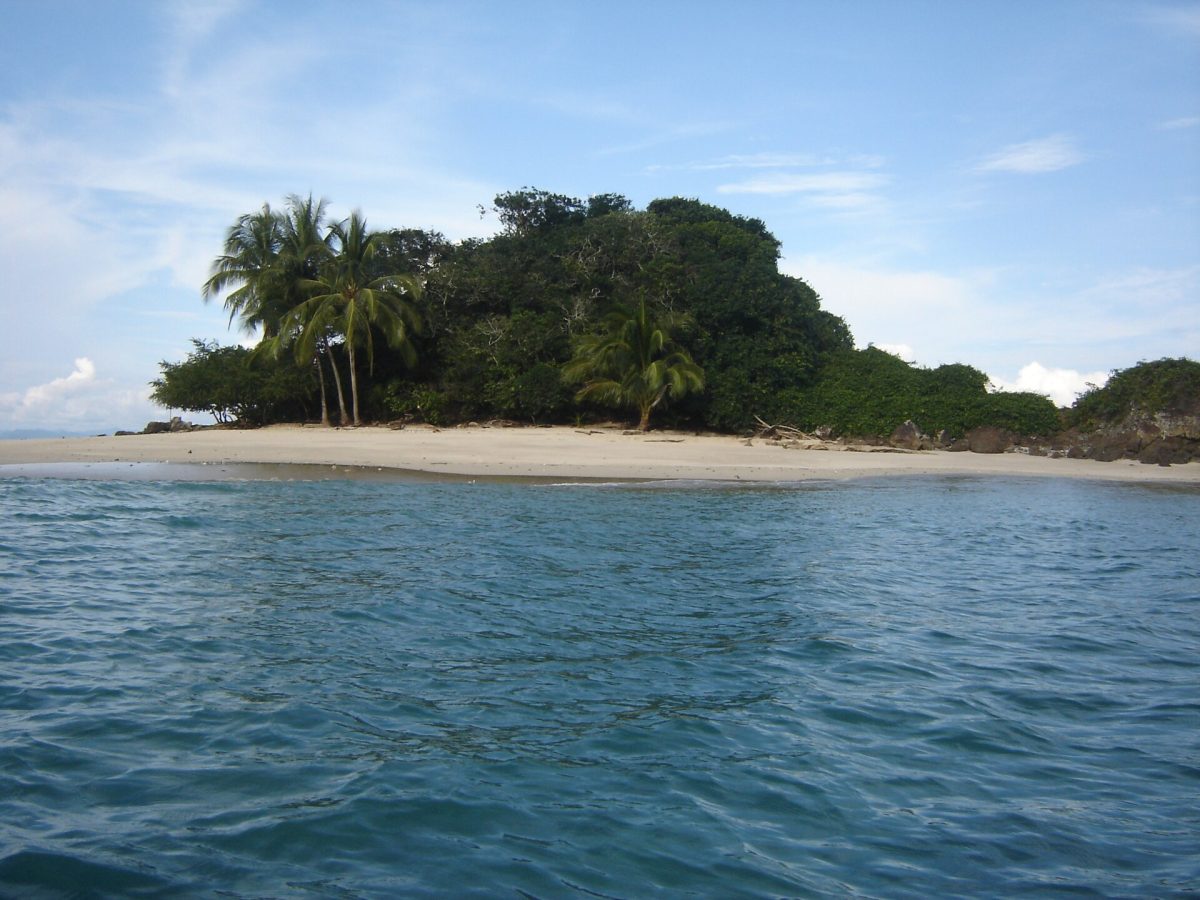
Photo: Seibert, CC BY-SA 4.0
Coiba is a remote archipelago in the Pacific, off the coast of the Panamanian province of Veraguas, and it is one of the finest places in the eastern Pacific for diving and snorkelling with large marine animals, often compared to the Galapagos and Cocos island, with which it shares an underwater mountain chain, but far cheaper and easier to reach. The gateway is Santa Catalina, a small surfing village at the end of a road, five and a half to six hours from Panama City by car or by a succession of buses through Santiago and Sona, where all the operators have their offices. From its beach, open boats with outboard motors take an hour to an hour and a half to reach the park, across water that can be rough, and trips should be booked a day or more ahead.
The day tours for snorkellers follow much the same pattern: two or three stops among the small islands off the north-eastern side of Coiba, such as Granito de Oro, a speck of sand and rock surrounded by coral where turtles, reef sharks and clouds of fish are met in water shallow enough to stand in, Rancheria, also called Coibita, and Cocos, with lunch and a short walk at the ranger station on Coiba itself, where the park fee is paid, and a return by late afternoon. Dive centres run day trips of two or three dives and, much better, trips of two or three days that sleep in the station's simple cabins and reach the more distant sites. Longer tours add a walk on the Monkey trail or to the hot springs, a visit to the ruins of the penal colony, or birdwatching for the macaws. The ranger station's cabins, basic, with shared facilities and a generator, are the only accommodation in the park, and food must be brought. Sport fishing boats work the banks outside the no-take zone.
Live dates and prices from GetYourGuide. Free cancellation on most tickets.
The national park was created in 1991 and extended in 2004, covering about 2,700 square kilometres of sea and thirty-eight islands, and was inscribed as a World Heritage Site in 2005. Coiba itself, at 503 square kilometres, is the largest island on the Pacific side of Central America, and some four fifths of it are still covered with primary rainforest, a state of preservation that it owes to an unusual cause: from 1919 to 2004 the island was a penal colony, the most feared in Panama, holding up to three thousand convicts in a central prison and a score of outlying work camps, where they farmed, raised cattle and cut timber under guards and, in a sense, under the sharks and crocodiles of the surrounding water, which made escape a desperate gamble. Under the military governments of Torrijos and Noriega political opponents were sent here, and some were never seen again, so that to be one of the disappeared of Coiba has a precise meaning in Panama. No settlers, loggers or hotel builders could approach, and when the last prisoners left, the forest and the reefs were almost intact. The crumbling cell blocks, chapel and cemetery of the main camp can be visited.
The island has been separated from the mainland for some twelve to eighteen thousand years, long enough for its animals to diverge: the Coiba howler monkey, the Coiba agouti and a bird, the Coiba spinetail, are found nowhere else, along with a number of distinct subspecies, and it holds the last large flock of scarlet macaws in Panama, a bird now almost extinct on the mainland, as well as crested eagles, white-faced capuchins, and American crocodiles, one of which habitually lies near the ranger station. Underwater, Coiba is sheltered from the cold, nutrient-poor effects of El Nino by the gulf of Chiriqui, and the reef in Damas bay, of 135 hectares, is reckoned the second largest in the eastern tropical Pacific. The park's waters hold some 760 species of fish, thirty-three of sharks, among them white-tip reef sharks, seen on every dive, bull, tiger and scalloped hammerhead sharks, and whale sharks, with giant manta and mobula rays, enormous schools of jacks, snappers and barracuda, four species of turtle, spotted and bottlenose dolphins, orcas and pilot whales, and humpback whales from both hemispheres, which come to calve. The Smithsonian Tropical Research Institute has worked here for decades, and a Panamanian research station operates on the island.
The park can be visited all year. The dry season, from mid-December to April, brings sunshine, calmer seas on the crossing and the best conditions for the beaches and snorkelling; curiously, it is also the time when cold upwellings lower the visibility and temperature at depth, while attracting the largest animals, whale sharks and mantas being most often seen between about January and April.
The rainy season, from May to November, has warm, clear water, up to thirty metres of visibility, afternoon storms, rougher crossings in September and October, and the humpback whales of the southern hemisphere, from July to October, which are seen on almost every trip. The sun on the open boats is fierce, so bring a long-sleeved shirt, a hat, reef-safe sunscreen, a dry bag and cash for the fee. Allow three days including travel. Santa Catalina's surf break and beaches fill the rest of a stay, and the highland town of Boquete is five hours away.
Yes. GetYourGuide lists one ticket or tour for Coiba National Park, with live dates and prices and free cancellation on most of them.
Allow three days including travel.
Coiba National Park covers 2 701 km².
Coiba National Park was established in 1991.
Coiba National Park is in Panama. The map on this page shows the exact spot.
Panama
Chagres is a very large rainforest park that begins only about forty kilometres north-east of Panama City, an hour or…
2 tickets & tours
Panama
The Parque Natural Metropolitano is a tract of tropical forest inside the limits of Panama City, ten to fifteen minutes…
2 tickets & tours
Panama
Soberania is a tract of lowland rainforest along the eastern bank of the Panama Canal, beginning only twenty-five…
2 tickets & tours
Panama
Darien is the great wilderness at the eastern end of Panama, against the Colombian border, the largest national park in…
No online ticket


