
Chagres National Park
Panama
Chagres is a very large rainforest park that begins only about forty kilometres north-east of Panama City, an hour or…
2 tickets & tours
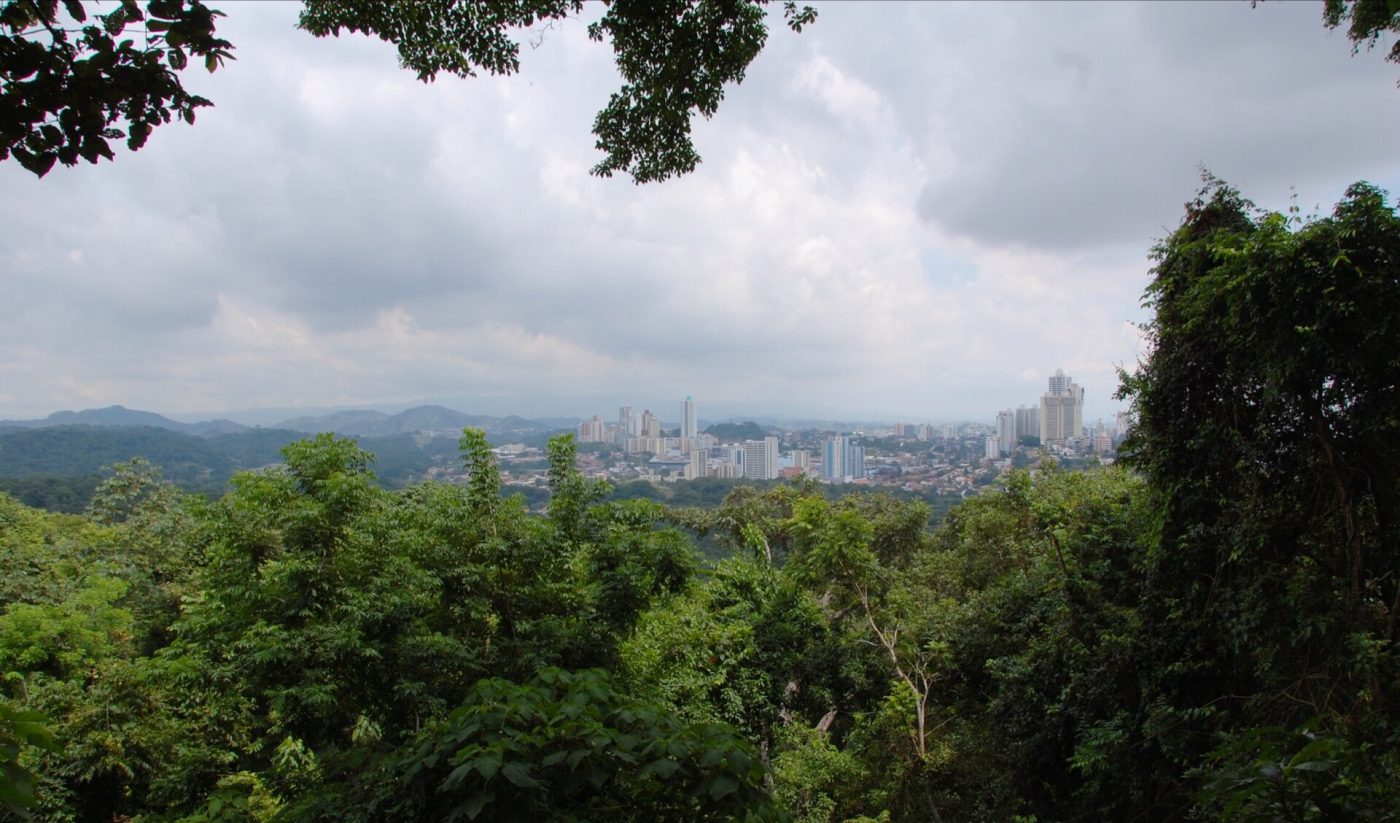
Photo: LWY from Pasadena, USA, CC BY-SA 2.0
The Parque Natural Metropolitano is a tract of tropical forest inside the limits of Panama City, ten to fifteen minutes by taxi from the banking district, the old quarter of Casco Viejo or the Albrook bus terminal and domestic airport, and its keepers like to say that it is the only protected tropical forest within a capital city in Latin America; it has nothing to do with the metropolitan park of Quito, whose cycling tours share its name in searches. For visitors with a morning to spare, or a long layover, it is the quickest possible encounter with Panamanian wildlife. The entrance and visitor centre are on Avenida Juan Pablo II, where a small fee is paid, higher for foreigners, and a trail map is given out.
There are five trails, about five kilometres in all, well maintained and signed, which can be combined into a loop of two hours: the easy Los Momótides, named for the motmots, near the entrance; Los Caobos, through old mahogany trees; El Roble; La Cienaguita, with numbered stops keyed to a booklet on the forest; and Mono Tití, named for the Geoffroy's tamarin, the small monkey that is the park's emblem, which climbs steadily for about a kilometre to the lookout of Cerro Cedro, 150 metres above the sea, from which the skyscrapers of the city, the bay, the Bridge of the Americas, the entrance to the canal and the hill of Ancón are spread out over the treetops. No guide is needed, but the guided birdwatching and wildlife tours, which start at six or six-thirty, find several times as many animals, and the guided hikes commonly pair the park with Ancón hill.
Live dates and prices from GetYourGuide. Free cancellation on most tickets.
The park was created by law in 1985 and opened in 1988, covers about 232 hectares, and is the southernmost link in a continuous corridor of protected forest, with the Camino de Cruces and Soberanía national parks, that runs along the eastern bank of the Panama Canal from the Pacific almost to the Caribbean and protects the watershed on which the canal's locks depend. The land lay within the former Canal Zone, under American administration from 1904, and was used by the United States army during the Second World War, when aircraft engines were tested here, of which a few concrete structures remain in the trees; it reverted to Panama under the treaties of 1977. What it protects is lowland Pacific dry forest, a semi-deciduous forest in which many of the trees drop their leaves during the dry season from January to April, a forest type that has almost disappeared from the Pacific side of Central America under pasture and cities, and of which this is one of the last accessible examples: barrigón trees with swollen green trunks, huge cuipos and espavés, mahogany, Panama trees, gumbo-limbos, strangler figs and wild cashews.
In this modest area some 227 species of birds have been recorded, among them keel-billed toucans, slaty-tailed trogons, several motmots, lance-tailed manakins, which display at leks near the trails, blue-crowned parrots, and in the northern winter a stream of migrant warblers and raptors, together with 45 mammals, two- and three-toed sloths asleep in the cecropias, Geoffroy's tamarins, white-nosed coatis, agoutis, which are seen on almost every walk, white-tailed deer, armadillos and kinkajous, and reptiles including green iguanas, basilisks, boa constrictors and turtles in the pond. The Smithsonian Tropical Research Institute operates a construction crane in the park, forty-two metres tall, from whose gondola scientists have studied the life of the forest canopy since 1990; it is not open to the public.
The park is open daily, from about 6 am for walkers until 4.30 or 5 pm, with the visitor centre keeping office hours. The dry season, from mid-December to April, has reliably sunny mornings, a leafless, open forest in which animals are easier to see, and great heat by ten o'clock; in the wet season, from May to early December, the forest is dense and green, mornings are usually fine and the rain comes in afternoon downpours.
At any season, go as early as possible, since the wildlife is active and the air bearable until about nine, and carry water and repellent. Allow two to three hours. The Miraflores locks of the canal are fifteen minutes away, Ancón hill and Casco Viejo ten, the Biomuseo and the Amador causeway fifteen, and Soberanía's Pipeline Road forty minutes.
Yes. GetYourGuide lists 2 tickets and tours for Metropolitan Natural Park, with live dates and prices and free cancellation on most of them.
The park is open daily, from about 6 am for walkers until 4.30 or 5 pm, with the visitor centre keeping office hours.
Allow two to three hours.
Metropolitan Natural Park covers 2.3 km².
Metropolitan Natural Park was established in 1985.
Metropolitan Natural Park is in Panama. The map on this page shows the exact spot.
Panama
Chagres is a very large rainforest park that begins only about forty kilometres north-east of Panama City, an hour or…
2 tickets & tours
Panama
Soberania is a tract of lowland rainforest along the eastern bank of the Panama Canal, beginning only twenty-five…
2 tickets & tours
Panama
Coiba is a remote archipelago in the Pacific, off the coast of the Panamanian province of Veraguas, and it is one of…
1 ticket or tour
Panama
Darien is the great wilderness at the eastern end of Panama, against the Colombian border, the largest national park in…
No online ticket


