Than Bok Khorani National Park
Thailand
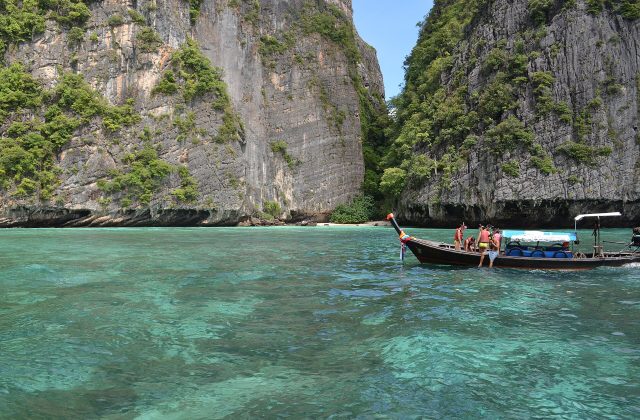
Than Bok Khorani is a national park in the north of the province of Krabi, in southern Thailand, and it consists of two…
79 tickets & tours
Waterfall & Lake Park · Thailand

Photo: Nina R from Africa, CC BY 2.0
Erawan is the waterfall park sixty-five kilometres north-west of the town of Kanchanaburi in western Thailand, three to three and a half hours by road from Bangkok, and it is visited almost entirely for one thing, the Erawan falls, seven tiers of turquoise pools strung up a forested hillside along a kilometre and a half of trail, in which swimming is allowed. The day tours from Bangkok leave at six or seven, spend two to three hours at the falls in the late morning, and spend the afternoon at the sights of Kanchanaburi, the Bridge on the River Kwai, the war cemetery and sometimes a ride on the Death Railway over the wooden viaduct at Wang Pho, returning in the evening, a long day that works; the two-day versions sleep on a raft house or at a river resort and add Hellfire Pass, which is the better plan.
From Kanchanaburi itself, public bus 8170 leaves the bus station roughly hourly from 8 am and takes an hour and a half to the park's visitor centre, with the last bus back at about 4 pm, and a rented scooter or car makes an early arrival possible. The entrance fee for foreign adults is 300 baht, paid at the gate, with a small charge for vehicles. At the second tier a checkpoint takes a refundable deposit on every plastic bottle carried higher, no food is allowed beyond it, and life jackets, compulsory for swimmers in the deeper pools, are rented cheaply. The park has bungalows and a campsite for those who want the falls at dawn, booked through the national parks department. The tour that adds the Salak Phra wildlife sanctuary is for the birds and the elephants' tracks.
Live dates and prices from GetYourGuide. Free cancellation on most tickets.
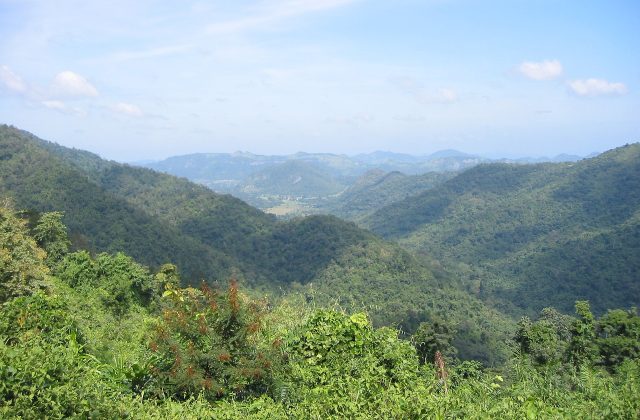
The park was established in 1975 as Thailand's twelfth and covers 550 square kilometres of the Tenasserim hills in Kanchanaburi province, limestone ridges rising to 996 metres, covered in mixed deciduous forest with bamboo and dry evergreen forest in the valleys. The falls are on the Huai Mong Lai and Huai Omtala streams near the park's eastern edge, and they take their colour and their shapes from the limestone: the water is saturated with calcium carbonate, which scatters light to give the milky blue-green, and deposits it as tufa, building rounded dams, curtains and terraces over which the water slides into pool after pool. The seven tiers all have names; the first three, Lai Khuen Rang, Wang Matcha, a wide fall into a deep pool full of fish, and Pha Nam Tok, are reached on an easy, mostly level path within fifteen or twenty minutes and are where most visitors stop; the fourth, Oke Nang Phee Seua, is a smooth bulge of rock that serves as a natural slide;
the fifth is a series of wide, shallow basins, the best for swimming in peace; and the sixth and seventh require a steeper climb on ladders, roots and slippery rock, an hour or so from the start. The topmost fall, Phu Pha Erawan, has tufa formations said to resemble the three heads of Erawan, the elephant mount of the god Indra in the Thai version of the Hindu myths, which gave the falls and the park their name. The pools are full of mahseer and of small Garra fish that nibble the dead skin from bathers' feet, to general shrieking. Long-tailed macaques patrol the lower tiers and steal bags. Elsewhere in the park, little visited, are several caves: Phra That, with large chambers of stalactites, twelve kilometres from the visitor centre, Ta Duang with prehistoric rock paintings, Mi and Rua. Wild elephants, gibbons, sambar, barking deer, wild boar, king cobras, hornbills and kalij pheasants live in the forest.
The park is open daily from 8 am to 4.30 pm, with the upper tiers closed from about 3 pm and everyone asked to be down by 4. The water is at its bluest and the flow good from about November to February, the cool, dry season, which is also the most crowded; in the hot season, March to May, the flow weakens and the upper tiers may be reduced to a trickle, though the pools remain;
in the rains, from June to October, the falls are powerful, the water turns brownish after storms, the trail is slippery and swimming may be suspended. Whatever the month, come on a weekday and be at the gate at opening, since Thai weekenders and the Bangkok tours arrive from ten. Wear shoes with grip that can get wet. Allow three hours. Kanchanaburi and the River Kwai bridge are an hour and a half away, Hellfire Pass an hour, and Sai Yok's falls on the same road.
Yes. GetYourGuide lists 5 tickets and tours for Erawan National Park, with live dates and prices and free cancellation on most of them.
The entrance fee for foreign adults is 300 baht, paid at the gate, with a small charge for vehicles.
The park is open daily from 8 am to 4.30 pm, with the upper tiers closed from about 3 pm and everyone asked to be down by 4.
Erawan National Park covers 550 km².
Erawan National Park was established in 1975.
Erawan National Park receives about 519 235 a year (2024).
Erawan National Park is in Thailand. The map on this page shows the exact spot.
Thailand
Than Bok Khorani is a national park in the north of the province of Krabi, in southern Thailand, and it consists of two…
79 tickets & tours
Thailand
Ao Phang Nga is the bay of limestone towers between Phuket and Krabi that Hollywood made famous as the setting for a…
73 tickets & tours
Thailand
Doi Inthanon is the highest mountain in Thailand and the most visited national park in the north, sixty kilometres from…
72 tickets & tours
Thailand
The Phi Phi islands are protected as the Hat Noppharat Thara–Mu Ko Phi Phi National Park, and the park fee is collected…
37 tickets & tours
Thailand
Tarutao is a marine park of fifty-one islands in the Andaman Sea, in the far south-west of Thailand, off the coast of…
31 tickets & tours
Thailand
Khao Yai is Thailand's first national park, two and a half to three hours north-east of Bangkok, and it is sold…
27 tickets & tours