Montgrí, Medes Islands and Baix Ter Natural Park
50 km away
This natural park on the Costa Brava, in Catalonia, about an hour and three quarters north of Barcelona and forty-five…
3 tickets & tours
Volcano Park · Catalonia · Spain
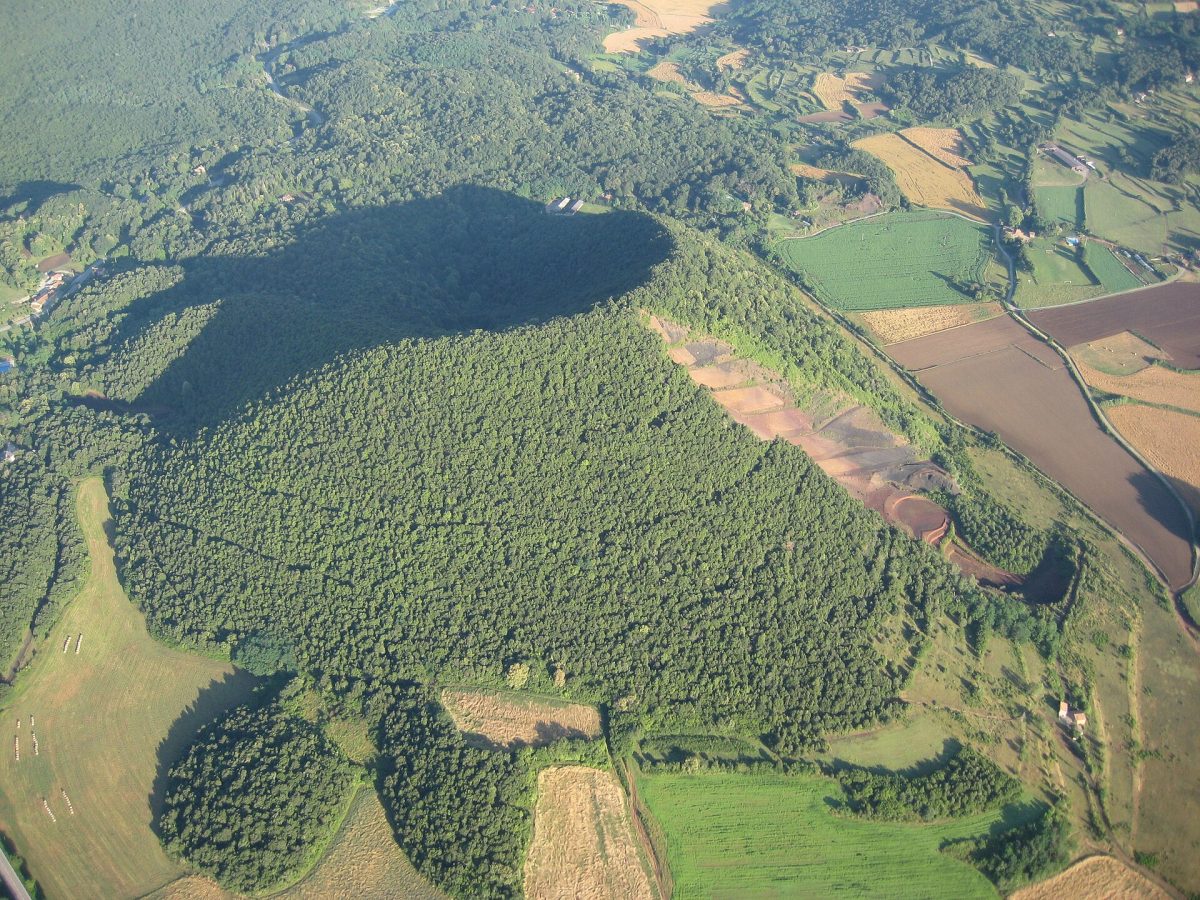
Photo: Carquinyol from Badalona, Catalunya, CC BY-SA 2.0
La Garrotxa is a district of green, wooded hills in the north of Catalonia, in the foothills of the Pyrenees, and its natural park protects the best preserved volcanic landscape in the Iberian peninsula, some forty small extinct cones scattered among beech woods, farms and medieval villages round the market town of Olot. It lies about fifty minutes by road from Girona and its airport, and an hour and three quarters from Barcelona, from both of which buses run to Olot; day tours come from Barcelona and from the Costa Brava, though a car, or a bicycle, gives the freedom that the place deserves. The park is free and unfenced, the only charges being for the car parks at the most visited spots, and it is crossed by twenty-eight signposted walking itineraries, most of them easy circuits of one to four hours.
The classic is the walk that links its three most famous sights, starting from the car park of Can Serra, or of Santa Margarida, on the road between Olot and Santa Pau: the Fageda d'en Jorda, a beech wood growing on a lava flow, threaded by level paths; the volcano of Santa Margarida, up whose wooded flank a path climbs in half an hour to the rim, and down into the grassy bowl of the crater, in the middle of which stands a small Romanesque chapel; and the volcano of Croscat, where an old quarry has cut the cone open like a slice of cake; the whole circuit is about ten kilometres and takes four hours, and each part can be done separately. Horse-drawn carriages take visitors through the beech wood, and hot-air balloons, which are a speciality of the district, fly over the craters at dawn, with a breakfast of local sausage and wine on landing. The visitor centres are at Can Serra, at Can Passavent beside Croscat, and in the Casal dels Volcans in Olot, which has a small museum with an earthquake simulator.
Live prices from GetYourGuide for tours whose route includes this park. Free cancellation on most of them.
The natural park was created by the Catalan parliament in 1982, after a long popular campaign against the quarrying of the cones for volcanic gravel, and covers about 150 square kilometres, in which some forty thousand people live, so that it is as much a cultural landscape as a natural one. The volcanoes belong to a field that has been intermittently active for some 700,000 years, as a result of the stretching and cracking of the crust in this corner of the peninsula, and they are of the small, short-lived kind, each the product of a single eruption lasting weeks or months: cones of loose scoria and ash, mostly between fifty and a hundred and fifty metres high, with a crater at the top, accompanied by more than twenty flows of basalt lava, which dammed valleys, created lakes and marshes that have since filled with fertile soil, and cooled in places into cliffs of columns, as at Castellfollit de la Roca, where a village stands in a single line along the top of a basalt precipice fifty metres high and a kilometre long. Croscat, the youngest, last erupted about eleven to thirteen thousand years ago, which means that the field is regarded as dormant, not dead. It is also the tallest cone in the peninsula, 160 metres, and the great gash cut into its side by the quarrymen between the 1950s and 1991, exposing layers of black, red and ochre ash, has been turned, after its closure, into an open-air lesson in the anatomy of a volcano, a restoration that won an international prize.
Santa Margarida, a broader cone some 1,200 metres round, was formed by explosions where rising magma met groundwater, and the chapel in its crater, dedicated to St Margaret of Antioch, was rebuilt after the earthquakes of 1427 and 1428, which destroyed Olot. Montsacopa, another cone, rises in the middle of the town, with a chapel and watchtowers on its rim. The humid climate, the wettest in Catalonia, and the fertile volcanic soils have clothed all this in a vegetation more characteristic of central Europe than of the Mediterranean, oak woods, holm oak on the sunny slopes, and beech, of which the Fageda d'en Jorda is remarkable in growing on nearly level ground at only 550 metres, on the hummocky surface of the Croscat lava flow; the poet Joan Maragall celebrated it in a well-known poem, and a cooperative farm in the wood, which employs people with mental disabilities, makes the most popular yoghurt in Catalonia. At the end of the nineteenth century the landscape inspired the Olot school of painters, and the town had a flourishing industry of religious statues. The medieval village of Santa Pau, with an arcaded square and a castle, is known for its small white beans, grown on volcanic soil, and Besalu, with its fortified bridge, lies at the park's eastern gate. Wild boar, genets, martens, goshawks and the rare Pyrenean lily are among the natural inhabitants.
The park can be visited all year. The great season is the autumn, from mid-October to mid-November, when the beeches of the Fageda turn gold and copper and the oaks russet, and visitors come in such numbers at weekends that the car parks fill early and the road may be regulated, so that a weekday is much to be preferred. Spring, from April to June, is green and flowery, with the beeches in fresh leaf from late April; summer is warm, 25 to 30 degrees, with afternoon thunderstorms, and markedly cooler and greener than the coast, which makes the woods a refuge;
winter is cold, often misty, with the beech wood bare and quiet and occasional snow. Balloons fly all year at sunrise when the weather allows, and should be booked ahead. Rain is frequent at every season, so bring a waterproof and shoes that can cope with mud. Allow one to two days. Besalu is twenty minutes from Olot, the lake of Banyoles half an hour, Girona fifty minutes, and the Dali museum at Figueres under an hour.
50 km away
This natural park on the Costa Brava, in Catalonia, about an hour and three quarters north of Barcelona and forty-five…
3 tickets & tours
86 km away
Montserrat is the serrated mountain an hour north-west of Barcelona with the Benedictine abbey on its flank, and the…
14 tickets & tours
212 km away
Ordesa y Monte Perdido lies in the central Pyrenees, in the province of Huesca in Aragon, in the north of Spain,…
4 tickets & tours
Yes. GetYourGuide sells tickets and guided tours whose route includes La Garrotxa Volcanic Zone Natural Park; live prices are shown on this page.
Allow one to two days.
La Garrotxa Volcanic Zone Natural Park covers 153 km².
La Garrotxa Volcanic Zone Natural Park was established in 1982.
La Garrotxa Volcanic Zone Natural Park is in Catalonia, Spain. The map on this page shows the exact spot.
Catalonia, Spain
Montserrat is the serrated mountain an hour north-west of Barcelona with the Benedictine abbey on its flank, and the…
14 tickets & tours
Catalonia, Spain
The Ebro Delta is the great flat triangle of rice fields, lagoons and empty beaches that the longest river wholly…
3 tickets & tours
Catalonia, Spain
This natural park on the Costa Brava, in Catalonia, about an hour and three quarters north of Barcelona and forty-five…
3 tickets & tours
Catalonia, Spain
Aiguestortes i Estany de Sant Maurici, the only national park in Catalonia, lies in the highest part of the central…
No online ticket
Catalonia, Spain
The Montseny is a wooded mountain massif that rises abruptly from the plains of Catalonia about fifty kilometres…
No online ticket