Taman Negara National Park
Malaysia
Taman Negara, the name simply means national park in Malay, is the great rainforest of the Malay Peninsula, and nearly…
8 tickets & tours
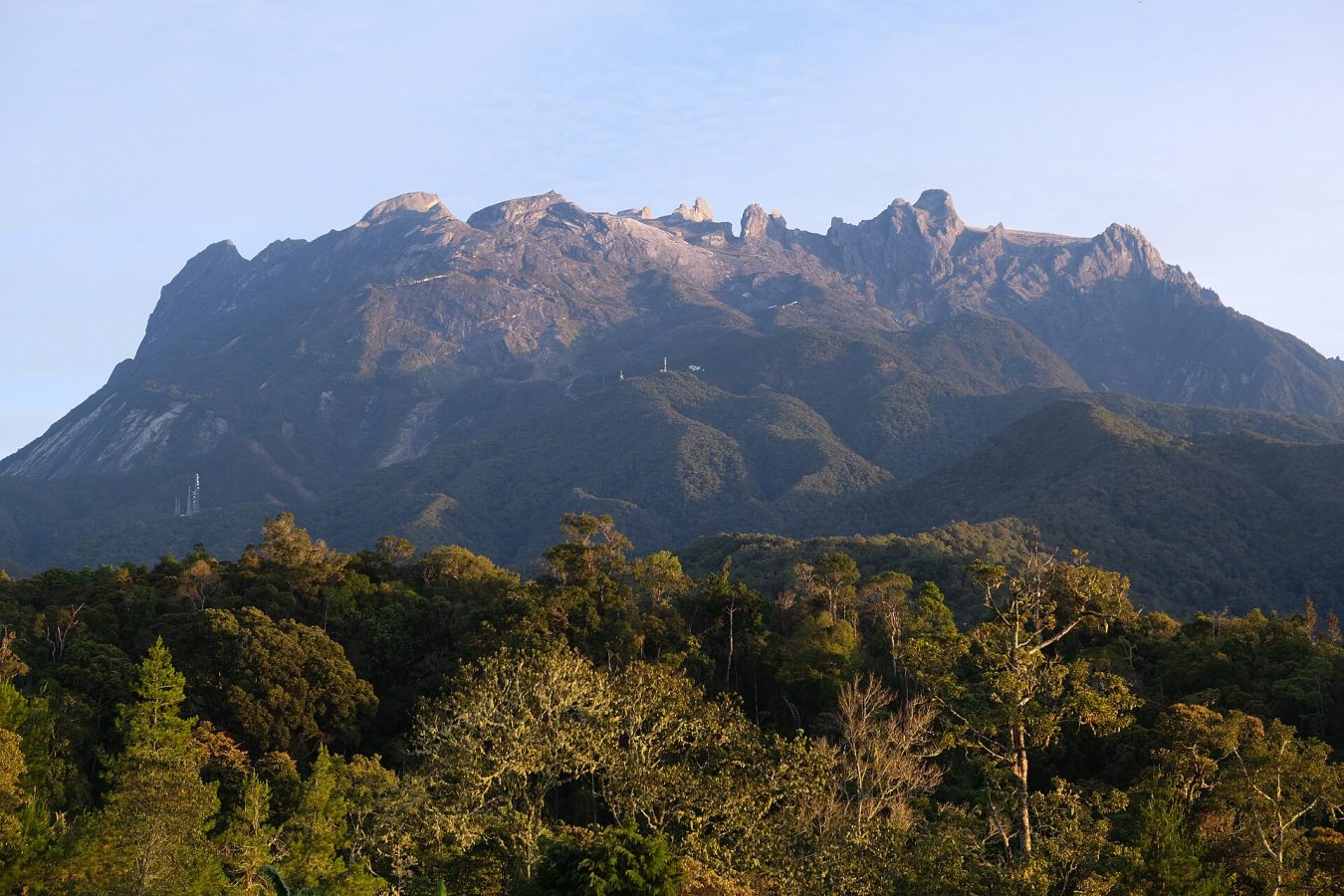
Photo: kallerna, CC BY-SA 4.0
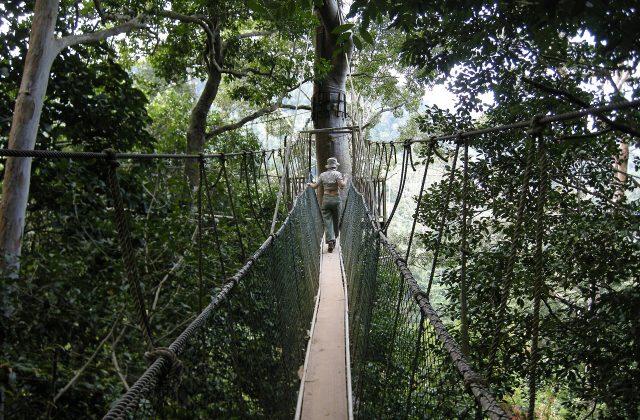
Kinabalu Park surrounds the highest mountain in Borneo, two hours by road from Kota Kinabalu, the capital of the Malaysian state of Sabah, and there are two entirely different ways of visiting it. The day tours from Kota Kinabalu are gentle: a stop at the Nabalu market for fruit and the view, an hour or two at the park headquarters at 1,560 metres, walking a short forest trail and the botanical garden in cool mountain air, then a drive round to Poring, on the park's eastern edge, for the sulphur hot-spring tubs built by the Japanese in the war, the canopy walkway forty metres up in lowland rainforest and, if one happens to be flowering in a villager's plot, a paid look at a Rafflesia, the largest flower in the world; many end at the Desa dairy farm in Kundasang, whose green pastures and Friesian cows under the mountain amuse visitors from the tropics.
The climb is the other thing. It takes two days and one night, and it cannot be improvised: permits are limited to about 160 climbers a day, tied to a bed in the huts at Panalaban, at 3,270 metres, which are sold through Sutera Sanctuary Lodges and licensed agents and are often full three to six months ahead, and a licensed mountain guide is compulsory. Packages include permit, guide, insurance, bed and meals. No technical skill is needed, only fitness and a tolerance for altitude and for rising at two in the morning. A via ferrata, the highest in the world, offers two routes down the rock face after the summit. The Maragang Hill sunrise hikes sold from the city are a short, easy alternative with the mountain as the view.
Live dates and prices from GetYourGuide. Free cancellation on most tickets.
The park was gazetted in 1964 and became Malaysia's first World Heritage Site in 2000, covering 754 square kilometres around Gunung Kinabalu, 4,095 metres, the highest point between the Himalaya and New Guinea: a granite pluton that pushed up through the surrounding sandstones less than ten million years ago, is still rising, and was planed and scratched by an ice cap in the last glaciation, so that its summit is a bare, grey, tilted plateau of rock set with horns and spires, Low's Peak, the highest, St John's, the Donkey's Ears, South Peak, which appears on the hundred-ringgit note, split by Low's Gully, a chasm 1,800 metres deep. Because the mountain rises from near sea level through every climatic zone, and much of it stands on nutrient-poor ultramafic rock, it is one of the richest sites for plants on earth: between five and six thousand species, among them some 800 orchids, 600 ferns, more than Africa has, 27 rhododendrons, and the pitcher plants, of which thirteen species grow here, including Nepenthes rajah, whose pitchers hold over two litres and have been found with drowned rats.
The climb passes from lower montane oak and chestnut forest, through mossy cloud forest dripping with orchids and pitchers, to stunted scrub and then naked granite, which is ascended in the dark along a fixed white rope to reach Low's Peak for sunrise, with the shadow of the mountain stretching over Sabah to the sea. Sir Hugh Low made the first recorded ascent to the plateau in 1851. To the Kadazan-Dusun the mountain is Aki Nabalu, the resting place of the dead, and guides still make an annual offering. On 5 June 2015 an earthquake sent rockfalls across the summit trail, killing eighteen people, among them schoolchildren from Singapore and four guides; part of the route was rebuilt. The park has 326 birds, the mountain's own among them, and gibbons, orangutans in the remote north, and tree shrews that lick the pitchers' lids.
The headquarters is open daily from about 7 am, and climbers register in the morning of the first day. March to August is the drier season and the best for the climb, with April the clearest; October to January is the wettest, when the summit is sometimes closed by rain and the rope section becomes dangerous, though the park below is always open.
The summit plateau is near freezing at dawn, with wind, so gloves, a hat, a head torch and waterproofs are essential. Poring is hot and lowland; the headquarters is cool at any time. Allow a long day for the tour, three days for the climb. Kota Kinabalu is two hours away, the Sepilok orangutan centre and the Kinabatangan river are across the state at Sandakan, and the islands of Tunku Abdul Rahman park lie off the city.
Yes. GetYourGuide lists 5 tickets and tours for Kinabalu Park, with live dates and prices and free cancellation on most of them.
The headquarters is open daily from about 7 am, and climbers register in the morning of the first day.
Allow a long day for the tour, three days for the climb.
Kinabalu Park covers 754 km².
Kinabalu Park was established in 1964.
Kinabalu Park is in Malaysia. The map on this page shows the exact spot.
Malaysia
Taman Negara, the name simply means national park in Malay, is the great rainforest of the Malay Peninsula, and nearly…
8 tickets & tours
Malaysia
Bako is the oldest and smallest of Sarawak's national parks, at the tip of a peninsula thirty-seven kilometres…
4 tickets & tours
Malaysia
Kubah is a small rainforest park on a sandstone ridge about twenty-two kilometres, forty minutes by road, west of…
2 tickets & tours
Malaysia
Gunung Mulu, in the interior of the Malaysian state of Sarawak in northern Borneo, close to the border of Brunei,…
No online ticket