Than Bok Khorani National Park
Thailand
Than Bok Khorani is a national park in the north of the province of Krabi, in southern Thailand, and it consists of two…
79 tickets & tours
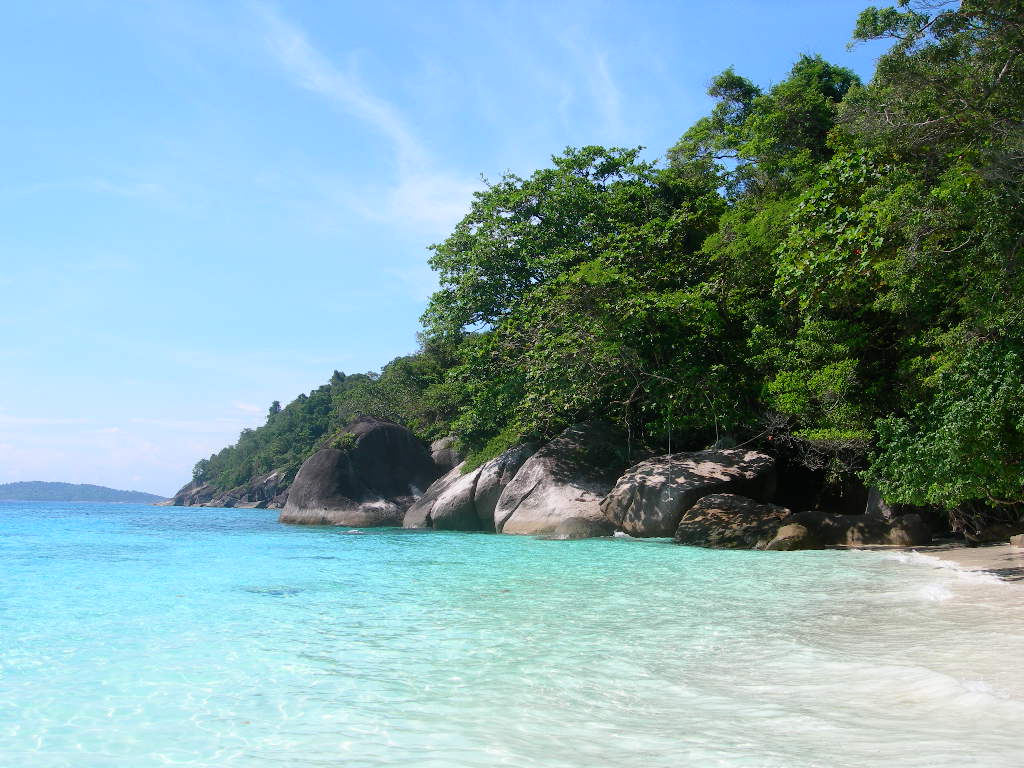
Photo: by Electrostatico, CC BY-SA 2.0
The Similans are a line of small granite islands in the Andaman Sea, some sixty-five kilometres off the west coast of southern Thailand, and they are reckoned the finest diving and snorkelling grounds in the country and among the best in Asia. Nobody lives on them and, since 2018, nobody may stay on them overnight, so that there are only two ways to go: on a day trip by speedboat, or on a liveaboard dive boat. The speedboats leave each morning from the pier of Thap Lamu, just south of the resort strip of Khao Lak in Phang Nga province, and reach the islands in an hour to an hour and a half; visitors staying in Phuket, who are the majority, are collected from their hotels before dawn for a drive of an hour and a half to two hours to the same pier, and return at about seven in the evening, which makes a long day.
The programme is always much the same: two or three snorkelling stops over the reefs, with masks, fins and life jackets supplied; a landing on island number eight, Ko Similan, to swim from the dazzling white beach of what is called Donald Duck bay and to climb, in ten minutes, to the balanced boulder known as Sail Rock for the classic view; and lunch and another swim on island number four, Ko Miang, where the park has its headquarters. The park fee, substantial for foreigners, is usually included in the price, and because the number of visitors is capped each day, places must now be booked ahead with the identity details of each passenger. Divers take liveaboards of three or four nights from Khao Lak or Phuket, which cover the Similans together with Ko Bon, Ko Tachai and Richelieu Rock to the north; day diving boats also operate. Speedboats are fast, crowded and bumpy, and are unsuitable for bad backs or pregnancy.
Live dates and prices from GetYourGuide. Free cancellation on most tickets.
The park was established in 1982, with nine islands, the name Similan being derived from the Malay word for nine, sembilan, and was extended in 1998 to take in the two outlying islands of Ko Bon and Ko Tachai, giving eleven islands and about 140 square kilometres, of which a tenth is land. The islands, which are known by numbers as well as names, are the tops of a granite ridge formed some sixty-five million years ago, clothed in dense evergreen forest and fringed with beaches of powdery white coral sand, and their shores are piled with enormous rounded boulders, smoothed by the sea into strange shapes. The same contrast continues below the surface and gives the diving its variety. On the western sides, exposed to the open ocean, the boulders tumble down to forty metres, forming arches, tunnels and swim-throughs swept by currents and covered with sea fans and soft corals in purple, orange and pink, as at Elephant Head Rock, the most famous site; on the sheltered eastern sides, gentle slopes of hard coral descend from the beaches, with staghorn and table corals, bommies crowded with glassfish, and sand flats with garden eels, as at East of Eden. The water is exceptionally clear, thirty metres and more of visibility being normal.
More than two hundred species of hard coral and several hundred of fish have been recorded, with green and hawksbill turtles, which nest on the beaches of islands one to three, closed to all visitors for that reason, leopard sharks, reef sharks, Napoleon wrasse, barracuda, giant trevally and moray eels, while Ko Bon is known for manta rays and Richelieu Rock, in the neighbouring Surin park, for whale sharks. On land live the Nicobar pigeon, a heavy, iridescent green and bronze bird with a white tail, found only on small islands from the Andamans to the Pacific, the pied imperial pigeon, the white-bellied sea eagle, flying foxes, monitor lizards, and a hairy-legged land crab that comes out of the forest at night. The reefs have suffered. The tsunami of December 2004 damaged some sites; a period of very warm water in 2010 bleached and killed a large proportion of the shallow hard corals, which have only partly recovered; and for years the number of visitors grew without control, to as many as seven thousand a day, until the park authorities closed Ko Tachai to landings in 2016, banned overnight stays and removed the tents and bungalows in 2018, and imposed a limit of 3,325 day visitors and 525 divers a day. Each long closure during the monsoon, and the enforced one during the pandemic, has visibly helped.
The park is open only from about the middle of October to the middle of May, and is closed for the whole of the south-west monsoon, when the sea is rough and the reefs are left to rest; the exact dates are announced each year. The season begins with some residual swell and rain, and from December to April the sea is generally calm and the sky clear, with February to April the very best months for visibility, for manta rays and whale sharks, and also the hottest;
the weeks round Christmas, New Year and Chinese New Year are the most crowded, when the daily quota sells out. By late April and May, storms may cancel boats. Take seasickness tablets before the crossing, and bring a rash vest, reef-safe sunscreen, a hat and a dry bag; single-use plastics are not allowed. Never touch or stand on coral, or feed the fish. Allow a day, four for a liveaboard. Khao Lak is ten minutes from the pier, Phuket airport an hour and a quarter, and Khao Sok National Park an hour and a half inland.
Yes. GetYourGuide lists one ticket or tour for Similan Islands National Park, with live dates and prices and free cancellation on most of them.
The park fee, substantial for foreigners, is usually included in the price, and because the number of visitors is capped each day, places must now be booked ahead with the identity details of each passenger.
The park is open only from about the middle of October to the middle of May, and is closed for the whole of the south-west monsoon, when the sea is rough and the reefs are left to rest; the exact dates are announced each year.
Allow a day, four for a liveaboard.
Similan Islands National Park covers 140 km².
Similan Islands National Park was established in 1982.
Similan Islands National Park is in Thailand. The map on this page shows the exact spot.
Thailand
Than Bok Khorani is a national park in the north of the province of Krabi, in southern Thailand, and it consists of two…
79 tickets & tours
Thailand
Ao Phang Nga is the bay of limestone towers between Phuket and Krabi that Hollywood made famous as the setting for a…
73 tickets & tours
Thailand
Doi Inthanon is the highest mountain in Thailand and the most visited national park in the north, sixty kilometres from…
72 tickets & tours
Thailand
The Phi Phi islands are protected as the Hat Noppharat Thara–Mu Ko Phi Phi National Park, and the park fee is collected…
37 tickets & tours
Thailand
Tarutao is a marine park of fifty-one islands in the Andaman Sea, in the far south-west of Thailand, off the coast of…
31 tickets & tours
Thailand
Khao Yai is Thailand's first national park, two and a half to three hours north-east of Bangkok, and it is sold…
27 tickets & tours