Phu Quoc National Park
Vietnam
Phu Quoc National Park covers the forested northern two-thirds of Phu Quoc, Vietnam's largest island, and it is…
166 tickets & tours
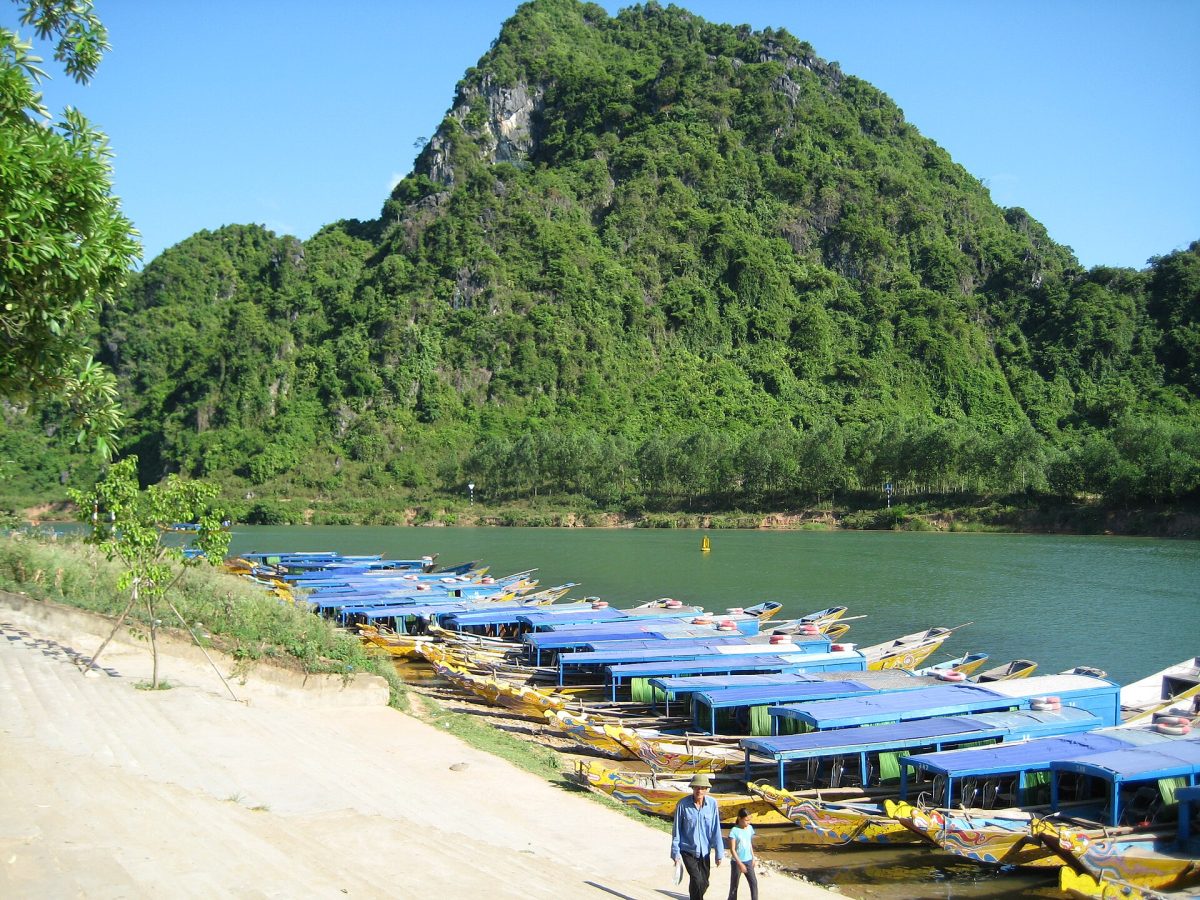
Phong Nha-Ke Bang is the cave country of central Vietnam, forty-five minutes inland from Dong Hoi, which has an airport and a station on the Hanoi to Saigon railway, and four hours north of Hue; visitors stay in the village of Phong Nha, also called Son Trach, on the Son river, among farmstays and guesthouses. The caves divide into two kinds. The show caves are open to anyone with a ticket, bought at each site: Phong Nha cave, entered by dragon boat from the village jetty along the river and then for more than a kilometre into an underground river, with Tien Son cave up the steps beside it; Paradise cave, where a boardwalk runs a kilometre into chambers of great size and beauty, with a seven-kilometre guided trek beyond it for those who book;
and the Dark cave, a day of zip-lining, swimming into the cave by headlamp, a mud bath and kayaking. The day tours from the village, Dong Hoi and Hue combine two of them with the park's scenic loop road, the botanic garden and wartime sites on the Ho Chi Minh trail, and the two-day tours from Hue add the DMZ and Khe Sanh on the way. The wild caves are licensed each to one operator, with numbers capped and a fixed price: Oxalis runs the four-day expedition into Son Doong, the largest cave on earth, for a few hundred people a year, booked a year or more ahead, and the more attainable Hang En, Tu Lan, Hang Va and Hang Tien treks; Jungle Boss runs Hang Pygmy, the Tiger cave series and the Abandoned Valley. These require fitness and a medical form.
Live dates and prices from GetYourGuide. Free cancellation on most tickets.
The park was created in 2001 and inscribed as a World Heritage Site in 2003, extended in 2015, protecting a core of some 1,230 square kilometres with a wide buffer zone on the Lao border, where it adjoins the Hin Namno reserve; together they form one of the largest and oldest karst regions in Asia, limestone that has been eroding for about 400 million years, clothed in one of the largest remaining tracts of primary forest in Indochina. More than four hundred caves have been explored since the British Cave Research Association began working with Hanoi University in 1990, and the total grows every season. Phong Nha cave, known for centuries, with Cham inscriptions on its walls, sheltered a hospital and a ferry depot in the American war, when the river crossing here fed the Ho Chi Minh trail and was bombed incessantly. Paradise cave, found by a local man in 2005, is thirty-one kilometres long.
Son Doong was found by a farmer, Ho Khanh, in 1990, lost again, and surveyed in 2009 by the British team led by Howard Limbert: its main passage is over five kilometres long and in places 200 metres high and 150 wide, enough to hold a block of forty-storey buildings, with two collapsed dolines where daylight falls on a jungle growing inside the cave, cave pearls the size of baseballs and a calcite barrier ninety metres high named the Great Wall of Vietnam. Hang En, the approach to it, has the third largest chamber in the world, with a beach beside an underground river, and swifts nesting in the roof. The forest above shelters the saola, discovered in 1992 and hardly seen since, the giant muntjac, the endemic Hatinh langur, red-shanked doucs and gibbons. The district was among the poorest in Vietnam, and cave tourism, employing hundreds of former loggers and hunters as porters, has changed it.
The show caves are open daily from about 7 am to 4 pm. February to August is the season: spring is cool and dry, and from May to August it is hot, which makes the cold water of the Dark cave and the river welcome, and Vietnamese holidaymakers fill Phong Nha and Paradise caves in June and July. From mid-September to November the rains flood the river caves, Phong Nha cave may close, and the expedition caves shut altogether until January; typhoons strike this coast in October. December and January are grey, cool and quiet. Allow two full days for the show caves, more for a trek. Dong Hoi's beach is forty-five minutes away, the DMZ and the Vinh Moc tunnels two hours south, and Hue four.
Yes. GetYourGuide lists 8 tickets and tours for Phong Nha-Ke Bang National Park, with live dates and prices and free cancellation on most of them.
The show caves are open daily from about 7 am to 4 pm.
Allow two full days for the show caves, more for a trek.
Phong Nha-Ke Bang National Park covers 2 201 km².
Phong Nha-Ke Bang National Park was established in 2001.
Phong Nha-Ke Bang National Park is in Vietnam. The map on this page shows the exact spot.
Vietnam
Phu Quoc National Park covers the forested northern two-thirds of Phu Quoc, Vietnam's largest island, and it is…
166 tickets & tours
Vietnam
Cuc Phuong is Vietnam's oldest national park, two hours south of Hanoi and forty minutes from Ninh Binh, and it is…
64 tickets & tours
Vietnam
Van Long is the quiet alternative to Tam Coc and Trang An in Ninh Binh province, two hours south of Hanoi, a wetland…
50 tickets & tours
Vietnam
Pu Luong is the terraced valley reserve in Thanh Hoa province, about four hours south-west of Hanoi and two from Ninh…
43 tickets & tours
Vietnam
Ba Be is a lake among limestone mountains in the far north of Vietnam, in what was until the provincial mergers of 2025…
27 tickets & tours
Vietnam
Bach Ma is the mountain park between Hue and Da Nang in central Vietnam, forty kilometres from Hue and an hour and a…
25 tickets & tours