Nambung National Park
Western Australia, Australia
Nambung is a coastal park on the Indian Ocean about two hundred kilometres north of Perth, the capital of Western…
19 tickets & tours
Canyon Park · Western Australia · Australia
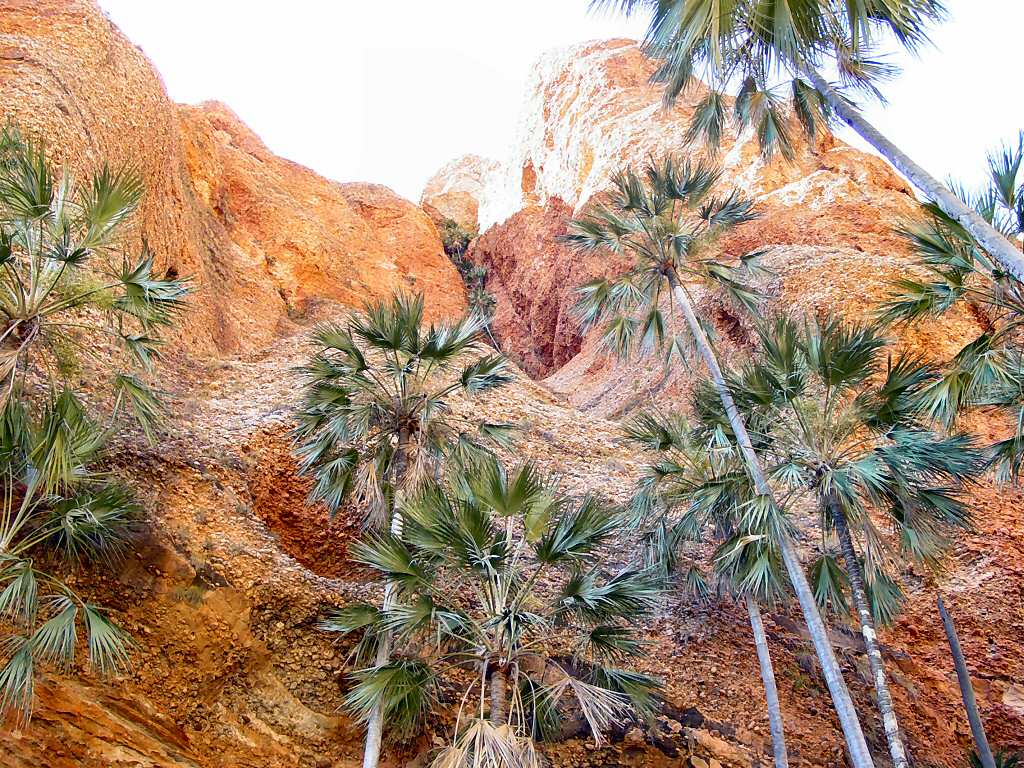
Photo: CC BY-SA 3.0
Purnululu, in the East Kimberley region of the far north of Western Australia, contains the Bungle Bungle range, a maze of orange and black striped sandstone domes that is one of the strangest and most photographed landscapes in Australia, and one of the most remote. It lies about three hundred kilometres by road south of the town of Kununurra and a hundred and sixty north-east of Halls Creek, both on the Great Northern Highway, which are themselves a very long way from anywhere, Kununurra being reached by air from Perth, Darwin and Broome. There are two ways of seeing it. The first is from the air, and many visitors see it in no other way: light aircraft make scenic flights of about two hours from Kununurra, passing over Lake Argyle and the Argyle diamond mine, and shorter flights leave from Halls Creek and from the roadhouse at Warmun; helicopters, which fly lower and slower with the doors off, operate from an airstrip inside the park and from a caravan park at the turn-off on the highway.
The second is on the ground. The access track, the Spring Creek track, which leaves the highway 250 kilometres south of Kununurra, is fifty-three kilometres long, rough, corrugated and stony, with several creek crossings, takes two to three hours, and is open only to high-clearance four-wheel-drive vehicles and single-axle off-road trailers; at its end is a visitor centre, where the entry and camping fees are paid. Those without such a vehicle join a four-wheel-drive tour from the highway, or fly in from Kununurra on a day or overnight tour that combines the flight with guided walks and, for some, a night at one of the permanent safari camps, which with two public campgrounds are the only places to stay. The walks are in two groups, half an hour's drive apart: in the south, the Domes trail, Cathedral Gorge and the Piccaninny creek lookout, and, in the north, Echidna Chasm, Mini Palms and Homestead Valley.
The national park was declared in 1987 and covers nearly 2,400 square kilometres, the smaller figure given in some databases being wrong, and it was inscribed as a World Heritage Site in 2003. The Bungle Bungle range is a deeply dissected plateau, rising two to three hundred metres above the surrounding grassy plain, of sandstone and conglomerate laid down by rivers some 360 million years ago and since raised and eroded. On its southern and eastern sides, over an area of some 450 square kilometres, rain, running down the joints of the soft rock over twenty million years, has carved it into thousands of separate, closely packed, rounded towers, shaped like old-fashioned beehives, the most outstanding example of cone karst in sandstone anywhere on earth. Their horizontal banding, the feature that makes them unmistakable, is a living skin. The dark grey or black bands are layers of the rock with a higher clay content, which hold moisture and so support a crust of cyanobacteria, single-celled organisms among the oldest forms of life, a few millimetres thick; the orange bands between them, drier and more porous, are stained by oxides of iron and manganese. The crust protects the soft, friable sandstone beneath it, which crumbles at a touch where it is broken, and for that reason climbing on the domes is forbidden.
Between the domes and cutting into the massif are deep, narrow gorges and chasms, sheltering pools and pockets of vegetation that do not belong in this semi-arid country: Cathedral Gorge, an easy walk of an hour return, ends in a vast natural amphitheatre of red rock with a pool and a beach of white sand, whose acoustics are remarkable, and Echidna Chasm, in the north, is a cleft up to two hundred metres deep and in places barely a metre wide, lined at its mouth with tall Livistona fan palms, the walls of which glow orange for a short time round midday, when the sun reaches into it. The range has been known for at least twenty thousand years to the Kija and Jaru peoples, whose rock paintings, burial sites and stories are found throughout it, and who are joint managers of the park, Purnululu being a Kija word for sandstone; and it was known, from the 1880s, to the cattlemen who ran stock on the surrounding plains, to whose overgrazing the erosion of the country round about bears witness. To the rest of the world it was unknown until 1983, when a television crew making a documentary about the Kimberley filmed it from the air, and the pictures caused a sensation. The origin of the name Bungle Bungle is uncertain, being perhaps a corruption of the name of a common Kimberley grass or of an Aboriginal word. The park lies between the desert and the monsoon tropics, with spinifex grassland, eucalypt woodland and, in the gorges, rainforest species, and it shelters more than 130 species of birds, among them flocks of budgerigars, the spinifex pigeon, the white-quilled rock pigeon and the rainbow bee-eater, together with the short-eared rock-wallaby, the euro, the nailtail wallaby and many reptiles.
The park is open only in the dry season, from about the beginning of April to the middle of December, depending on the weather, and the track is closed throughout the wet season, from December to March, when it is cut by floods, though scenic flights continue. The best months are from May to August, with cloudless days of 28 to 32 degrees and cool nights, sometimes close to freezing in June and July; September and October are very hot, above 38 degrees, and walks should then be finished by mid-morning;
April and early May are green, with water still in the creeks and pools. The colours are richest in the early morning and the late afternoon, except in Echidna Chasm, which should be visited between about eleven and one. There is no fuel, food, drinking water to rely on or telephone signal in the park, so everything must be carried, including at least four litres of water a person a day, spare tyres and recovery gear. Allow two full days on the ground. Kununurra, Lake Argyle and the Gibb River Road are the other attractions of the East Kimberley.
No online tour for Purnululu National Park is listed on GetYourGuide; entry, where it is charged, is paid at the gate or through the park authority. Nearby parks with bookable tours are listed on this page.
The park is open only in the dry season, from about the beginning of April to the middle of December, depending on the weather, and the track is closed throughout the wet season, from December to March, when it is cut by floods, though scenic flights continue.
Allow two full days on the ground.
The best months are from May to August, with cloudless days of 28 to 32 degrees and cool nights, sometimes close to freezing in June and July; September and October are very hot, above 38 degrees, and walks should then be finished by mid-morning; April and early May are green, with water still in the creeks and pools.
Purnululu National Park covers 2 397 km².
Purnululu National Park was established in 1987.
Purnululu National Park is in Western Australia, Australia. The map on this page shows the exact spot.
Western Australia, Australia
Nambung is a coastal park on the Indian Ocean about two hundred kilometres north of Perth, the capital of Western…
19 tickets & tours
Western Australia, Australia
Cape Range is the limestone range and the beaches of the North West Cape at Exmouth in Western Australia, with the…
4 tickets & tours
Western Australia, Australia
Francois Peron National Park occupies the northern end of the Peron peninsula, which juts into the middle of Shark Bay,…
1 ticket or tour
Western Australia, Australia
Cape Le Grand is a park of granite headlands and beaches of blinding whiteness on the remote south coast of Western…
No online ticket
Western Australia, Australia
Shannon National Park lies in the far south-west of Western Australia, in the country of the giant karri trees, about…
No online ticket
Western Australia, Australia
Torndirrup is a park of granite sea cliffs, wind-swept heath and white beaches on the peninsula that shelters the…
No online ticket