Archipelago National Park
Finland
The Archipelago National Park lies in the outer skerries of the Archipelago Sea off south-west Finland, south of the…
21 tickets & tours

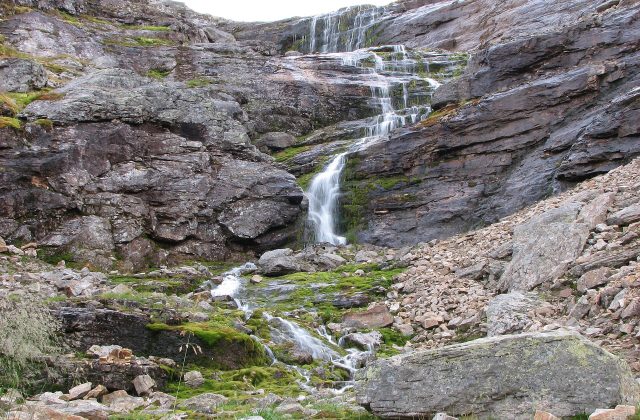
Photo: Trainthh, CC BY-SA 3.0
Pyhä-Luosto is a chain of fells in central Finnish Lapland, about 130 kilometres and an hour and a half to two hours north-east of Rovaniemi, the town on the Arctic Circle to which most visitors to Lapland fly, and it is the easiest national park in the region to reach from there: ski buses and scheduled coaches run from Rovaniemi's airport and station, by way of Kemijärvi, to the two small resort villages that bracket it, Pyhä at the southern end and Luosto at the northern, thirty-five kilometres apart, each with hotels, cabins, rental shops and a modest ski area. The park is free. At Pyhä, the Naava visitor centre, beside the ski slopes, is the starting point for the most popular walk, a well-made path and boardwalk of about ten kilometres return through the Isokuru gorge to the Pyhänkasteenlampi pond and its waterfall, with long wooden staircases, a day shelter and campfire sites along the way.
At Luosto, the fell of Ukko-Luosto is climbed by a staircase of some 670 steps to a panorama over forest to the horizon, and nearby, on the Lampivaara hill, is the only amethyst mine in the world open to visitors, reached in summer on foot, about two and a half kilometres each way, and in winter by a snowcat-drawn sleigh called the Pendolino or on skis or snowshoes; visitors hear about the mine, dig for a few minutes with a hand tool and keep a stone that fits in a closed fist. The day tours from Rovaniemi combine the mine with a walk in the park. In winter there are some 150 kilometres of groomed cross-country ski trails, marked snowshoe and fat-bike routes, and guided northern-lights outings.
Live dates and prices from GetYourGuide. Free cancellation on most tickets.
The park was formed in 2005 by joining the Pyhätunturi national park, founded in 1938 and thus among the very first in Finland, with the forests and fells of Luosto, and covers about 142 square kilometres. Its backbone is a line of twelve fell summits, thirty-five kilometres long, which are the worn-down roots of a range of alpine scale that stood here some two billion years ago, the southernmost large fells in Finland and among the oldest mountains in the world; their rock is a hard, pale quartzite, formed from the sand of an ancient seabed, in which ripple marks left by waves can still be seen on slabs beside the path, and which has shattered under frost into great fields of angular boulders, the rakka, on the upper slopes. The highest tops are Noitatunturi, the witch's fell, 540 metres, and Ukko-Luosto, 514. Between the fells, meltwater from the ice sheet cut deep, steep-walled ravines, of which Isokuru, the great gorge, 220 metres deep, is the deepest in Finland.
The forests on the slopes are old-growth pine, with trees of four hundred years and more, their trunks twisted and silver, hung with beard lichen, and spruce in the damper hollows, and to the north and east lie wide aapa mires, open bogs crossed by the duckboards. Pyhä means holy. The Pyhä fells were a sacred place, a seita, of the forest Sámi of Pyhäjärvi, who made offerings at the gorge and at Uhriharju, the ridge of sacrifice; in 1648 the priest Esaias Mansveti Fellman baptised them in the pond at the gorge's end, which has been called Pyhänkasteenlampi, the pond of holy baptism, ever since. Reindeer, belonging to the local herding cooperative, wander through the park; bears, otters, wolverines and elk are present; and the birds include the Siberian jay, tame at the campfires, the Siberian tit, the capercaillie and the three-toed woodpecker. The amethysts of Lampivaara formed in cavities of the quartzite some two billion years ago, and are dug only by hand, with no machinery.
The park is open at all times. The snow season runs from about November to early May, with the polar night in December, when the sun barely rises, the best skiing and the most light in March and April, and the northern lights visible on clear nights from September to March. Summer, from mid-June to August, has the midnight sun, from early June to early July, easy walking, and mosquitoes from late June to early August, for which repellent and a head net are advisable.
The autumn colours, the ruska, peak in the second and third weeks of September and are the finest time for hiking. Winter temperatures of minus twenty to minus thirty are normal; dress accordingly. Allow two days. Rovaniemi is an hour and a half south-west, Kemijärvi forty minutes, Sodankylä forty minutes north, and the ski resorts of Levi and Saariselkä further north.
Yes. GetYourGuide lists 3 tickets and tours for Pyhä-Luosto National Park, with live dates and prices and free cancellation on most of them.
The park is open at all times.
Pyhä-Luosto National Park covers 144 km².
Pyhä-Luosto National Park was established in 2005.
Pyhä-Luosto National Park receives about 198 900 a year (2024).
Pyhä-Luosto National Park is in Finland. The map on this page shows the exact spot.
Finland
The Archipelago National Park lies in the outer skerries of the Archipelago Sea off south-west Finland, south of the…
21 tickets & tours
Finland
Riisitunturi is the fell park of the candle spruces in Finnish Lapland, an hour and a half south-east of Rovaniemi near…
17 tickets & tours
Finland
Nuuksio is the forest and lake country on the north-western doorstep of Helsinki, forty-five minutes from the city…
8 tickets & tours
Finland
Oulanka is the river and forest wilderness of north-eastern Finland, just below the Arctic Circle on the Russian…
6 tickets & tours
Finland
Syöte is a quiet forest park in the fell country of northern Finland, where the region of Northern Ostrobothnia meets…
3 tickets & tours
Finland
Urho Kekkonen National Park, UKK to everyone in Finland, is the great wilderness of north-eastern Finnish Lapland,…
3 tickets & tours