Archipelago National Park
Finland
The Archipelago National Park lies in the outer skerries of the Archipelago Sea off south-west Finland, south of the…
21 tickets & tours
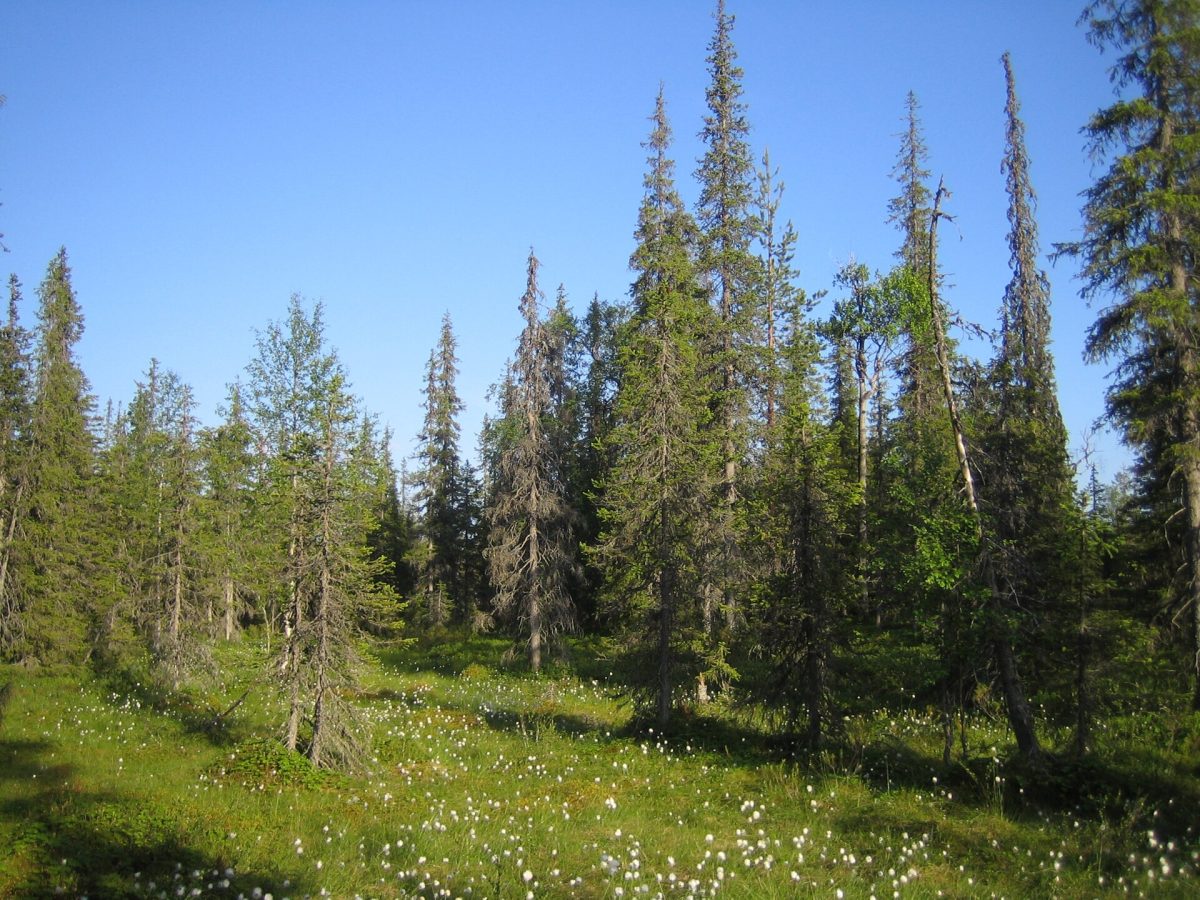
Photo: Original uploader was Hujane at fi.wikipedia, CC BY-SA 3.0
Syöte is a quiet forest park in the fell country of northern Finland, where the region of Northern Ostrobothnia meets the southern edge of Lapland, about 140 kilometres and two hours north-east of the coastal city of Oulu, whose airport has frequent flights from Helsinki, and about the same distance south of Rovaniemi. It lies beside Iso-Syöte and Pikku-Syöte, the southernmost fells in Finland, which carry two small downhill ski resorts, a hilltop hotel with wide views, holiday cottages and a husky farm or two, and between them a visitor centre for the national park, where there is an exhibition, a café, maps and advice, and from which the most used trails begin. A car is the practical way to come, since buses from Oulu and the railway town of Pudasjärvi are infrequent; the day trips sold from Oulu supply the transport, a guide and a meal cooked on an open fire.
The park is free. It is best known within Finland for two things: a long season of reliable, heavy snow, on which a large network of groomed cross-country ski tracks, marked snowshoe trails and winter cycling routes are maintained, and one of the best networks of mountain-bike trails in any Finnish national park, more than a hundred kilometres of them. Hikers have some 120 kilometres of marked paths, from short circuits near the visitor centre, such as the three-kilometre nature trail and the Naamanka loop, to the Ahmankierros of seventeen kilometres and multi-day routes using the park's free open wilderness huts, lean-tos and campfire sites stocked with firewood. Local guides offer snowshoe hikes, forest walks with a campfire meal, fat-bike tours and northern-lights outings.
Live dates and prices from GetYourGuide. Free cancellation on most tickets.
Syöte National Park was established in 2000 and covers about 300 square kilometres, in four separate blocks, in the municipalities of Pudasjärvi, Taivalkoski and Posio. It protects a chain of old-growth forests on a line of high forested hills, vaara in Finnish, between about 250 and 430 metres, which belong to the watershed region called the Maanselkä; because of their height, these hills catch far more snow than the country around them, and their spruce forests are one of the best examples in Finland of what foresters call high-altitude forest, where in midwinter the moisture in the air freezes onto the trees in a thick crust of rime and packed snow, tykky, up to several thousand kilograms on a single spruce, bending and breaking the crowns and shaping the narrow, candle-like form of the trees. In February and March, under a low sun, the snow-laden forest on the summits is a spectacle of white columns.
The spruces are old, many over two hundred years, bearded with hanging lichens that need clean air and undisturbed forest, and standing and fallen dead wood supports rare beetles and fungi. About a quarter of the park is mire: open aapa bogs, sloping hillside fens fed by springs, and wooded swamps. The human history is of a poor frontier. People lived here by slash-and-burn farming, hay-making on natural flood meadows along the streams, reindeer herding, which still continues, this being at the southern limit of the reindeer husbandry area, tar burning and logging; old meadow barns stand by the brooks, and the Rytivaara crown tenant farm, a restored settler's homestead deep in the forest, shows how hard the life was. Bears, wolverines, lynx, otters, elk and flying squirrels live in the park, and the birds are those of the northern taiga: the Siberian jay, the three-toed woodpecker, the capercaillie, the hazel grouse, the red-flanked bluetail, a rarity from the east that sings from the old spruces on the hilltops, and hawk, Tengmalm's and great grey owls.
The park is open at all times. Snow usually lies from late October or November to early May, among the longest snow seasons south of Lapland proper, with the deepest cover, often more than a metre, and the heaviest crown snow from January to March, the darkest days in December and the best light and skiing in March and early April; the northern lights may be seen on clear nights from September to March.
Summer, from June to August, brings the nightless night, hiking, biking and, from mid-June to late July, many mosquitoes. The autumn colours arrive in the second and third weeks of September, with berries and mushrooms. Winter temperatures of minus twenty-five are not unusual. Allow two days. Pudasjärvi is forty minutes away, Oulu two hours, Kuusamo and the Oulanka and Riisitunturi parks an hour and a half north-east, and Rovaniemi two hours north.
Yes. GetYourGuide lists 3 tickets and tours for Syöte National Park, with live dates and prices and free cancellation on most of them.
The park is open at all times.
Syöte National Park covers 302 km².
Syöte National Park was established in 2000.
Syöte National Park receives about 88 200 a year (2024).
Syöte National Park is in Finland. The map on this page shows the exact spot.
Finland
The Archipelago National Park lies in the outer skerries of the Archipelago Sea off south-west Finland, south of the…
21 tickets & tours
Finland
Riisitunturi is the fell park of the candle spruces in Finnish Lapland, an hour and a half south-east of Rovaniemi near…
17 tickets & tours
Finland
Nuuksio is the forest and lake country on the north-western doorstep of Helsinki, forty-five minutes from the city…
8 tickets & tours
Finland
Oulanka is the river and forest wilderness of north-eastern Finland, just below the Arctic Circle on the Russian…
6 tickets & tours
Finland
Pyhä-Luosto is a chain of fells in central Finnish Lapland, about 130 kilometres and an hour and a half to two hours…
3 tickets & tours
Finland
Urho Kekkonen National Park, UKK to everyone in Finland, is the great wilderness of north-eastern Finnish Lapland,…
3 tickets & tours