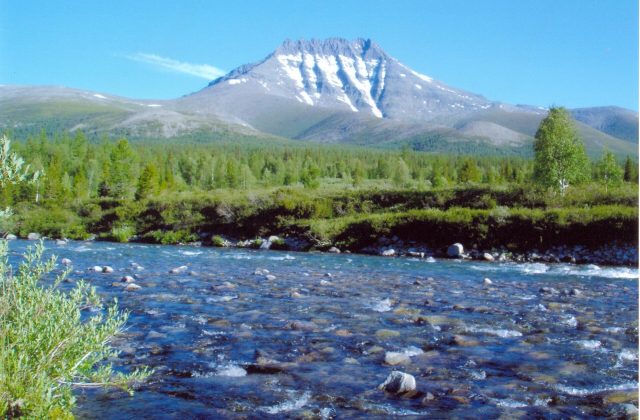
Yugyd Va National Park
Russia
Yugyd Va lies on the western slope of the Northern and Subpolar Urals, in the Komi republic, in the far north-east of…
No online ticket

Photo: Timinilya, CC BY-SA 4.0
The Russian Arctic National Park covers the two most northerly pieces of land in Eurasia, the archipelago of Franz Josef Land and the northern tip of Novaya Zemlya, in the Barents Sea and the Arctic Ocean, and it is one of the most inaccessible protected areas on earth. There is no civilian settlement, no airport open to the public, no accommodation and no independent access: the territory lies in a border security zone, entry to which requires permits from the Russian security service as well as from the park's administration in Arkhangelsk, and the only visitors have been the passengers of expedition cruise ships. In the years when such voyages operated normally, they were of two kinds. Ice-strengthened expedition vessels carrying about a hundred passengers sailed in July and August from Longyearbyen, in Spitsbergen, or from Murmansk, on voyages of about two weeks, spending five or six days among the islands of Franz Josef Land, with landings by inflatable boat, where ice and bears allowed, at the historic sites and bird cliffs, accompanied by park rangers and armed guards.
And the Russian nuclear icebreaker that carries tourists from Murmansk to the North Pole several times each summer called at the archipelago on the way, landing its passengers by helicopter. Since 2022 the war in Ukraine and the sanctions that followed have ended almost all voyages by foreign operators, western governments advise against travel to Russia, and flights and payments are difficult, so that for most readers a visit is not at present a practical possibility; a few Russian-operated sailings from Murmansk have continued, chiefly for the domestic market. This entry describes what the park contains, for the sake of completeness and in the expectation that it may some day be reachable again. A similar experience of the high Arctic, of polar bears, walruses and ice, is obtainable at Svalbard.
The national park was created in June 2009, initially on the northern part of the northern island of Novaya Zemlya and the adjoining sea, and in 2016 it was enlarged to absorb the federal reserve of Franz Josef Land, bringing it to some 88,000 square kilometres of land and sea, which makes it the largest national park in Russia. Franz Josef Land consists of 192 islands, lying between eighty and nearly eighty-two degrees north, within nine hundred kilometres of the pole; Cape Fligely, on Rudolf Island, is the northernmost point of Europe and Asia. Some eighty-five per cent of their surface is covered by ice caps, from which glaciers reach the sea on all sides, and the ice-free ground is a polar desert of basalt plateaus and raised beaches, with mosses, lichens and, in sheltered places in July, poppies and saxifrages. The archipelago was the last major piece of land on earth to be discovered: it was found by accident in August 1873 by an Austro-Hungarian expedition under Julius Payer and Karl Weyprecht, whose ship, the Tegetthoff, had been frozen into the pack ice off Novaya Zemlya and had drifted helplessly for a year, and who named it after their emperor. For the next forty years it was the springboard of attempts on the pole, and the relics of those expeditions, preserved by the cold, are what visitors are shown.
At Cape Flora, on Northbrook Island, the British explorer Frederick Jackson had his base from 1894 to 1897, and there, in June 1896, occurred one of the most extraordinary meetings in the history of exploration, when Jackson, hearing dogs bark, walked out and found a filthy, long-haired man on skis, who proved to be Fridtjof Nansen; Nansen and his companion Hjalmar Johansen had left their ship, the Fram, fifteen months before to try for the pole, had turned back at a record latitude, and had passed the winter in a hut of stones and walrus hides on another island, living on bear meat. At Tikhaya Bay, on Hooker Island, stand the wooden buildings of the first Soviet polar station, established in 1929, now restored by the park, with the world's northernmost post office, beside the towering bird cliff of Rubini Rock. On Champ Island the ground is strewn with perfectly spherical stone balls, from a few centimetres to three metres across, natural concretions whose origin is still discussed. The Soviet Union annexed the archipelago in 1926, and it still holds military bases, on Alexandra Land and elsewhere. The park's wildlife is that of the high Arctic: polar bears, for which the islands are an important denning area, Atlantic walruses, in rookeries of hundreds, bowhead whales, of a population once hunted almost to extinction, narwhals, belugas, ringed and bearded seals, arctic foxes, and immense colonies of little auks, Brunnich's guillemots, kittiwakes, fulmars and the rare, pure white ivory gull.
The only season in which ships can reach the archipelago is from about mid-July to the end of August, when the sea ice has retreated sufficiently, and even then the ice, fog and wind decide each day's programme, and whole sections of an itinerary are regularly abandoned. At that time the sun does not set, the air temperature stays between about minus two and plus five degrees, and fog is frequent. Polar bears are present everywhere, and no landing is made until the shore has been scouted and guards posted.
For the rest of the year the islands are locked in ice and, from October to February, in darkness, with temperatures of minus twenty-five to minus forty. Anyone considering a voyage when circumstances permit should book more than a year ahead, bring windproof and waterproof clothing, warm layers and rubber boots, and must at present check the travel advice of their own government, the state of sanctions and the validity of insurance before making any commitment. Allow two weeks.
No online tour for Russian Arctic National Park is listed on GetYourGuide; entry, where it is charged, is paid at the gate or through the park authority. Nearby parks with bookable tours are listed on this page.
Russian Arctic National Park covers 88 000 km².
Russian Arctic National Park was established in 2009.
Russian Arctic National Park is in Russia. The map on this page shows the exact spot.
Russia
Yugyd Va lies on the western slope of the Northern and Subpolar Urals, in the Komi republic, in the far north-east of…
No online ticket