
Grand Canyon National Park
Arizona, United States
The Grand Canyon, in northern Arizona, is the most famous natural sight in the United States, and the first thing a…
180 tickets & tours
Desert Park · Arizona · United States
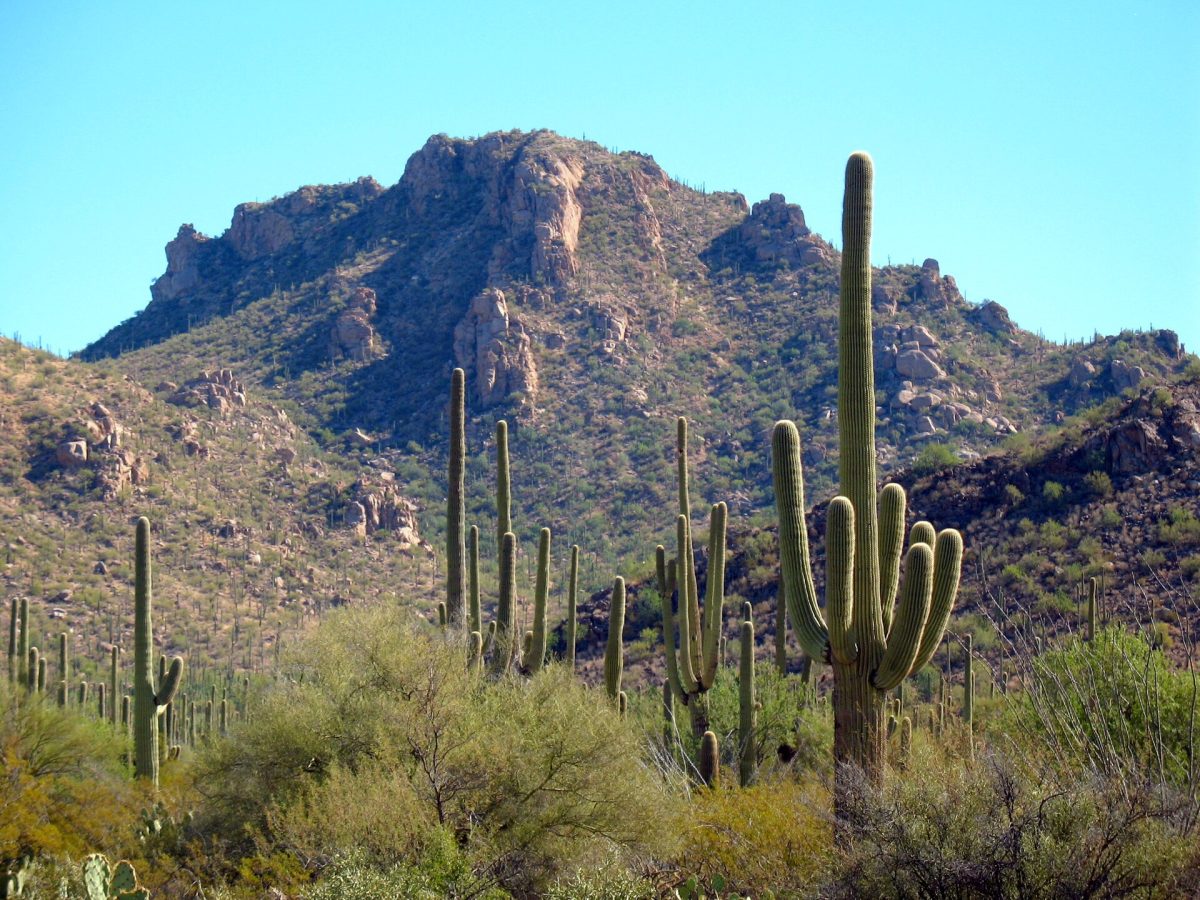
Photo: Luke Jones from Yucca Valley, CC BY 2.0
Saguaro National Park protects the giant cactus that is the emblem of the American south-west, and it is unusual in consisting of two separate districts on opposite sides of a city, Tucson, in southern Arizona, each fifteen to twenty minutes' drive from the centre and about fifty kilometres from the other; Phoenix is an hour and a half to two hours to the north, and day tours from there sometimes combine the park with the old mining and gunfighting towns of Tombstone and Bisbee. A car is necessary, and the entrance fee, per vehicle, is valid for a week in both districts. The western one, the Tucson Mountain district, is smaller, lower and hotter, and has the denser stands of saguaros, a true forest of them;
from its Red Hills visitor centre, where a film presents the desert from the point of view of the Tohono O'odham people, the unpaved Bajada loop drive, of about ten kilometres, passable by ordinary cars, leads to short walks such as the Valley View overlook trail, half an hour, and the Signal Hill trail, ten minutes to a knoll of boulders covered with petroglyphs pecked by the Hohokam people about a thousand years ago. Next door is the Arizona-Sonora Desert Museum, a first-rate zoo and botanical garden of the region, which most visitors combine with it. The eastern one, the Rincon Mountain district, is much larger and climbs into high mountains; its paved Cactus Forest loop drive, thirteen kilometres, one way, popular with cyclists, gives access to the short Desert Ecology trail, the Freeman Homestead trail and the network of paths in the cactus forest, while long trails climb six thousand feet into a roadless wilderness of oak and pine, where backpackers camp with a permit. There is no lodging, food or campground reached by car in either district.
Live dates and prices from GetYourGuide. Free cancellation on most tickets.
A national monument was proclaimed here by President Hoover in 1933, in the last days of his term, at the urging of the University of Arizona's botanists, the western district was added by President Kennedy in 1961, and the whole became a national park in 1994, covering about 370 square kilometres, most of it designated wilderness. The saguaro, pronounced sa-wah-ro, grows wild only in the Sonoran desert of southern Arizona and north-western Mexico, and its life is a lesson in patience. A plant produces tens of millions of seeds in its lifetime, of which perhaps one survives; the seedling, which must germinate in the shade of a nurse tree, generally a palo verde or a mesquite, to escape the sun, frost and rodents, is barely four centimetres tall after eight or ten years; it first flowers at about thirty-five, begins to grow its first arm at fifty to seventy-five, or in drier places at a hundred, and may live for a hundred and fifty to two hundred years, reaching twelve to fifteen metres and, when swollen with water after rain, a weight of several tons, supported by an internal ring of woody ribs. Its pleated skin expands like a concertina to store water drawn in by a shallow net of roots as wide as the plant is tall.
In May and June each stem tip bears a crown of creamy white flowers, the state flower of Arizona, which open at night and close by the following noon, pollinated by long-nosed bats that migrate from Mexico, by white-winged doves and by bees, and in late June the red fruits split open; the Tohono O'odham have harvested them for centuries with long poles made of saguaro ribs, to make syrup, jam and a ceremonial wine drunk to bring the summer rains, and their new year begins with the harvest, which they are still permitted to carry on in the park. The cactus is a block of flats for the desert's animals: Gila woodpeckers and gilded flickers dig nest holes in it, which the plant lines with hard scar tissue, and which are afterwards occupied by elf owls, the smallest owls in the world, purple martins, flycatchers and screech owls, while Harris's hawks and red-tailed hawks nest in the arms. The park's other inhabitants include javelinas, coyotes, bobcats, mule deer, desert tortoises, the Gila monster, a venomous lizard beaded in black and orange, six kinds of rattlesnake, roadrunners, Gambel's quail and cactus wrens. The eastern district rises to 2,641 metres at Mica Mountain, one of the sky islands of the borderlands, with forests of ponderosa pine and fir, black bears and white-tailed deer. Severe frosts, as in 1937 and 1962, kill many saguaros, and the theft of cacti for gardens has led the rangers to implant microchips in those near the roads.
Both districts are open daily from sunrise to sunset to vehicles, and at all hours to walkers, with the visitor centres open from 9 am to 5 pm. The season is from October to April, when days are sunny and mild, 18 to 28 degrees, and nights cool; wild flowers, poppies, lupins and brittlebush, bloom in March and early April after a wet winter, other cacti in April, and the saguaros themselves from late April to early June, when it is already hot.
From May to September temperatures regularly exceed 40 degrees, walking is safe only in the first hours after dawn, and from early July to mid-September the summer monsoon brings spectacular afternoon thunderstorms, lightning and flash floods in the washes. The western district is the place for sunset, when the cacti stand in silhouette. Carry at least a litre of water for each hour of walking, wear a hat, watch where hands and feet are put, and keep clear of cholla cactus. Allow half a day for each district. Tucson, the mission of San Xavier del Bac and Mount Lemmon are all within an hour.
Yes. GetYourGuide lists one ticket or tour for Saguaro National Park, with live dates and prices and free cancellation on most of them.
A car is necessary, and the entrance fee, per vehicle, is valid for a week in both districts.
Both districts are open daily from sunrise to sunset to vehicles, and at all hours to walkers, with the visitor centres open from 9 am to 5 pm.
Allow half a day for each district.
Saguaro National Park covers 374 km².
Saguaro National Park was established in 1933.
Saguaro National Park receives about 946 369 a year (2024).
Saguaro National Park is in Arizona, United States. The map on this page shows the exact spot.
Arizona, United States
The Grand Canyon, in northern Arizona, is the most famous natural sight in the United States, and the first thing a…
180 tickets & tours
Arizona, United States
Petrified Forest lies on the high, windy plateau of north-eastern Arizona, and it is one of the easiest of all the…
No online ticket
