
Grand Canyon National Park
235 km away
The Grand Canyon, in northern Arizona, is the most famous natural sight in the United States, and the first thing a…
180 tickets & tours
Desert Park · Arizona · United States
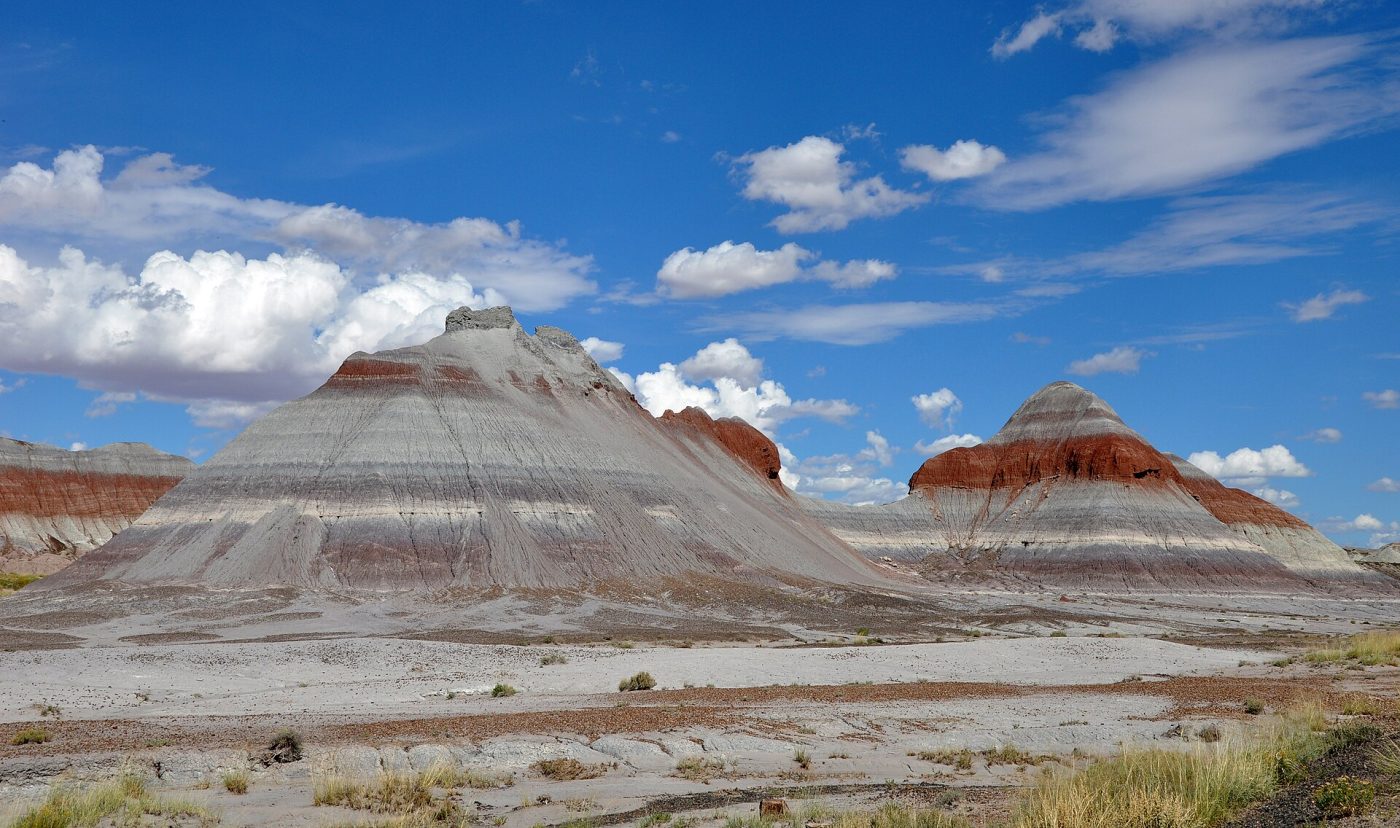
Photo: Finetooth, CC BY-SA 3.0
Petrified Forest lies on the high, windy plateau of north-eastern Arizona, and it is one of the easiest of all the national parks of the American West to visit, because Interstate 40, the main highway across the south-west, which here follows the line of the old Route 66, runs straight through the middle of it. It is about an hour and three quarters by road east of Flagstaff, three and a half hours from Phoenix and three from Albuquerque, and the nearest town, with motels and restaurants, is Holbrook, half an hour to the west; there is no lodging and no campground in the park, and no public transport. The entrance fee, per vehicle, is valid for seven days. The park is arranged along a single paved road of forty-five kilometres, which runs from a northern entrance, directly off the interstate, to a southern one on highway 180, so that travellers crossing the country can drive through it in one direction and rejoin their route, a detour of an hour and a half if they hardly stop and of half a day if they do it properly.
There is a visitor centre at each end. The northern third is the Painted Desert, seen from a series of overlooks on the rim of a plateau, with the Painted Desert Inn, a restored adobe building that is now a museum, and the rusting shell of a 1932 car marking the place where Route 66 crossed. South of the interstate, the road passes the ruins of Puerco Pueblo, the petroglyphs of Newspaper Rock, seen through telescopes from above, the banded cones of the Tepees, and the side road to Blue Mesa, where a steep paved loop trail of a mile descends among blue and purple badlands. The great concentrations of petrified wood lie in the south: Jasper Forest, Crystal Forest, with an easy loop trail, and, behind the Rainbow Forest museum, the Giant Logs trail and the Long Logs trail, where the biggest and most numerous trunks lie.
Petrified Forest was proclaimed a national monument by Theodore Roosevelt in 1906, among the first to be created under the act that gave presidents that power, and for a pressing reason, since the wood was being carried away by the wagonload and a mill was planned to crush the logs into industrial abrasive; it became a national park in 1962 and has been enlarged to about nine hundred square kilometres, most of it wilderness. It contains one of the largest and most colourful deposits of petrified wood in the world. Some 218 million years ago, in the late Triassic period, this was a broad tropical flood plain near the equator, crossed by rivers flowing north-west, with forests of tall conifers, some of which grew sixty metres high, tree ferns and giant horsetails. Trees that fell were carried off by floods and buried in silt mixed with ash from distant volcanoes; cut off from oxygen, they did not rot, and over thousands of years the groundwater, charged with silica dissolved from the ash, replaced the woody tissue, cell by cell, with quartz, preserving in places the grain, the knots and the growth rings, while impurities of iron, manganese and carbon stained the stone red, yellow, orange, purple, black and white. Buried for two hundred million years and then uplifted with the Colorado plateau, the logs are now being released by erosion from the soft clays that enclose them, and lie scattered over the surface in their thousands, mostly broken cleanly into sections, as though by a saw, because the brittle quartz snapped as the ground shifted.
The same beds, the Chinle formation, banded in lavender, grey, blue, red and white, erode into the rounded, barren badlands of the Painted Desert and Blue Mesa, whose colours are strongest in low light and after rain, and they are one of the richest sources anywhere of fossils from the dawn of the age of dinosaurs, crocodile-like phytosaurs, armoured aetosaurs, giant amphibians and some of the earliest dinosaurs themselves, small, slender animals not yet the rulers of the world, new species being found by the park's palaeontologists almost every year. People have lived here for more than thirteen thousand years, and more than a thousand archaeological sites have been recorded, including Puerco Pueblo, a village of a hundred rooms occupied in the thirteenth and fourteenth centuries, the Agate House, a small dwelling built entirely of blocks of petrified wood, and hundreds of petroglyphs, some of which act as solar calendars, a shaft of light crossing a spiral at the summer solstice. In spite of its name the park is grassland, not desert, among the best surviving examples of the shortgrass prairie of the plateau, grazed by pronghorn and inhabited by coyotes, bobcats, prairie dogs, golden eagles, ravens and collared lizards. The taking of petrified wood is strictly forbidden and carries a heavy fine; pieces sold in the shops of Holbrook come from private land, and the park used to display letters from remorseful visitors returning stolen fragments, which they blamed for subsequent misfortune.
Unlike most national parks, this one keeps fixed hours, the road being open only during the day, generally from eight in the morning to five or six in the evening, with gates that are locked at night, so that sunrise and sunset can be seen from inside only by arrangement or on special occasions. Spring and autumn, from April to early June and from September to October, are the most pleasant seasons, with days of 18 to 28 degrees; spring is very windy.
Summer is hot, 32 to 38 degrees, with no shade on the trails, and from July to early September the monsoon brings dramatic afternoon thunderstorms, lightning, which is a real danger on the open ground, and rainbows, after which the colours of the badlands are at their deepest. Winter is cold, often below freezing at night, with occasional snow, which makes a beautiful contrast with the rock, and very few visitors. The park lies at 1,700 metres, and the sun is strong at all seasons. Carry water on every walk. Allow half a day. Holbrook is half an hour away, the Canyon de Chelly two hours north, and the meteor crater near Winslow an hour west.
235 km away
The Grand Canyon, in northern Arizona, is the most famous natural sight in the United States, and the first thing a…
180 tickets & tours
269 km away
Mesa Verde is in the south-west corner of Colorado, its entrance ten miles east of Cortez and thirty-five west of…
7 tickets & tours
329 km away
Saguaro National Park protects the giant cactus that is the emblem of the American south-west, and it is unusual in…
1 ticket or tour
No online tour for Petrified Forest National Park is listed on GetYourGuide; entry, where it is charged, is paid at the gate or through the park authority. Nearby parks with bookable tours are listed on this page.
The entrance fee, per vehicle, is valid for seven days.
Petrified Forest National Park covers 895 km².
Petrified Forest National Park was established in 1906.
Petrified Forest National Park receives about 315 951 a year (2025).
Petrified Forest National Park is in Arizona, United States. The map on this page shows the exact spot.
Arizona, United States
The Grand Canyon, in northern Arizona, is the most famous natural sight in the United States, and the first thing a…
180 tickets & tours
Arizona, United States
Saguaro National Park protects the giant cactus that is the emblem of the American south-west, and it is unusual in…
1 ticket or tour

