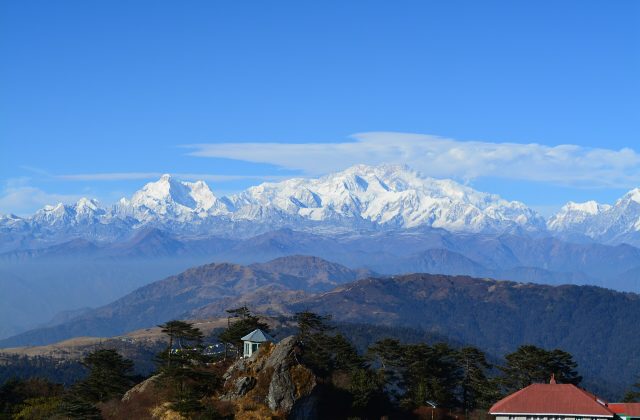
Singalila National Park
West Bengal, India
Singalila is a high forested ridge on the frontier between India and Nepal, in the Darjeeling hills of West Bengal, and…
3 tickets & tours
Wetland Park · West Bengal · India

Photo: Soumyajit Nandy, CC BY-SA 4.0
The Sundarbans is the vast mangrove forest at the mouths of the Ganges and the Brahmaputra, on the Bay of Bengal, shared between India and Bangladesh, the largest of its kind in the world, and the Indian national park protects the core of the Indian part, in the state of West Bengal, about a hundred kilometres south-east of Kolkata. It is a world of water, mud and tides, and everything about a visit follows from the fact that there are no roads and that nobody may set foot in the forest: one travels entirely by boat, and looks from the deck and from fenced watchtowers. From Kolkata one drives, or takes a suburban train to Canning and a shared vehicle on, about three hours in all, to the jetty of Godkhali, the end of the road, and crosses by ferry to the inhabited island of Gosaba, from which it is a short ride to the villages of Pakhiralay and Dayapur, on the river facing the forest, where most of the lodges, resorts and the government tourist lodge stand.
Nearly all visitors come on packages of two or three days from Kolkata, which include transport, lodging, meals and the boat, and this is much the simplest way. Permits, entry fees and a compulsory forest department guide are obtained at the Sajnekhali station, across the river, which has a small interpretation centre, a crocodile pond and a watchtower. The days are then spent cruising slowly along the broad rivers and into narrow creeks in a wooden motor launch, scanning the mudbanks at low tide, and landing at a series of watchtowers, reached by caged walkways, at Sudhanyakhali, which overlooks a sweet-water pond where animals come to drink and is reckoned the likeliest for tigers, Dobanki, which has a canopy walk half a kilometre long through the mangroves, and, on longer trips, Netidhopani, with the ruins of an old temple, and Burirdabri. The chance of seeing a tiger is small, and one should come for the place, not the cat.
Live dates and prices from GetYourGuide. Free cancellation on most tickets.
The Indian Sundarbans was made a tiger reserve in 1973, its core was declared a national park in 1984, covering 1,330 square kilometres, and this was inscribed as a World Heritage Site in 1987, the adjoining Bangladeshi forest following in 1997; the whole mangrove region covers some ten thousand square kilometres, of which about two fifths lie in India. It is the seaward edge of the largest delta on earth, a labyrinth of low, flat islands of silt divided by a mesh of tidal rivers, creeks and channels, some of them kilometres wide, in which the water rises and falls twice a day by five to seven metres, alternately drowning and exposing the forest floor, and nothing is permanent, islands being built up on one side and eaten away on the other. The name is generally derived from the sundari, a mangrove tree that was once dominant, and it may also be read as the beautiful forest. Some eighty species of mangroves and their associates grow here, the largest assemblage anywhere, recognisable by the forest of pointed breathing roots that stick up through the mud. It is the only mangrove forest in the world inhabited by tigers, about a hundred on the Indian side and a similar number in Bangladesh, which have adapted to an amphibious life, swimming across rivers several kilometres wide, drinking brackish water, and eating fish, crabs and monitor lizards as well as spotted deer and wild boar.
They are notorious as man-eaters. Every year a number of the villagers who enter the forest to fish, to catch crabs and to collect wild honey and firewood are killed, some dozens in a bad year, and the honey collectors, who go in each April in groups with a forest department permit, used to wear masks on the backs of their heads, because a tiger is believed to attack only from behind. Before entering, Hindus and Muslims alike pray at the small shrines of Bonbibi, the lady of the forest, a goddess peculiar to the delta, who protects all who enter with a pure heart and empty hands against Dakshin Rai, the demon king who takes the form of the tiger. The forest is also the home of the estuarine crocodile, which reaches six metres, the water monitor, the king cobra, the fishing cat, the Gangetic and Irrawaddy dolphins, the olive ridley turtle, the critically endangered river terrapin, which is bred at Sajnekhali, the lesser adjutant stork, eight species of kingfisher and the rare masked finfoot. Some four and a half million people live on the embanked islands on the forest's northern fringe, among the poorest and most exposed in India: cyclones, such as Aila in 2009 and Amphan in 2020, regularly breach the earthen dykes and flood the fields with salt water, and the sea is rising here faster than the world average, so that several islands have already vanished and their inhabitants have become refugees.
The park is open all year, but the season is the cool, dry winter, from November to February, when the days are sunny and pleasant, 15 to 27 degrees, the rivers calm, and crocodiles and, occasionally, tigers bask on the banks; December and January, and the period round Christmas and New Year especially, are crowded with visitors from Kolkata, and the launches then queue at the watchtowers. March to May is hot and humid, up to 38 degrees, with violent pre-monsoon storms, though April is the honey season and animals come to the ponds to drink;
from June to September the monsoon brings heavy rain, rough water and the risk of cyclones, which continue into November, and few boats go out. The tide table governs everything, the mudbanks and the wildlife on them being visible only at low water. Bring binoculars, a hat, sunscreen, mosquito repellent and warm clothing for winter mornings on the water, and never trail a hand in the river. Allow two nights. Kolkata is three to four hours away.
Yes. GetYourGuide lists one ticket or tour for Sundarbans National Park, with live dates and prices and free cancellation on most of them.
Sundarbans National Park covers 1 330 km².
Sundarbans National Park was established in 1984.
Sundarbans National Park is in West Bengal, India. The map on this page shows the exact spot.
West Bengal, India
Singalila is a high forested ridge on the frontier between India and Nepal, in the Darjeeling hills of West Bengal, and…
3 tickets & tours