
Una National Park
Bosnia and Herzegovina
The Una is a river of astonishing emerald clarity in the north-western corner of Bosnia and Herzegovina, along the…
2 tickets & tours
Forest Park · Bosnia and Herzegovina
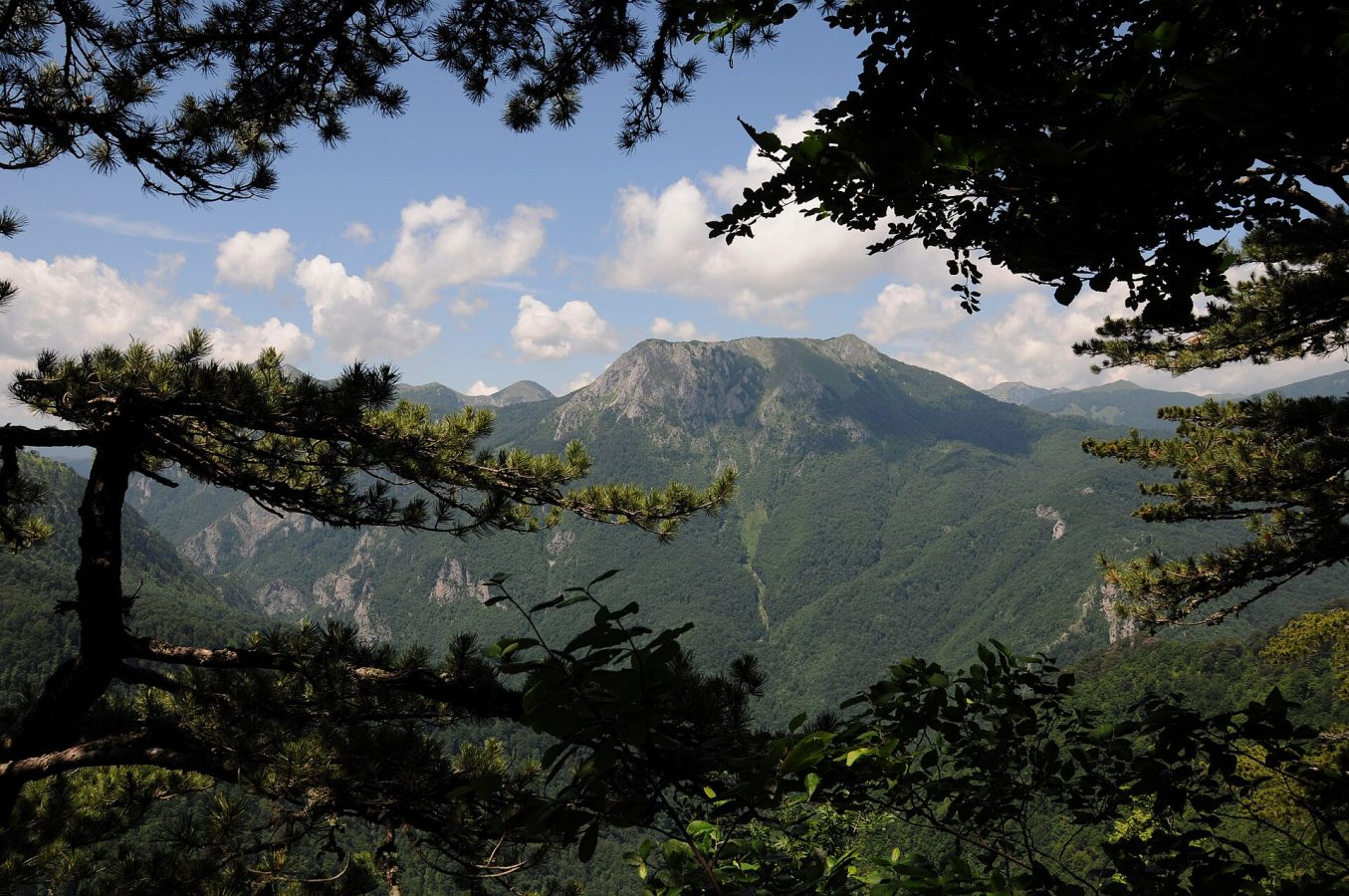
Photo: Budzak2, CC BY-SA 4.0
Sutjeska is the oldest national park of Bosnia and Herzegovina, in the south-east of the country against the border of Montenegro, and it contains the country's highest mountain, one of the last primeval forests in Europe and the most imposing war memorial of the former Yugoslavia. It is about a hundred kilometres, two to two and a half hours by road, from Sarajevo, and three hours from Dubrovnik, the main road between the two, by way of the town of Foca, running through the park along the gorge of the Sutjeska river; buses on this route stop at Tjentiste, the only settlement, where there are a hotel, a campsite, the park office and the memorial, and where the entrance fee is paid. Tjentiste can be seen without any effort. Everything else lies up rough forest roads, steep and stony, for which a four-wheel drive is necessary, and this is why most visitors join a guided day tour by jeep, with hiking, from Foca, twenty kilometres to the north, which is also the base for rafting on the Tara, or from Sarajevo.
The standard excursion climbs to the viewpoint of Dragos Sedlo, which looks across the canopy of the Perucica forest to the Skakavac waterfall, continues to the high pasture of Prijevor, at 1,668 metres, and from there walks, in about an hour and a half each way, across the border to the heart-shaped Trnovacko lake, in Montenegro, under a ring of peaks, for which passports should be carried. Prijevor is also the starting point for the ascent of Maglic, four to five hours up by a steep route with fixed cables in places, for experienced walkers, or a longer, easier way from the lake. The interior of Perucica may be entered only with a park ranger, arranged at the office. On the other side of the valley, the Zelengora range offers gentle walking between mountain lakes.
Live dates and prices from GetYourGuide. Free cancellation on most tickets.
The national park was established in 1962 and covers about 175 square kilometres on either side of the Sutjeska river, which has cut a canyon more than a thousand metres deep between the Zelengora mountains, on the west, and the massifs of Maglic, Volujak and Bioc, on the east. Maglic, 2,386 metres, whose summit stands exactly on the frontier, is the highest peak of Bosnia and Herzegovina, a bastion of pale limestone rising sheer above the forest. Below it lies Perucica, some 1,400 hectares of forest that has never been felled, in a steep, enclosed valley so difficult of access that it escaped the axe, and was set aside as a strict reserve as early as 1952; it is regarded as one of the two largest surviving primeval forests of the continent. Beech, silver fir and spruce, with sycamore, ash, elm and black pine on the crags, grow here to heights of more than fifty metres, some of them three hundred years and more in age, and the ground is strewn with fallen giants in every stage of decay, which support fungi, mosses, insects and woodpeckers in a profusion unknown in managed forest; some 170 species of trees and shrubs and more than a thousand herbaceous plants have been recorded. In the middle of it the Perucica stream leaps from a ledge as the Skakavac, the grasshopper, a fall of about seventy-five metres. Bears, wolves, wild boar, chamois, roe deer, martens, wildcats, golden eagles, capercaillie and eagle owls inhabit the park.
The name of the Sutjeska is known to everyone in the former Yugoslavia for another reason. In May and June 1943, in what the Germans called Operation Black, some 127,000 German, Italian, Bulgarian and Croatian troops encircled the main force of Tito's partisans, about 22,000 men and women encumbered with several thousand wounded and sick with typhus, in these mountains, with the aim of annihilating them; after a month of fighting the partisans broke out across the Sutjeska at Tjentiste, Tito himself being wounded, at the cost of more than seven thousand dead, a third of their strength, among them the commander Sava Kovacevic, and most of the wounded, who were left behind and killed. The battle became the founding epic of socialist Yugoslavia. In the Valley of Heroes at Tjentiste, where 3,301 of the dead are buried, stands the monument by the sculptor Miodrag Zivkovic, completed in 1971, two colossal, fractured wings of white concrete, nineteen metres high, framing a passage through which the visitor walks, one of the most powerful of the abstract memorials that Yugoslavia built; a memorial house near by, with large frescoes by Krsto Hegedusic, has been restored. A film of the battle, made in 1973 at vast expense, had Richard Burton in the part of Tito. The war of the 1990s left the monument damaged and the park neglected, and mines were laid in a few places away from the visited areas, so that marked paths should be kept to.
The park is open all year, but the forest roads to Prijevor and Zelengora are generally passable only from about late May or June to October, and the high routes on Maglic carry snow until June. July and August are warm and stable, the busiest months, with a rock music festival at Tjentiste in July; June has flowers on the high pastures and full waterfalls; September and the first half of October are clear and quiet, with the beeches of Perucica turning copper and gold, the finest sight of the year.
Afternoon thunderstorms are common in summer, so start early for Maglic. Winter brings deep snow, and only Tjentiste is accessible. Bring walking boots, waterproofs, a passport for the lake, and cash, and do not leave marked trails. Allow a full day, two with Maglic. Foca and the rafting camps of the Tara canyon are half an hour away, Sarajevo two hours, and Durmitor, in Montenegro, two and a half.
Yes. GetYourGuide lists one ticket or tour for Sutjeska National Park, with live dates and prices and free cancellation on most of them.
The park is open all year, but the forest roads to Prijevor and Zelengora are generally passable only from about late May or June to October, and the high routes on Maglic carry snow until June.
Allow a full day, two with Maglic.
Sutjeska National Park covers 175 km².
Sutjeska National Park was established in 1962.
Sutjeska National Park is in Bosnia and Herzegovina. The map on this page shows the exact spot.
Bosnia and Herzegovina
The Una is a river of astonishing emerald clarity in the north-western corner of Bosnia and Herzegovina, along the…
2 tickets & tours
Bosnia and Herzegovina
Kozara is a small park on a densely wooded mountain in the north-west of Bosnia and Herzegovina, in the entity of…
No online ticket
