Banff National Park
Alberta, Canada
Banff is Canada's first and most visited national park, ninety minutes west of Calgary, and it is sold in every…
61 tickets & tours
Mountain Park · Alberta · Canada
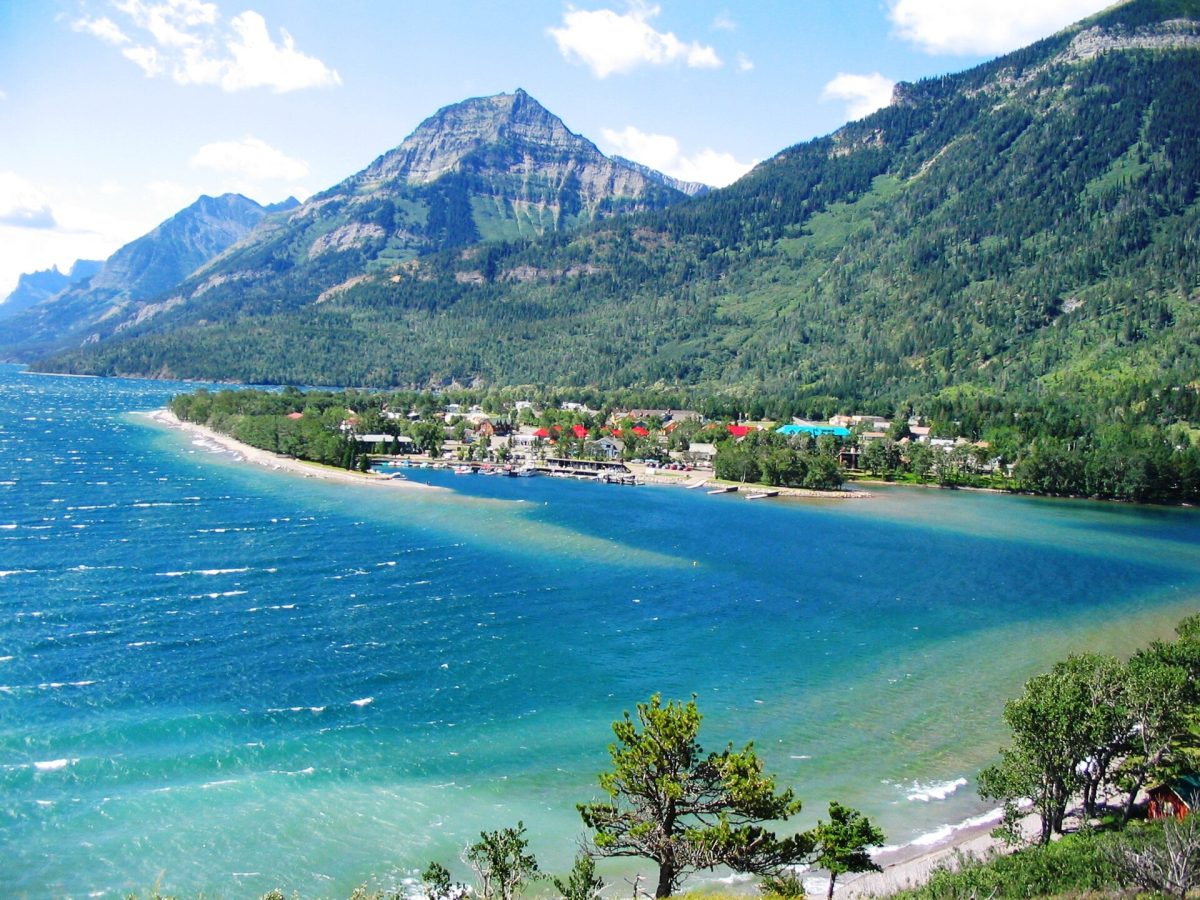
Photo: Kenneth Hynek from Edmonton, Canada, CC BY 2.0
Waterton Lakes lies in the south-western corner of the Canadian province of Alberta, against the border of Montana, at the point where the prairies run straight into the Rocky Mountains without any intervening foothills, and it is a small, quiet and beautiful park, far less visited than Banff or Jasper, which forms with the American Glacier National Park, immediately to the south, a single international peace park. It is about two hundred and seventy kilometres, three hours by road, south of Calgary, which has the nearest large airport, an hour and a quarter from Lethbridge, and an hour from the Chief Mountain border crossing, open in summer, which leads to the eastern side of Glacier; there is no public transport, and a Parks Canada pass is required. Everything centres on the little township of Waterton, on the shore of Upper Waterton Lake beneath a ring of peaks, where deer graze on the lawns, which has motels, a campground, restaurants and the landmark Prince of Wales Hotel, a many-gabled timber building of 1927 standing alone on a windswept bluff above the lake.
From the town's marina a historic motor vessel, in service since 1927, makes a cruise of about two hours down the lake and across the international boundary, marked by a cleared strip through the forest, to the ranger station of Goat Haunt in Montana. Two scenic roads lead into the mountains: the Akamina parkway, sixteen kilometres to Cameron Lake, a subalpine lake at the foot of a snowy headwall on the American side, with canoes for hire, and the Red Rock parkway, fifteen kilometres up a valley of prairie and wild flowers to Red Rock canyon, a small gorge of vivid red and green rock with a loop path. The park is known for its day hikes: Bear's Hump, a steep climb of forty-five minutes above the town; the Bertha Lake and Carthew-Alderson trails; and Crypt Lake, reached by a boat across the lake and a route that includes a ladder, a tunnel and a cable.
Live dates and prices from GetYourGuide. Free cancellation on most tickets.
The park was set aside in 1895, as a forest park, at the urging of a local rancher, Frederick Godsell, and of John George Brown, known as Kootenai Brown, an Anglo-Irish adventurer, soldier, gold prospector, buffalo hunter and scout, who had settled by the lakes and became its first warden; it is thus the fourth oldest national park in Canada, and covers 505 square kilometres. In 1932, on the initiative of the Rotary clubs of Alberta and Montana, the parliaments of Canada and the United States joined it with Glacier as the Waterton-Glacier International Peace Park, the first of its kind in the world, commemorating the peace and goodwill between the two nations; the combined park was inscribed as a World Heritage Site in 1995, and Waterton has been a biosphere reserve since 1979. The lakes were named in 1858 by a member of the Palliser expedition after Charles Waterton, an eccentric English naturalist who never saw them. The mountains here are the result of the Lewis overthrust, one of the most celebrated structures in geology: a slab of very ancient sedimentary rock, several kilometres thick and laid down up to one and a half billion years ago, was pushed eastwards for some eighty kilometres over much younger and softer rocks, so that the oldest exposed sedimentary rocks in the Canadian Rockies sit on top of shales a thousand million years their junior. These old rocks are brightly coloured, red and green argillites, stained by iron in different states, buff limestones and dolomites, in which ripple marks, mud cracks and fossil colonies of algae can still be seen, and they give Red Rock canyon its colour.
Upper Waterton Lake, scooped out by a glacier, is 148 metres deep, the deepest lake in the Canadian Rockies. Because the prairie meets the mountains so abruptly, and because the park lies where several climatic regions overlap, it has a richer flora than any other in the Rockies, more than a thousand species of vascular plants, over half of all those found in Alberta, in an area smaller than most cities, including bear grass, with its tall white plumes, which reaches its northern limit here, and a wild flower festival is held each June. The grasslands and aspen groves of the valleys hold elk in large herds, mule and white-tailed deer, bighorn sheep, which wander through the town, and a small display herd of plains bison, and the mountains shelter grizzly and black bears, which are often seen along the parkways, cougars, wolves, mountain goats, moose and wolverines. In September 2017 the Kenow wildfire, driven by high winds, burned through thirty-eight per cent of the park in a few hours, including most of its forested valleys, destroying the visitor centre and many facilities, though the town and the hotel were saved; the blackened slopes are now covered with flowers and young growth, and the episode has been treated as an opportunity to show how these forests renew themselves. The Blackfoot, for whom these mountains are sacred, have used the valleys for more than ten thousand years.
The park is open all year, but it is essentially a summer destination, from about late May to the end of September, when the hotels, the boat and the parkways are all operating; in winter the town is almost deserted, most businesses close, the Akamina road is left unploughed for cross-country skiers, and only the keenest come. July and August are the warmest months, 20 to 25 degrees, and the busiest, though never crowded by the standards of Banff, with the wild flowers at their height in late June and July and the high trails free of snow from early July;
September is clear, cool and golden, with the elk rutting on the flats. Waterton is one of the windiest places in Alberta, gusts of more than a hundred kilometres an hour being common, particularly from autumn to spring. The Chief Mountain border crossing is open only from about mid-May to the end of September, and a passport is needed to land at Goat Haunt. Carry bear spray on every trail, make a noise, and check for closures. Allow two to three days. Head-Smashed-In Buffalo Jump, a World Heritage Site, is an hour and a half to the north.
Yes. GetYourGuide lists 10 tickets and tours for Waterton Lakes National Park, with live dates and prices and free cancellation on most of them.
The Chief Mountain border crossing is open only from about mid-May to the end of September, and a passport is needed to land at Goat Haunt.
Allow two to three days.
Waterton Lakes National Park covers 505 km².
Waterton Lakes National Park was established in 1895.
Waterton Lakes National Park is in Alberta, Canada. The map on this page shows the exact spot.
Alberta, Canada
Banff is Canada's first and most visited national park, ninety minutes west of Calgary, and it is sold in every…
61 tickets & tours
Alberta, Canada
Jasper is the largest and the quieter of the Canadian Rockies parks, four hours west of Edmonton and three and a half…
18 tickets & tours
Alberta, Canada
Elk Island is a small, fenced national park on the prairie's edge thirty-five minutes east of Edmonton, Alberta,…
No online ticket
Alberta, Canada
Wood Buffalo is the largest national park in Canada and one of the largest in the world, a tract of northern forest,…
No online ticket