
Grand Teton National Park
Wyoming, United States
Grand Teton is the range of granite peaks above Jackson Hole in Wyoming, ten miles south of Yellowstone, and it is sold…
38 tickets & tours
Volcano Park · Wyoming · United States
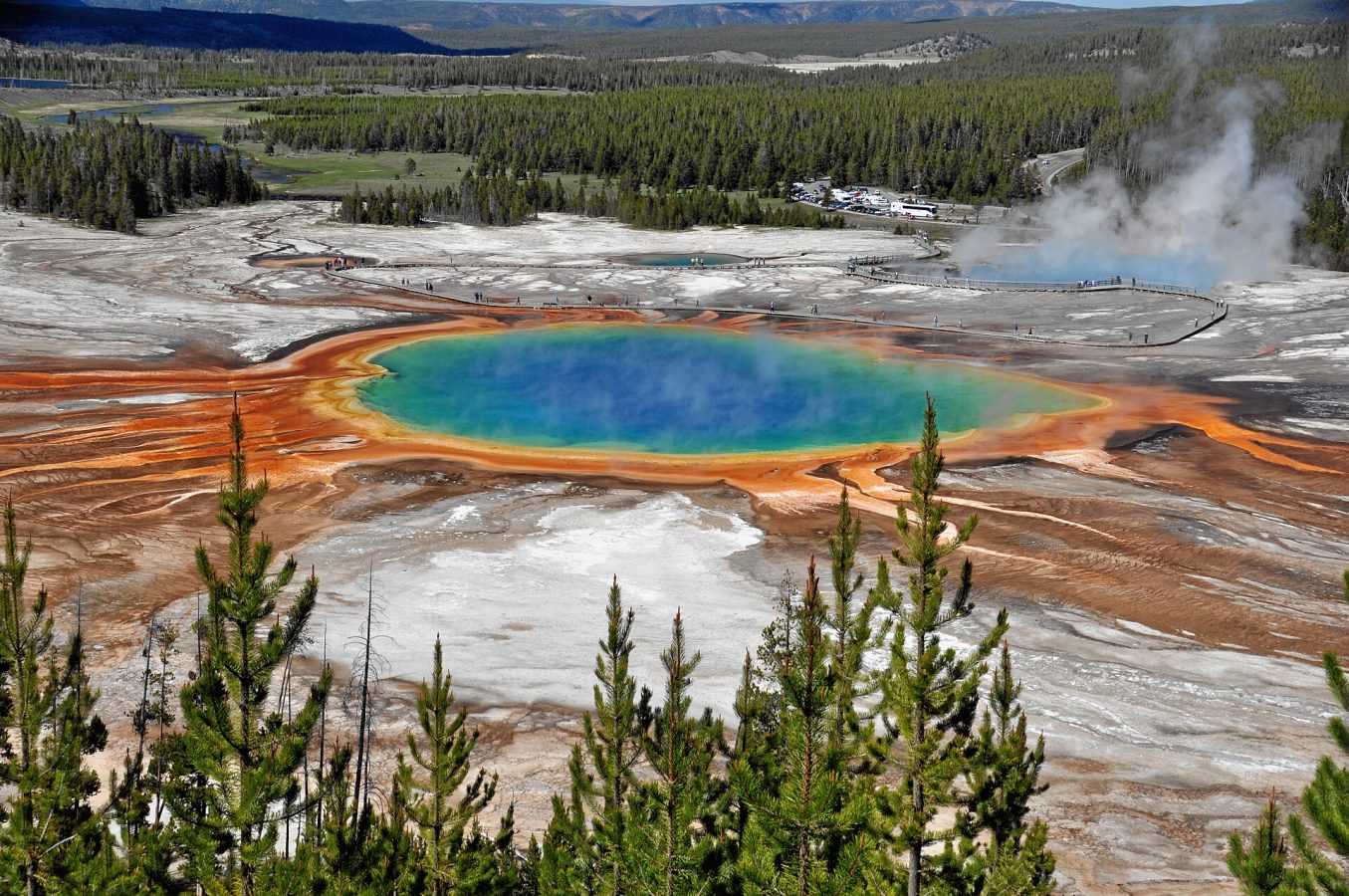
Photo: James St. John from Newark, Ohio, CC BY 2.0
Yellowstone occupies the north-western corner of Wyoming, overlapping into Montana and Idaho, and it is a very large park, the size of Corsica, in which the principal sights lie an hour or more apart along the Grand Loop, a road of 142 miles in the form of a figure of eight; a car is essential, unless one joins one of the guided tours, by coach or small van, of one to several days, that start from the gateway towns and from Jackson, Bozeman and Salt Lake City. There are five entrances: the west, at the town of West Yellowstone, the busiest and the nearest to the geyser basins; the north, at Gardiner, Montana, an hour and a half from Bozeman's airport, the only one open to cars all year; the south, from Grand Teton National Park and the airport of Jackson; the east, from Cody; and the north-east, by the Beartooth Highway. The entrance fee is charged per vehicle for seven days.
The lodges inside the park, among them the great log Old Faithful Inn of 1904, and the reservable campgrounds are booked up to a year ahead, and most visitors stay outside. Three days is a reasonable minimum. One goes to the geyser basins of the south-west: Old Faithful, which erupts about every ninety minutes to the applause of a thousand spectators, with a boardwalk circuit of two hours round the Upper Geyser Basin behind it, and Grand Prismatic Spring at Midway, seen best from the overlook reached by a walk of twenty minutes from the Fairy Falls car park. One goes to the Grand Canyon of the Yellowstone, to stand at Artist Point and the brink of the Lower Falls. One goes to the terraces of Mammoth Hot Springs, and to Norris, the hottest basin. And the last is given to wildlife, at dawn or dusk in the Hayden and Lamar valleys. Walking trails of every length start from the roads.
Live dates and prices from GetYourGuide. Free cancellation on most tickets.
Yellowstone was established by an act of Congress signed by President Grant on 1 March 1872, as a public park or pleasuring ground for the benefit and enjoyment of the people, the first national park in the world and the origin of the idea; it covers 8,983 square kilometres and has been a World Heritage Site since 1978. Trappers' tales of boiling rivers and mountains of glass had been dismissed as lies until three expeditions between 1869 and 1871, the last led by the geologist Ferdinand Hayden and accompanied by the photographer William Henry Jackson and the painter Thomas Moran, brought back evidence that persuaded Congress to withdraw the land from settlement. For its first decades the park had neither money nor staff, poachers and vandals did as they pleased, and from 1886 to 1918 it was administered by the United States cavalry, whose fort at Mammoth is still the headquarters. People had lived and hunted here for eleven thousand years, quarrying obsidian that was traded across the continent, and in 1877 the Nez Perce, fleeing the army, crossed the new park and took tourists hostage. The park sits on one of the largest active volcanic systems on earth, a plume of hot rock rising from the mantle, over which the continent is slowly moving, which has produced three cataclysmic eruptions, 2.1 million, 1.3 million and 640,000 years ago, the last of which expelled a thousand cubic kilometres of ash and left a caldera forty-five by eighty-five kilometres, since filled by lava flows and occupied in part by Yellowstone Lake.
Molten rock still lies a few kilometres down, the ground rises and falls by centimetres a year, there are a thousand or more small earthquakes annually, and rain and snowmelt, percolating down to the heat and rising again through fractures, feed more than ten thousand hot springs, mud pots, fumaroles and geysers, including some five hundred geysers, more than half of all those on the planet. Steamboat, at Norris, is the tallest active geyser in the world, throwing water more than ninety metres at unpredictable intervals. The colours of the springs, the rings of yellow, orange and brown round the blue centre of Grand Prismatic, which is 110 metres across, are living mats of heat-loving microbes, each adapted to a band of temperature, and an enzyme isolated from one of them in the 1960s made possible the technique on which modern genetic testing depends. The Yellowstone river has cut through rock softened and stained yellow by hot water a canyon thirty kilometres long and up to 370 metres deep, into which it drops by two falls, the lower of 94 metres. The park is the heart of one of the last nearly intact temperate ecosystems, with every large mammal that was present when Europeans arrived: about five thousand bison, the only herd in the United States that has lived wild continuously since prehistoric times, elk, moose, pronghorn, bighorn sheep, grizzly and black bears, and wolves, which were exterminated by 1926 and reintroduced from Canada in 1995 and 1996, an experiment whose effects on the elk, the willows and the rivers are still debated. In 1988 fires burned more than a third of the park, and in June 2022 floods destroyed its northern approach roads.
Most park roads are open to cars from about mid or late April to early November, opening and closing in stages, and only the road from Gardiner through Mammoth and the Lamar valley to Cooke City stays open through the winter. July and August are warm, 20 to 27 degrees by day, and extremely crowded, with car parks at the main sights full from mid-morning to late afternoon, so that an early start is the only remedy. May and early June bring newborn bison, elk and bears in the valleys, snow on the higher ground and unsettled weather;
September and early October are the favourite of those who know the park, with golden aspens, the bugling of rutting elk, frosty mornings and far fewer people. From mid-December to mid-March the interior is reached only by guided snowcoach or snowmobile, to see geysers in deep snow and wolves in the Lamar valley. Snow can fall in any month. Stay on the boardwalks, since the crust is thin and the water scalding, and keep at least twenty-five yards from bison and elk and a hundred from bears and wolves. Allow three to five days. Grand Teton adjoins the park on the south.
Yes. GetYourGuide lists 27 tickets and tours for Yellowstone National Park, with live dates and prices and free cancellation on most of them.
The entrance fee is charged per vehicle for seven days.
Most park roads are open to cars from about mid or late April to early November, opening and closing in stages, and only the road from Gardiner through Mammoth and the Lamar valley to Cooke City stays open through the winter.
Allow three to five days.
Yellowstone National Park covers 8 983 km².
Yellowstone National Park was established in 1872.
Yellowstone National Park receives about 4.7 million a year (2024).
Yellowstone National Park is in Wyoming, United States. The map on this page shows the exact spot.
Wyoming, United States
Grand Teton is the range of granite peaks above Jackson Hole in Wyoming, ten miles south of Yellowstone, and it is sold…
38 tickets & tours