Kootenay National Park
British Columbia, Canada
Kootenay is the least visited of the four contiguous national parks of the Canadian Rockies, on the British Columbia…
3 tickets & tours
Mountain Park · British Columbia · Canada
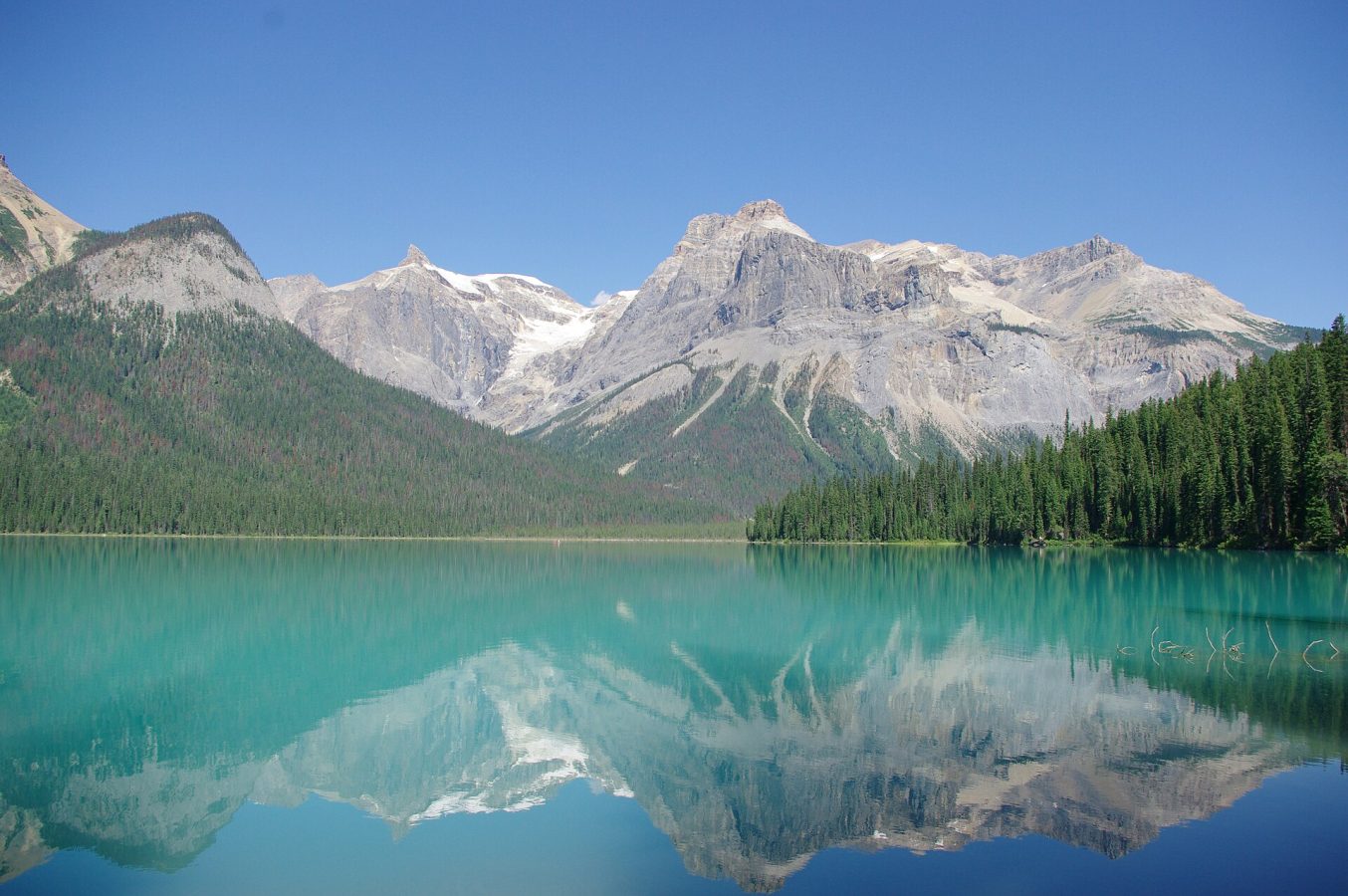
Photo: JZ85, CC BY 3.0
Yoho lies on the western, British Columbian slope of the Canadian Rockies, immediately across the continental divide from Banff National Park, and the Trans-Canada Highway runs through the middle of it, so that it is reached in twenty-five minutes from Lake Louise and an hour and a quarter from the town of Banff, from which day tours, often combined with the neighbouring Kootenay park, are run. It is much smaller and quieter than Banff, and its principal sights can be seen in a day. A Parks Canada pass, daily or annual, is required and is sold at the gates and visitor centres. The tiny railway village of Field, in the centre, has the park's visitor centre, a few lodgings and cafes. Three places make up the standard circuit. Takakkaw Falls, among the highest in Canada, is reached by the Yoho Valley road, thirteen kilometres, which includes a pair of switchbacks so tight that long vehicles must reverse up one leg and trailers are forbidden;
from the car park a paved path of ten minutes leads to the foot of the fall, and the road is open only from about late June to early October. Emerald Lake, at the end of another side road, open all year, is the largest lake in the park, of a vivid green, with a historic lodge, canoes for hire and a level circuit path of 5.2 kilometres, an hour and a half; on the way to it the Kicking Horse river has bored through a wall of rock to form the Natural Bridge. Wapta Falls, in the west, a broad curtain of water thirty metres high, is an easy walk of an hour and a half return. Serious walkers come for the Iceline trail, a day's circuit from Takakkaw across moraines beneath the glaciers, and for Lake O'Hara, the most beautiful alpine basin in the Rockies, access to which is strictly rationed.
Live dates and prices from GetYourGuide. Free cancellation on most tickets.
Yoho was set aside in 1886, as a small reserve round Mount Stephen, at the same time as Glacier, which makes them the second oldest national parks in Canada, and it now covers 1,313 square kilometres; since 1984 it has formed part of the World Heritage Site of the Canadian Rocky Mountain Parks. Its name is an exclamation of awe and wonder in the Cree language, and Takakkaw, in the same language, means it is magnificent. The fall, fed by the meltwater of the Daly glacier on the Waputik icefield, drops 373 metres in all, with an unbroken leap of 254, and is at its most thunderous on hot afternoons in July. The park's twenty-eight summits over three thousand metres, the highest of them Mount Goodsir, at 3,567, are built of layered sedimentary rocks, limestones and shales of Cambrian age, tilted and thrust, and it is one of these layers that gives Yoho its scientific fame. In 1909 Charles Walcott, the secretary of the Smithsonian Institution, riding along a trail high on the ridge between Mount Field and Wapta Mountain, found a slab of shale bearing the impressions of soft-bodied animals, and in the following seasons he quarried from the spot some sixty-five thousand specimens. The Burgess Shale, 508 million years old, preserves in exquisite detail, down to gills, guts and eyes, the creatures of a sea floor buried by mud slides shortly after the great burst of animal evolution at the beginning of the Cambrian: Anomalocaris, a predator a metre long with grasping arms and a circular mouth, Opabinia, with five eyes and a nozzle, Hallucigenia, first reconstructed upside down, Marrella, Wiwaxia, and Pikaia, an early relative of the vertebrates.
It is among the most important fossil sites in the world, the subject of a celebrated book by Stephen Jay Gould, and may be visited only on long, strenuous guided hikes, to the Walcott quarry, twenty-two kilometres return, or to the trilobite beds of Mount Stephen, shorter but steeper, offered in summer by the park and by a local foundation, and booked well ahead. The park's other monument is the railway. The Canadian Pacific line crossed the divide by the Kicking Horse pass, named after an incident in 1858 in which the explorer James Hector was kicked senseless by his packhorse, and descended to Field by the Big Hill, a gradient of four and a half per cent, four times the permitted maximum, which caused runaways and deaths from the first train onwards; in 1909 it was replaced by the Spiral Tunnels, two loops bored inside the mountains, in which a long freight train may be seen from the highway viewpoint emerging from the upper portal while its tail is still entering the lower. Lake O'Hara, ringed by hanging valleys, larch woods and small lakes linked by stone-stepped trails, is reached by an eleven-kilometre road closed to cars and bicycles, places on the bus being allotted by a lottery held in the spring; one may walk in without a reservation. Grizzly and black bears, mountain goats, elk, moose, wolverines and pikas inhabit the park.
The park is open all year, but the summer season is short. The Yoho Valley road and the high trails are generally open from late June to early October, and July and August are the warmest months, 18 to 24 degrees by day, with the waterfalls at their fullest early in that period and the alpine flowers in late July; Emerald Lake is crowded by late morning, and its car park fills, so arrive before nine or after five.
September brings stable weather, fewer people and, in the last ten days of the month, the gold of the larches at Lake O'Hara, the most sought-after time of all. From November to April the park is under snow, Emerald Lake becomes a centre for cross-country skiing and snowshoeing, and frozen waterfalls draw ice climbers; the highway is sometimes closed for avalanche control. Carry bear spray on the trails, and warm and waterproof clothing in any month. Allow one to two days. Lake Louise is twenty-five minutes east, and Golden forty-five minutes west.
Yes. GetYourGuide lists one ticket or tour for Yoho National Park, with live dates and prices and free cancellation on most of them.
The park is open all year, but the summer season is short.
Allow one to two days.
Yoho National Park covers 1 313 km².
Yoho National Park was established in 1886.
Yoho National Park is in British Columbia, Canada. The map on this page shows the exact spot.
British Columbia, Canada
Kootenay is the least visited of the four contiguous national parks of the Canadian Rockies, on the British Columbia…
3 tickets & tours
British Columbia, Canada
Canada's Glacier National Park, which must not be confused with the American park of the same name in Montana,…
No online ticket
