Yoho National Park
72 km away
Yoho lies on the western, British Columbian slope of the Canadian Rockies, immediately across the continental divide…
1 ticket or tour
Glacier Park · British Columbia · Canada

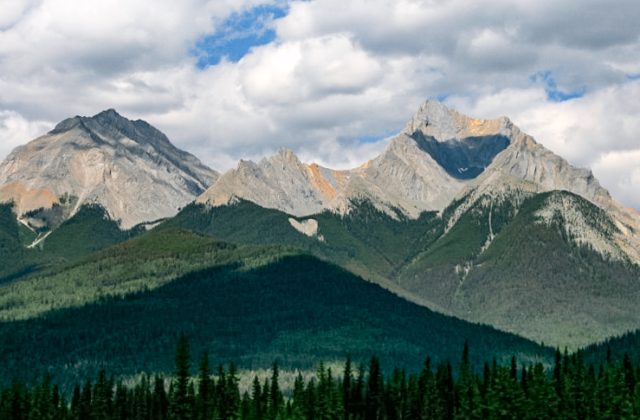
Photo: Sesivany/Jiri Eischmann, CC BY-SA 3.0
Canada's Glacier National Park, which must not be confused with the American park of the same name in Montana, lies in the Selkirk mountains of British Columbia, part of the Columbia ranges that stand to the west of the Rockies, and the Trans-Canada Highway runs through the middle of it, over Rogers Pass, so that it is seen by everyone who drives between Calgary and Vancouver. The pass is about seventy kilometres, three quarters of an hour, east of the town of Revelstoke and eighty kilometres, an hour, west of Golden, which are the nearest places with a full range of accommodation, and some four hours from Calgary; there is no public transport worth mentioning. A Parks Canada pass is required to stop in the park, though not to drive through. At the summit of the pass stands the Rogers Pass discovery centre, built in the form of one of the old railway snow sheds, with exhibits on the railway, the avalanches and the wildlife, a theatre and a bookshop, and it is the place to enquire about trail conditions and bear warnings.
For those merely passing, several short interpretive walks beside the highway are well worth a stop: the Hemlock Grove boardwalk, a loop of a few hundred metres through ancient, moss-hung forest, accessible to wheelchairs; the Loop Brook trail, 1.6 kilometres, among the stone pillars that carried the original railway across the valley in a great double loop; the Meeting of the Waters; and the short descent to Bear Creek falls. The serious walks, among the finest in Canada, start from the Illecillewaet campground, just west of the summit, and climb steeply, eight hundred to a thousand metres in four to six kilometres, to viewpoints over the glaciers, the Abbott Ridge, Glacier Crest, Avalanche Crest, the Asulkan valley, the Great Glacier trail and the Sir Donald trail. There are three campgrounds and no hotels inside the park.
Glacier was established in 1886, at the same time as Yoho and a year after Banff, as a direct consequence of the building of the Canadian Pacific Railway, and covers 1,349 square kilometres. The Selkirks are older, steeper, wetter and more heavily forested than the Rockies, and they had baffled the railway's surveyors until Major A. B. Rogers, a tobacco-chewing, foul-mouthed American engineer, found in 1881 and 1882 the pass that bears his name, for which he was given a cheque for five thousand dollars that he framed instead of cashing. The line was pushed over it in 1885, and the company, to avoid hauling heavy dining cars up the grades, built a hotel beside the track at the foot of the Illecillewaet glacier, Glacier House, which opened in 1887 and quickly became a resort in its own right. It has a fair claim to be the birthplace of mountaineering in North America: British and American alpinists made it their base, and in 1899 the railway brought over professional guides from Switzerland, the first on the continent, who led guests up the surrounding peaks for a quarter of a century without a fatal accident. In those days the snout of the glacier, then called the Great Glacier, lay less than an hour's stroll from the hotel; it has since retreated by more than a kilometre and a half, a change documented by photographs taken from fixed points since 1887, one of the longest such records in the world. What made the pass possible also made it deadly. The Selkirks receive enormous snowfalls, more than nine metres in an average winter at the pass, on slopes of great steepness, and the railway was from the first assailed by avalanches;
thirty-one snow sheds did not prevent disaster, and on the night of 4 March 1910 a slide buried a gang of men clearing the track of an earlier one, killing fifty-eight. The company abandoned the surface route and bored the Connaught tunnel, eight kilometres long, opened in 1916, to which a second, the Mount Macdonald tunnel, at 14.7 kilometres the longest railway tunnel in the Americas, was added in 1988; Glacier House, deprived of its trains, closed in 1925, and only its foundations remain. When the Trans-Canada Highway was built over the pass, in 1962, it required the creation of what is still the largest mobile avalanche control programme in the world, in which the Canadian army fires howitzers from fixed positions along the road to bring down the snow in more than a hundred and thirty avalanche paths while the traffic waits. The park has some 130 glaciers, fewer than a third of the number counted a century ago, covering a tenth of its area; its highest summit is Mount Dawson, 3,377 metres, and its most admired Mount Sir Donald, a sharp pyramid. The valley floors carry an inland temperate rainforest of western red cedar and western hemlock, some of the trees more than five hundred years old, a forest type found far from the sea nowhere else on earth, above which lie subalpine fir and spruce, and alpine meadows. Grizzly and black bears are numerous, with mountain goats, hoary marmots, pikas, wolverines and a dwindling remnant of mountain caribou, and beneath Cougar Mountain the Nakimu caves extend for six kilometres.
The highway is open all year, but it is closed for short periods, sometimes several hours, during avalanche control in winter, and drivers need winter tyres from October to April. The season for walking is brief: the valley trails are clear by about mid-June, the high trails not until mid or late July, and snow returns in late September or October; July and August have the warmest weather, 15 to 25 degrees in the valleys, with frequent rain, afternoon thunderstorms and flowers in the alpine meadows in early August, and September is cooler, clearer and quieter.
In the bear season some trails may be walked only in tight groups of four or more, by regulation, and bear spray should be carried on all of them. In winter the park is one of the celebrated ski touring areas of the world, governed by a permit system that opens and closes zones daily according to the artillery programme, and is for the trained and equipped only. The campgrounds open from about late June to September. Allow a few hours in passing, two to three days for the walks. Mount Revelstoke National Park, with its summit parkway and giant cedars, is forty-five minutes west.
72 km away
Yoho lies on the western, British Columbian slope of the Canadian Rockies, immediately across the continental divide…
1 ticket or tour
113 km away
Kootenay is the least visited of the four contiguous national parks of the Canadian Rockies, on the British Columbia…
3 tickets & tours
138 km away
Banff is Canada's first and most visited national park, ninety minutes west of Calgary, and it is sold in every…
61 tickets & tours
No online tour for Glacier National Park (Canada) is listed on GetYourGuide; entry, where it is charged, is paid at the gate or through the park authority. Nearby parks with bookable tours are listed on this page.
The highway is open all year, but it is closed for short periods, sometimes several hours, during avalanche control in winter, and drivers need winter tyres from October to April.
Allow a few hours in passing, two to three days for the walks.
Glacier National Park (Canada) covers 1 349 km².
Glacier National Park (Canada) was established in 1886.
Glacier National Park (Canada) is in British Columbia, Canada. The map on this page shows the exact spot.
British Columbia, Canada
Kootenay is the least visited of the four contiguous national parks of the Canadian Rockies, on the British Columbia…
3 tickets & tours
British Columbia, Canada
Yoho lies on the western, British Columbian slope of the Canadian Rockies, immediately across the continental divide…
1 ticket or tour