
Fiordland National Park
New Zealand
Fiordland covers the whole south-western corner of the South Island of New Zealand, the largest national park in the…
81 tickets & tours
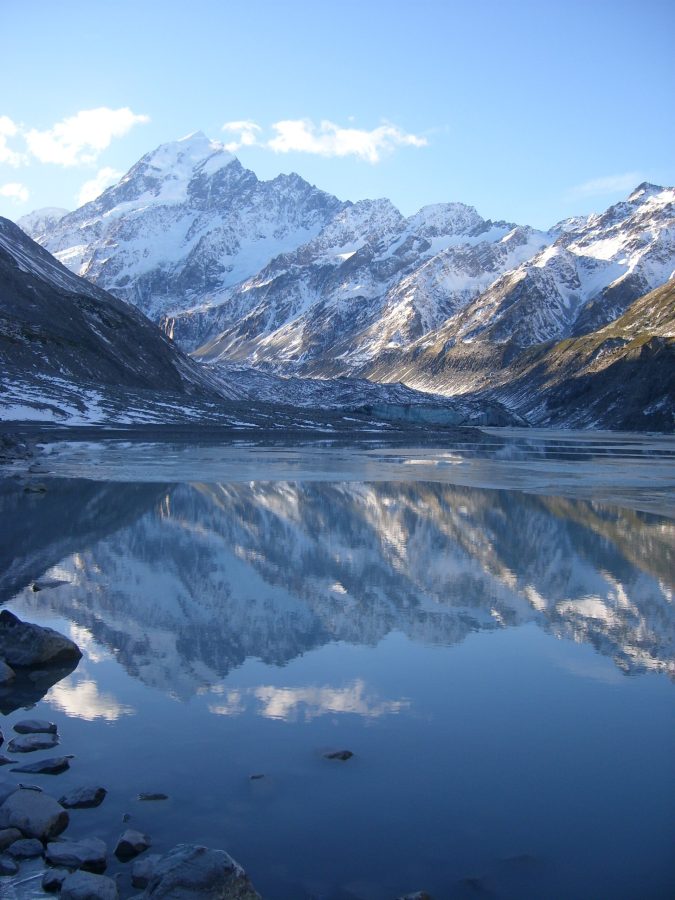
Photo: C.M. Lynch (talk · contribs), CC BY-SA 3.0
Aoraki / Mount Cook National Park contains the highest mountains and the longest glaciers of New Zealand, in the centre of the Southern Alps in the South Island, and unlike most high alpine regions it can be entered with no effort at all, since a good sealed road, fifty-five kilometres long, runs from the main highway up the western shore of the turquoise Lake Pukaki, with the mountain in view ahead the whole way, to end at Mount Cook Village, at 760 metres, in the middle of the park. The village is three to three and a half hours by road from Queenstown, four to four and a half from Christchurch, and an hour and a quarter from Lake Tekapo, and is served by daily coaches and by many day tours, though a night or two is greatly to be preferred. It consists of the Hermitage hotel, several lodges, a hostel, a campground at White Horse Hill, the national park visitor centre, which has a fine exhibition, and a museum devoted to Sir Edmund Hillary;
there is no supermarket and only a self-service fuel pump. The park is free. Its most popular walk, and one of the most popular in the country, is the Hooker Valley track, ten kilometres and three hours return, almost level, across three swing bridges to a lake with icebergs at the foot of the mountain's south face; parts of it have recently been closed for the replacement of a bridge, and the current state should be checked with the visitor centre. The Kea Point walk, an hour return, leads to a moraine viewpoint over the Mueller glacier; the Sealy Tarns track climbs some 2,200 steps to a shelf with an immense view, and continues, as a marked route, to the Mueller hut; and in the neighbouring Tasman valley short paths lead to the Blue Lakes and to views of the Tasman glacier and its lake, on which boat trips are run among the icebergs. Scenic flights by ski-plane and helicopter land on the upper glaciers.
Live dates and prices from GetYourGuide. Free cancellation on most tickets.
The national park was established in 1953, from reserves dating back to 1885, and covers about 707 square kilometres along the eastern side of the main divide, adjoining Westland Tai Poutini National Park on the other; since 1990 it has been part of Te Wahipounamu, the World Heritage area of south-western New Zealand. Nineteen of the country's twenty peaks over three thousand metres stand in it, and some forty per cent of its area is covered by ice. Aoraki / Mount Cook, 3,724 metres, is the highest; it was ten metres higher until the night of 14 December 1991, when the top of the mountain fell away in an avalanche of some twelve million cubic metres of rock and ice, and later erosion of the ice cap has lowered it further. To Ngai Tahu, the Maori of the South Island, Aoraki is the most sacred of ancestors: in their tradition he and his brothers, sons of the sky father, were voyaging in a canoe which ran aground and tilted, and as they climbed to its high side the south wind froze them into stone, the canoe becoming the South Island and the brothers the peaks of the Alps. The double name was made official by the settlement between the tribe and the Crown in 1998, under which the mountain was symbolically returned to the tribe and given by it to the nation. The English name was bestowed in 1851 in honour of Captain James Cook, who never saw it.
The first ascent was made on Christmas Day 1894 by three young New Zealanders, Tom Fyfe, George Graham and Jack Clarke, who hurried to the top on learning that an English climber and his Swiss guide had arrived with the same object. Edmund Hillary learned his craft here, making the first ascent of the south ridge in 1948, five years before Everest, and the mountain, with its long approaches, unstable ice and violent weather, remains a serious undertaking that has killed more than eighty climbers. The Tasman glacier, some twenty-three kilometres long, is the longest in New Zealand, its lower reaches so covered with rock debris that it looks like a gravel plain; since the 1970s a lake has formed at its snout, now several kilometres long, into which the ice front is retreating by up to 180 metres a year, a change that has taken place within the memory of the guides who show it. In 1955 Harry Wigley, a local aviator, devised retractable skis for a light aircraft and made the first landing on the glacier, founding a business that continues. The park has almost no forest, the vegetation being tussock grassland, thorny matagouri scrub and alpine herb fields, where the Mount Cook lily, in fact the world's largest buttercup, with white flowers and leaves like saucers, blooms from November to January. The kea, the mountain parrot, the rock wren, the falcon and, on the braided river beds below, the black stilt, one of the rarest wading birds in the world, are its notable birds. The park lies within an international dark sky reserve, and the stargazing is superb.
The park is open all year, and the village road is kept clear in winter. Summer, from December to February, brings long days, alpine flowers, temperatures of 15 to 25 degrees in the valley, and the greatest numbers of people, the Hooker Valley car park overflowing by mid-morning; March and April are often the most settled months, with clear, cool air; winter, from June to August, is cold, with snow to the valley floor at times, short days and the mountains at their most beautiful, the valley walks remaining possible with care, while the higher routes need alpine experience and carry avalanche risk into late spring.
The weather is notoriously changeable, the divide catching every westerly storm, and the mountain may be hidden for days, so that a stay of two nights doubles the chance of seeing it. Walk at dawn or towards sunset for the light and the quiet. Bring warm and windproof clothing in every month, sun protection and food. Allow two days. Lake Tekapo, with its church and observatory, is an hour and a quarter away, and Twizel forty-five minutes.
Yes. GetYourGuide lists 68 tickets and tours for Aoraki / Mount Cook National Park, with live dates and prices and free cancellation on most of them.
The park is open all year, and the village road is kept clear in winter.
Aoraki / Mount Cook National Park covers 707 km².
Aoraki / Mount Cook National Park was established in 1953.
Aoraki / Mount Cook National Park is in New Zealand. The map on this page shows the exact spot.
New Zealand
Fiordland covers the whole south-western corner of the South Island of New Zealand, the largest national park in the…
81 tickets & tours
New Zealand
Westland Tai Poutini National Park lies on the wet western side of the Southern Alps, in the South Island of New…
49 tickets & tours
New Zealand
Abel Tasman is the coastal park at the top of New Zealand's South Island, an hour from Nelson to the gateway…
16 tickets & tours
New Zealand
Arthur's Pass is the mountain park on the main divide of New Zealand's South Island, two hours from…
13 tickets & tours
New Zealand
Tongariro is the volcanic heart of New Zealand's North Island, four and a half hours'
6 tickets & tours
New Zealand
Kahurangi fills the north-western corner of the South Island of New Zealand, a vast, roadless tangle of mountains,…
1 ticket or tour


