Sagarmatha National Park
Nepal
Sagarmatha National Park, in the Khumbu region of north-eastern Nepal, contains Mount Everest and several others of the…
121 tickets & tours

Photo: Ganesh Paudel, CC BY-SA 3.0
Bardiya is the great wilderness of Nepal's far-western lowlands, and what Chitwan was forty years ago: as large, as rich, and visited by a small fraction of the people, because it is far away. The practical way to reach it is to fly from Kathmandu to Nepalgunj, an hour, and drive two and a half to three hours to the village of Thakurdwara, beside the park headquarters, where some twenty lodges, from simple family-run mud-and-thatch cottages to a few comfortable ones and the odd treehouse, stand along the buffer zone; by road it is fourteen to sixteen hours from Kathmandu or twelve from Pokhara, on buses that travel by night. Packages of four days or more from Kathmandu or Pokhara include the transport, the lodge, meals, park permits and activities, and since the lodges arrange everything in any case, independent travellers lose nothing by booking direct.
Bardiya's speciality is the walking safari: a full day on foot in the forest and along the riverbanks with two guides carrying nothing more than bamboo staffs, a packed lunch, and long, silent waits at viewpoints over the river where tigers come to drink and cool off in the hot months. It is one of the few places in Asia where tigers are regularly seen on foot, and it demands a guide one trusts, since rhinos, wild elephants and tigers are all met at close quarters. Jeep safaris cover more ground and reach the Babai valley; rafting and canoeing on the Karnali and Geruwa rivers look for Gangetic dolphins, crocodiles and birds. The elephant breeding centre, the crocodile breeding centre and the Tharu museum and villages are visited on foot or by bicycle.
Live dates and prices from GetYourGuide. Free cancellation on most tickets.
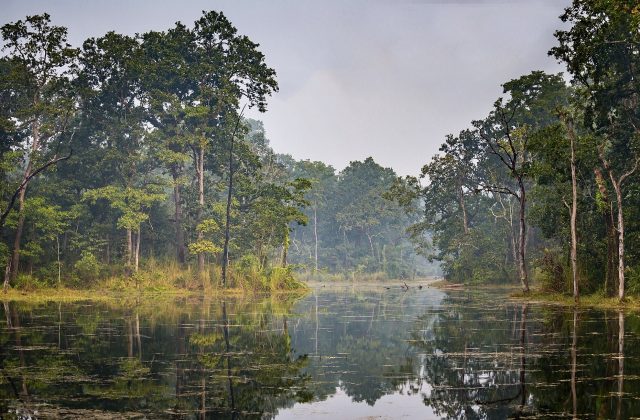
The area was a royal hunting reserve, became a wildlife reserve in 1976 and, enlarged with the Babai valley, a national park in 1988; at 968 square kilometres, with a buffer zone of 507 more and the adjoining Banke National Park, created in 2010, it forms the largest protected tract of lowland forest in Nepal, connected across the Indian border with the Katarniaghat sanctuary. It lies between the crest of the Siwalik, or Churia, hills in the north and the Geruwa, the eastern branch of the great Karnali river, in the west, and is bisected by the Babai river. About seventy per cent of it is sal forest, tall, open and deciduous, with riverine forest of khair and sissoo along the rivers, and between them the phantas, wide grasslands on the sites of villages removed when the park was created, some fifteen hundred households in all, which with the floodplain's tall elephant grass feed very large numbers of deer. On that prey base the tigers have multiplied.
Nepal undertook in 2010 to double its tigers, and Bardiya is the showpiece of that pledge: the census of 2009 found eighteen adults, that of 2022 a hundred and twenty-five, the fastest growth of any tiger population on record, which has brought with it a painful rise in attacks on villagers collecting grass and firewood. One-horned rhinoceroses, translocated from Chitwan from 1986, were almost wiped out by poachers during the Maoist insurgency, when the army withdrew from its posts, and have been restored to about forty. A herd of wild Asian elephants, more than a hundred strong, moves between the park and India, and swamp deer, hog deer, spotted deer, sambar, blackbuck in a nearby conservation area, nilgai, sloth bears, leopards, otters, mugger crocodiles and the fish-eating gharial live here, with the Gangetic river dolphin, now very rare, in the Karnali. Over four hundred birds include the Bengal florican, the lesser florican, the sarus crane and the great hornbill. The Tharu, the people of the Terai, have their own villages, dances and stick-fighting.
The park is open all year, from sunrise to sunset. The best months for tigers are March, April and May, hot, up to 40 degrees and more, when the grass has been cut and burned by the villagers, in January and February, and the cats spend the middle of the day lying in the river; October to December is pleasant, clear and green, with tall grass that hides the animals; December and January are cold and foggy in the mornings;
the monsoon, from mid-June to September, floods the rivers, closes the jeep tracks and most lodges. Wear dull colours for walking safaris, and carry plenty of water. Allow three nights at the least. Nepalgunj is the gateway, the Karnali bridge at Chisapani and its fishing an hour west, Shuklaphanta's swamp deer further west still, and Lumbini, the Buddha's birthplace, five hours east.
Yes. GetYourGuide lists 3 tickets and tours for Bardiya National Park, with live dates and prices and free cancellation on most of them.
The park is open all year, from sunrise to sunset.
Allow three nights at the least.
Bardiya National Park covers 968 km².
Bardiya National Park was established in 1988.
Bardiya National Park is in Nepal. The map on this page shows the exact spot.
Nepal
Sagarmatha National Park, in the Khumbu region of north-eastern Nepal, contains Mount Everest and several others of the…
121 tickets & tours
Nepal
Chitwan is Nepal's answer to an African safari, a lowland jungle park in the Terai five or six hours by road from…
77 tickets & tours
Nepal
Langtang is the Himalayan park closest to Kathmandu, a day's drive north to the trailhead at Syabrubesi, and it is…
55 tickets & tours
Nepal
Shivapuri is the forested ridge that closes the Kathmandu valley on the north, its gate at Budhanilkantha forty minutes…
17 tickets & tours