Arches National Park
158 km away
Arches is the park of red sandstone arches beside Moab in eastern Utah, and its entrance has been the most managed in…
13 tickets & tours
Canyon Park · Colorado · United States

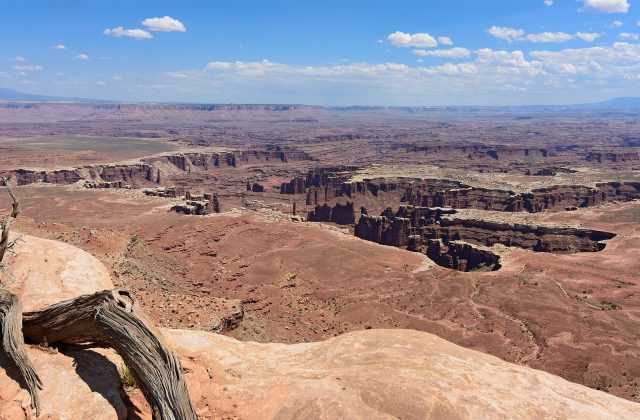
Photo: Hogs555, CC BY-SA 3.0
The Black Canyon of the Gunnison is a gorge of extraordinary depth, narrowness and gloom cut through a high plateau in western Colorado, and it is one of the least visited of the great national parks of the American West, being far from any city: the nearest town, Montrose, which has a small airport, is fifteen miles and about twenty-five minutes from the entrance, Grand Junction is an hour and a half to the north-west, and Denver five hours away across the Rockies. A car is essential, and the entrance fee, per vehicle, is valid for a week. The canyon has two rims, which are within shouting distance of each other and more than two hours apart by road.
Almost everyone goes to the South Rim, where there are a visitor centre at Gunnison Point, a campground, and a paved road of seven miles along the edge with a dozen signposted overlooks, most of them reached by paths of a few hundred metres to a railed platform of rock projecting over the void: Tomichi Point, Pulpit Rock, Chasm View, where the opposite rim is only 335 metres away and the river 550 metres below, Painted Wall, Sunset View and, at the end, High Point, from which the Warner Point nature trail, a mile and a half return, leads to the deepest part. Two or three hours suffice for the drive. A steep side road, with gradients of sixteen per cent and closed to long vehicles, descends at East Portal to the river itself, above the canyon proper, for fishing and picnics. The North Rim, reached by a gravel road from the village of Crawford, has a ranger station, a small campground and a rim drive with even more vertical views, and sees a tenth of the visitors. Descent into the canyon is by unmarked, unmaintained routes, down steep gullies, for which a free wilderness permit must be obtained on the day.
The canyon was proclaimed a national monument in March 1933 and made a national park in October 1999, covering about 124 square kilometres, which include the deepest and most spectacular twenty-two kilometres of a gorge seventy-seven kilometres long. No other canyon in North America combines its depth, its narrowness and the sheerness of its walls. At Warner Point it is 829 metres deep; at the Narrows the walls, there more than five hundred metres high, stand only twelve metres apart at the river; and because so little sunlight reaches the bottom, parts of which receive barely half an hour a day, the walls appear black and the place earned its name. The explanation lies in the rock and the river. The Gunnison, fed by the snows of the Rockies, established its course some two million years ago across soft volcanic deposits, and having cut through them found itself trapped in its channel above a dome of Precambrian gneiss and schist, 1.7 billion years old and among the hardest rocks on the continent, through which it had no choice but to saw its way downward; and it had the power to do so, for within the park it falls on average thirty-four feet in every mile, and at Chasm View two hundred and forty, a far steeper gradient than the Colorado in the Grand Canyon, which in flood moved boulders the size of houses. It cut at about the thickness of a human hair each year.
The dark walls are laced with veins of pale pink pegmatite, a coarse crystalline rock injected as molten fluid into cracks in the gneiss, and at the Painted Wall, which at 690 metres is the highest cliff in Colorado, these form swirling bands hundreds of metres long, like the brushwork of a giant. The Ute people knew the canyon and kept to its rims, and the early surveyors pronounced it inaccessible. In 1901 two men, Abraham Lincoln Fellows and William Torrence, made the first passage through it, in nine days, swimming and floating on a rubber air mattress with their supplies, in order to find a site from which water could be led to the dry Uncompahgre valley; the Gunnison tunnel, nearly six miles long, driven through the canyon wall at East Portal, was opened by President Taft in 1909, one of the first great works of the federal reclamation service, and still irrigates the farms round Montrose. Three dams upstream have since tamed the floods. The rims carry a scrub of Gambel oak and serviceberry, with pinyon pines and junipers, some of the pinyons at Warner Point being more than seven hundred years old; mule deer, elk, black bears, mountain lions, yellow-bellied marmots, golden eagles, white-throated swifts and the peregrine falcon, which nests on the Painted Wall, inhabit the park, and the river is celebrated for its trout. The cliffs offer some of the most serious traditional rock climbing in the country. It is an international dark sky park. A wildfire in July 2025 burned much of the South Rim, and some facilities and trails may remain closed.
The park is open all year, but the season in which everything is accessible runs from about late April to mid-November. From late May to September the days are warm, 24 to 32 degrees on the rim, and considerably hotter in the inner canyon, with thunderstorms on July and August afternoons; September and early October are clear and mild, with the oak scrub turning red and orange. In winter the South Rim road is ploughed only as far as the visitor centre at Gunnison Point, the remainder being left for cross-country skiers and snowshoers, and the North Rim and East Portal roads are closed altogether.
The canyon is most dramatic in the low light of early morning and late afternoon, when the walls show their relief; at midday it is flat and hazy. The rim is at about 2,500 metres, so take the walks slowly, carry water, and keep children and dogs well back from the unfenced edges. Inner canyon routes are for the fit and experienced only, and poison ivy grows head-high at the bottom. Allow half a day to a day. Montrose is twenty-five minutes away, Ouray and the San Juan mountains an hour south.
158 km away
Arches is the park of red sandstone arches beside Moab in eastern Utah, and its entrance has been the most managed in…
13 tickets & tours
161 km away
Mesa Verde is in the south-west corner of Colorado, its entrance ten miles east of Cortez and thirty-five west of…
7 tickets & tours
183 km away
Canyonlands is the larger, emptier neighbour of Arches, outside Moab in south-eastern Utah, and the first thing to know…
8 tickets & tours
No online tour for Black Canyon of the Gunnison National Park is listed on GetYourGuide; entry, where it is charged, is paid at the gate or through the park authority. Nearby parks with bookable tours are listed on this page.
A car is essential, and the entrance fee, per vehicle, is valid for a week.
The park is open all year, but the season in which everything is accessible runs from about late April to mid-November.
Allow half a day to a day.
Black Canyon of the Gunnison National Park covers 124 km².
Black Canyon of the Gunnison National Park was established in 1933.
Black Canyon of the Gunnison National Park receives about 357 069 a year (2023).
Black Canyon of the Gunnison National Park is in Colorado, United States. The map on this page shows the exact spot.
Colorado, United States
Rocky Mountain is the park of the Front Range above Estes Park, ninety minutes from Denver, and the tours sold for it…
36 tickets & tours
Colorado, United States
Mesa Verde is in the south-west corner of Colorado, its entrance ten miles east of Cortez and thirty-five west of…
7 tickets & tours