
Whitsunday Islands National Park
94 km away
The Whitsundays are a group of seventy-four islands lying just off the coast of central Queensland, inside the Great…
2 tickets & tours
Rainforest Park · Queensland · Australia
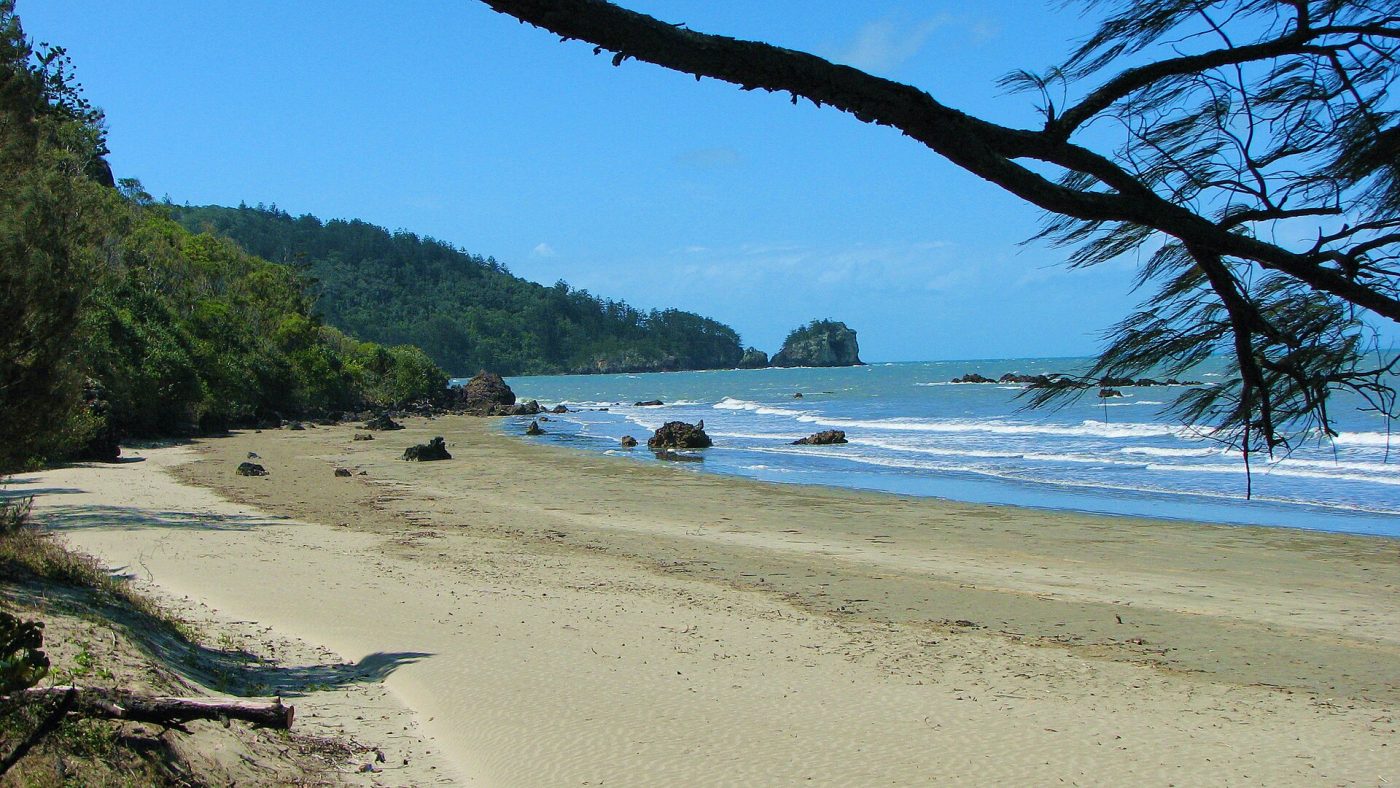
Photo: Rob and Stephanie Levy from Townsville, Australia, CC BY 2.0
Cape Hillsborough is a small, rugged headland of volcanic rock covered with rainforest on the coast of central Queensland, about fifty kilometres, forty-five minutes by road, north of the sugar city of Mackay, which has an airport, and an hour and a half to two hours south of Airlie Beach and the Whitsunday islands, and it owes its considerable fame to a single daily event: at dawn, wallabies and kangaroos come down on to the beach to feed, and are photographed against the sunrise by a line of visitors. The road from the Bruce Highway ends at a holiday park directly behind the beach, the only accommodation on the cape, with cabins, powered sites and a cafe, beside which is the national park's day-use area with picnic tables and barbecues; the park service has a small bush campground at Smalleys beach, a few kilometres away, which must be booked online. The park is free.
For the sunrise, people gather on the sand in front of the holiday park about forty-five minutes before the sun comes up, in darkness, and a ranger or guide from the tourist park, which manages the viewing under agreement, explains the rules: visitors stand behind a line of markers, keep quiet, do not feed or touch the animals and do not use flash, while the animals, usually between a handful and twenty, forage along the tide line in front of them as the sky turns orange over the sea. It lasts about an hour. The rest of the day can be given to the walking tracks: the Andrews Point track, 5.2 kilometres return, climbing over the headland through rainforest and hoop pines to five lookouts, and returning, if the tide is out, along the beach; the Diversity boardwalk, an easy 1.2 kilometres through mangroves and woodland; and, at low tide, the walk across a causeway of rocks to Wedge island.
Live prices from GetYourGuide for tours whose route includes this park. Free cancellation on most of them.
The cape was declared a national park in 1985, the date of 2018 given in some databases referring to a boundary change, and it covers about a thousand hectares. It was named in 1770 by James Cook, as he sailed past in the Endeavour, after the Earl of Hillsborough, the minister then responsible for the American colonies. The headland is the eroded remnant of a volcano that was active some thirty to thirty-three million years ago, and its cliffs, stacks and boulder-strewn slopes are of rhyolite and other lavas and of volcanic ash welded into rock, weathered into honeycombs and caverns, in places containing fragments of fossilised wood. The tides on this part of the Queensland coast are among the largest on the eastern seaboard, with a range of up to six metres, so that at low water the sea withdraws for several hundred metres across gently shelving sand and rock platforms, exposing the causeway to Wedge island and a broad shore rich in crabs, shellfish and wading birds. It is this combination that brings the animals to the beach. The agile wallaby, a sandy-coloured, medium-sized wallaby of tropical Australia, and the larger eastern grey kangaroo come down at first light to eat the seed pods of mangroves, washed up along the high-tide line, together with seaweed and coral spawn, which supply them with salts and minerals lacking in the vegetation inland;
the habit is natural, though it has certainly been encouraged by years of feeding by holidaymakers, now forbidden. For so small a park the variety of habitats is unusual: lowland rainforest with vines, figs and palms in the gullies, in which hoop pines, tall, dark conifers of an ancient lineage, stand above the canopy on the rocky slopes; open eucalypt forest with grass trees on the ridges; and, behind the beaches, mangrove forest of several species, salt flats and melaleuca swamp. More than 150 species of birds have been recorded, among them the orange-footed scrubfowl, which builds enormous mounds of leaf litter in which its eggs are incubated by the heat of decay, the brush turkey, the beach stone-curlew, the brahminy kite and the osprey; in the cooler months thousands of blue tiger and other butterflies gather in the sheltered gullies; and green and flatback turtles feed offshore and occasionally nest. The Yuibera people lived here for thousands of years, and the Diversity boardwalk passes one of their shell middens, a mound of discarded oyster and cockle shells, and leads to the remains of a stone fish trap on the tidal flat, built to strand fish as the great tide went out.
The park can be visited all year. The dry season, from May to October, is much the most comfortable, with clear skies, days of 22 to 26 degrees and cool mornings, for which a jumper is welcome on the beach before dawn; the butterflies are present from about May to August, and humpback whales pass offshore from July to September. The wet season, from December to April, is hot, humid and rainy, with the possibility of cyclones, biting midges and mosquitoes, and tracks that may be closed.
From October to May dangerous box jellyfish and irukandji are present in these waters, and estuarine crocodiles may occur at any time, so that swimming is not recommended. Sunrise falls between about half past five in midsummer and half past six in midwinter, and it is as well to check the time and the tide the evening before, since a very high tide leaves little beach. Bring insect repellent, a torch and a warm layer. Allow a night, or an early start from Mackay. Eungella National Park, with its platypuses, is an hour and a half inland.
94 km away
The Whitsundays are a group of seventy-four islands lying just off the coast of central Queensland, inside the Great…
2 tickets & tours
Yes. GetYourGuide sells tickets and guided tours whose route includes Cape Hillsborough National Park; live prices are shown on this page.
Allow a night, or an early start from Mackay.
Cape Hillsborough National Park covers 10.1 km².
Cape Hillsborough National Park was established in 1985.
Cape Hillsborough National Park is in Queensland, Australia. The map on this page shows the exact spot.
Queensland, Australia
Green Island is a tiny coral cay on the Great Barrier Reef, twenty-seven kilometres off the city of Cairns in tropical…
7 tickets & tours
Queensland, Australia
Noosa National Park begins where Hastings Street, the smart beachfront strip of Noosa Heads on Queensland's…
5 tickets & tours
Queensland, Australia
Great Sandy National Park, on the coast of southern Queensland, consists of two separate sections which visitors…
2 tickets & tours
Queensland, Australia
Lamington lies on a high plateau of the McPherson Range, on the border of Queensland and New South Wales, in the…
2 tickets & tours
Queensland, Australia
The Whitsundays are a group of seventy-four islands lying just off the coast of central Queensland, inside the Great…
2 tickets & tours
Queensland, Australia
Barron Gorge is the deep, rainforested ravine by which the Barron river drops from the Atherton tableland to the…
1 ticket or tour


