Tasman National Park
Tasmania, Australia
Tasman National Park is the sea-cliff coast of the Tasman Peninsula an hour and a half south-east of Hobart, and it…
10 tickets & tours
Mountain Park · Tasmania · Australia
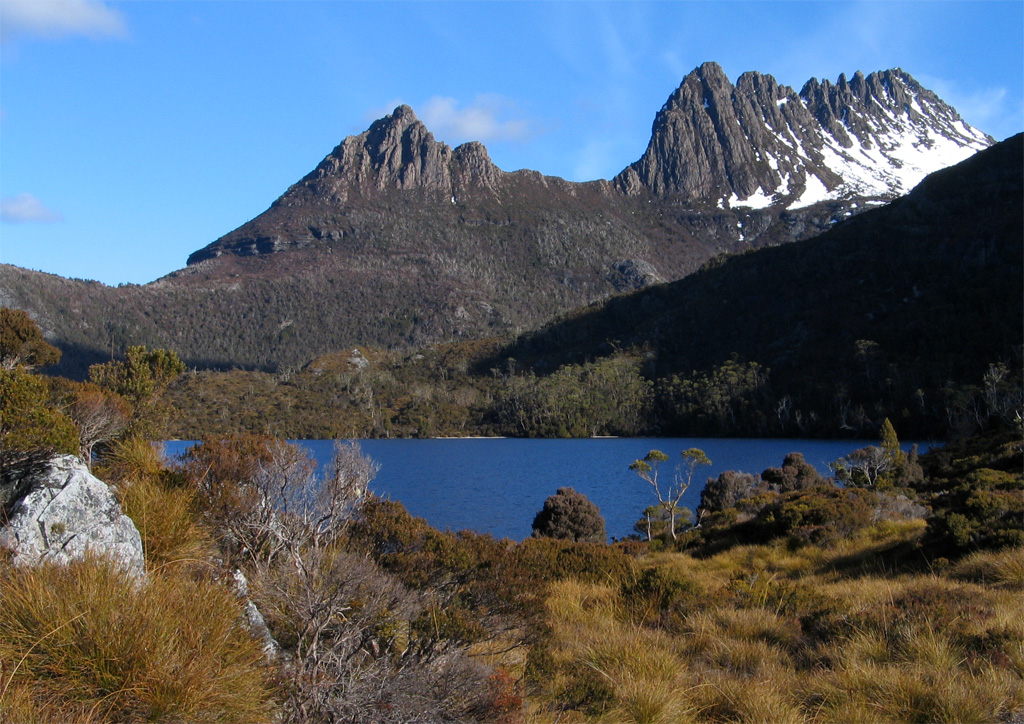
Cradle Mountain-Lake St Clair is the best known of the national parks of Tasmania, a highland of jagged dolerite peaks, glacial lakes, moorland and ancient rainforest in the centre of the island, and it has two entrances, at its northern and southern ends, which are some three hours apart by road and joined only by a famous walking track. Cradle Mountain, in the north, is an hour and a half's drive from the ferry port of Devonport and two to two and a half hours from Launceston, with a few bus and tour services, and it receives the great majority of visitors. A national parks pass is required. Cars are left at the visitor centre, outside the park boundary, where passes are sold and there are a cafe and an exhibition, and a shuttle bus, included in the pass, runs every few minutes along the narrow road to Dove Lake, stopping at the ranger station, at Snake Hill and at Ronny Creek;
private vehicles are not allowed along it during the day. At Dove Lake, beneath the twin-horned summit, a new shelter frames the classic view, and the circuit of the lake, six kilometres on a well-made, nearly level path, two to three hours, past an old timber boatshed, is the walk that almost everybody does. Stronger walkers climb to Marions lookout and Crater Lake, a circuit of three hours, or go on to the summit of Cradle Mountain itself, a full day of six to eight hours ending in a scramble over huge boulders. There are many short walks near the visitor centre, including a rainforest stroll suitable for wheelchairs, and wombats graze in the open at Ronny Creek in the late afternoon. At the southern end, Lake St Clair, two and a half hours from Hobart, has a visitor centre, lakeside walks, a ferry, and platypuses at dusk. The Overland Track joins the two.
Live dates and prices from GetYourGuide. Free cancellation on most tickets.
The area was first proclaimed a scenic reserve in 1922, and its protection is owed to one couple. Gustav Weindorfer, an Austrian-born naturalist, and his Tasmanian wife Kate climbed Cradle Mountain in 1910, and he is recorded as having declared from the summit that this must be a national park for the people for all time; they bought land in the valley, where in 1912 he built from King Billy pine a rustic guest house which he called Waldheim, the forest home, and until his death in 1932 he campaigned for the reserve. A replica of the chalet stands on the site, as a small museum. The park now covers about 1,614 square kilometres and since 1982 has formed part of the Tasmanian Wilderness, a World Heritage area covering a fifth of the island, which satisfies more of the criteria for listing than almost any other site on earth. The peaks are of Jurassic dolerite, a dark igneous rock intruded some 170 million years ago as Gondwana began to break up, which cools into vertical columns and gives the mountains their organ-pipe cliffs and serrated crests; Cradle Mountain rises to 1,545 metres, and Mount Ossa, further south, at 1,617 metres, is the highest in Tasmania. Glaciers of the last ice age carved the cirques and valleys and left the lakes, of which Lake St Clair, called leeawuleena, sleeping water, by the Aboriginal people of the highlands, is the deepest natural lake in Australia, at more than 160 metres.
The vegetation is of Gondwanan descent, related to that of New Zealand and Patagonia: cool temperate rainforest of myrtle beech, sassafras and leatherwood, hung with moss; the native conifers, King Billy pine and pencil pine, which grow extremely slowly and may live for more than a thousand years, and which fire destroys for ever; the pandani, the tallest heath plant in the world, resembling a palm; open moors of buttongrass; and cushion plants on the exposed tops. The deciduous beech, known as fagus, a shrubby tree with small crinkled leaves, is the only native tree of Australia that sheds its leaves in winter, and in late April and early May it turns the slopes round Crater Lake and Cradle Mountain gold, orange and rust red, an event that Tasmanians travel to see. The animals include the Tasmanian devil, the spotted-tailed and eastern quolls, wombats, which are very numerous and unafraid, Bennett's wallabies, pademelons, echidnas, platypuses, the black currawong, which has learned to unzip rucksacks, the green rosella and three species of snake, all venomous. The Overland Track, sixty-five kilometres from Ronny Creek to Lake St Clair, is the most famous long walk in Australia, taking six days, with public huts and tent platforms at each stage and side trips to Mount Ossa and several waterfalls.
The park is open all year. Summer, from December to March, has the longest days and the mildest weather, 10 to 20 degrees, and is the busiest period, with wild flowers from November to January; late April and early May bring the turning of the fagus; winter, from June to August, regularly covers the mountain in snow, the road may require chains or be closed for a time, and the landscape is at its most dramatic, with wombats still grazing in the snow.
The weather is notoriously fickle at every season: the park receives up to 2,800 millimetres of rain, the summit is hidden on the majority of days, and snow, sleet and gales can arrive in midsummer, walkers having died of exposure, so that waterproof and warm clothing is essential even on the Dove Lake circuit. From 1 October to 31 May the Overland Track must be booked in advance, a fee paid, and the route walked from north to south, and places sell out soon after bookings open in the middle of the year. Allow two days at Cradle Mountain. A sanctuary for Tasmanian devils stands near the park entrance, Sheffield, the town of murals, is an hour away, and Strahan and the west coast two hours.
Yes. GetYourGuide lists 12 tickets and tours for Cradle Mountain-Lake St Clair National Park, with live dates and prices and free cancellation on most of them.
The park is open all year.
Allow two days at Cradle Mountain.
Cradle Mountain-Lake St Clair National Park covers 1 614 km².
Cradle Mountain-Lake St Clair National Park was established in 1922.
Cradle Mountain-Lake St Clair National Park is in Tasmania, Australia. The map on this page shows the exact spot.
Tasmania, Australia
Tasman National Park is the sea-cliff coast of the Tasman Peninsula an hour and a half south-east of Hobart, and it…
10 tickets & tours
Tasmania, Australia
Freycinet is the granite peninsula on the east coast of Tasmania that holds Wineglass Bay, the beach that represents…
4 tickets & tours
Tasmania, Australia
Maria Island lies off the east coast of Tasmania, reached by a half-hour passenger ferry from Triabunna, an hour and a…
4 tickets & tours
Tasmania, Australia
Mount Field is Tasmania's oldest national park, an hour and a quarter north-west of Hobart in the Derwent valley,…
1 ticket or tour
Tasmania, Australia
South Bruny National Park covers the wild southern coast of Bruny Island, off the south-east of Tasmania, a landscape…
1 ticket or tour